
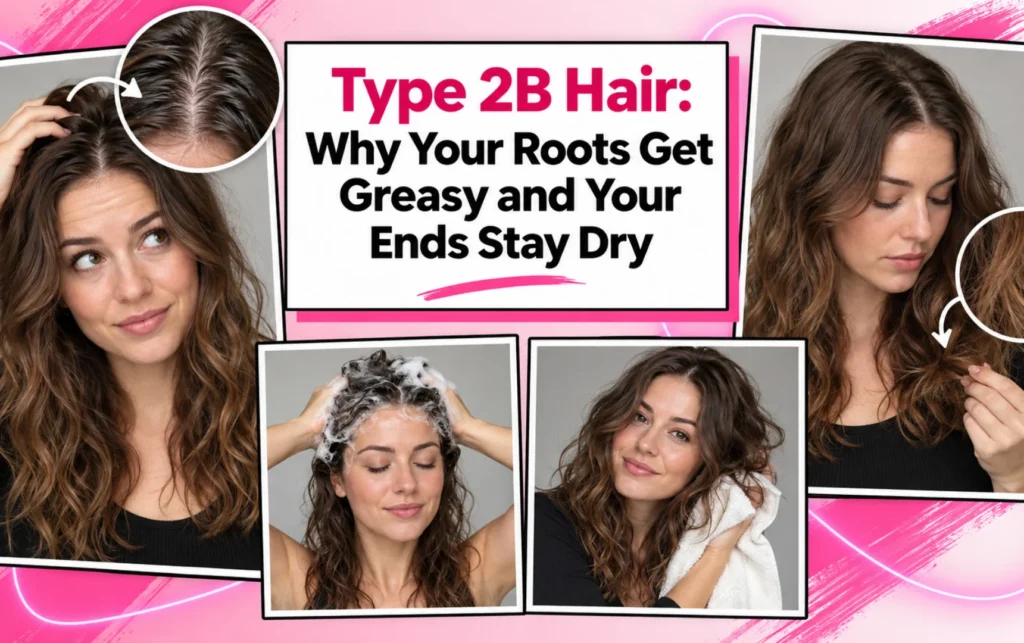
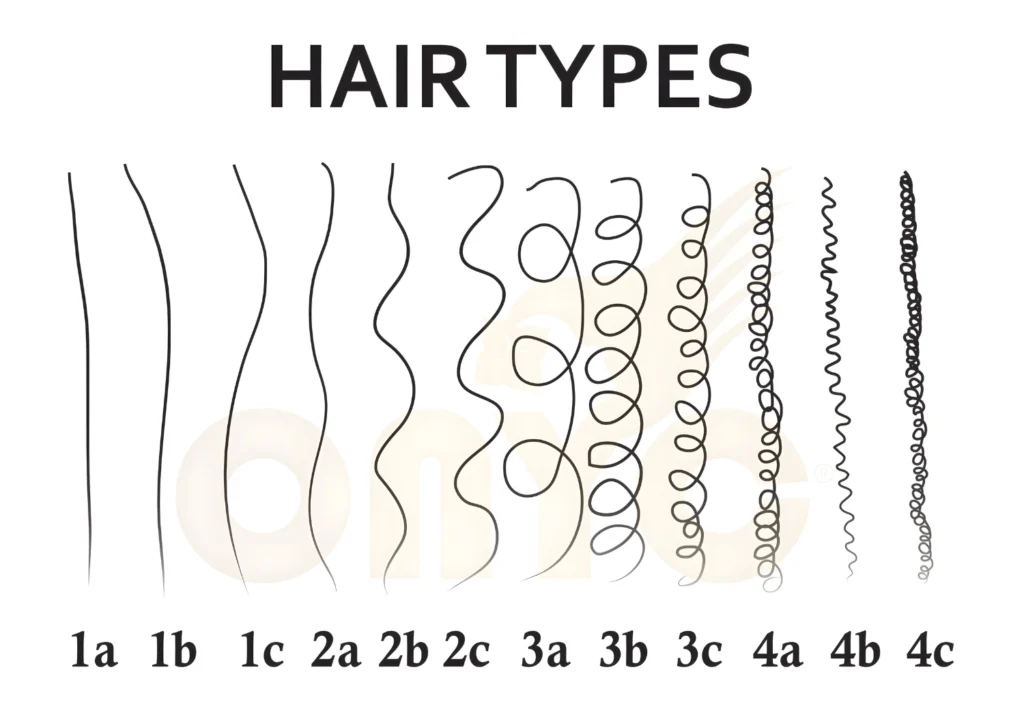
Type 2B hair has a loose S-shape that usually kicks in around the middle of the strand, while the roots stay flatter and closer to straight. It sits between 2A, which is barely wavy, and 2C, where the waves start right at the scalp.
If that sounds like you, you’ve probably noticed the annoying part already. Your scalp looks greasy a day after washing and your ends feel dry at the same time. That isn’t bad luck or the wrong shampoo. It’s the pattern itself, and once you know why it happens, most of the care advice starts making sense.
What Type 2B Hair Looks Like
The easiest way to check is to wash it, skip every product, and let it air dry.
You’re likely 2B if:
- The roots dry fairly flat and the bends show up from about mid-length down.
- There’s a clear S-shape, not just a slight kink.
- It frizzes easily, especially in humid weather.
- Volume at the crown is hard to come by and the lengths can look heavier than the top.
Barely any bend at all puts you closer to 2A. An S-shape starting right at the roots, with thicker strands, puts you closer to 2C.
Don’t be surprised if your head doesn’t pick one. Most people have more than one pattern across different sections, so a looser crown with tighter texture underneath or around the nape is really common.
Why Your Roots Get Greasy and Your Ends Stay Dry
Your scalp makes oil, and on a straight strand that oil slides down pretty easily. That’s why straight textures tend to look evenly oily.
On a wavy strand it doesn’t get far. Every bend slows it down, so it pools at the roots instead of traveling to the ends. You end up with two different problems on the same head: a scalp that looks greasy fast, and lengths that stay dry because they never get their share of the oil.
That’s also why the advice online seems to contradict itself. Some brands say this type is prone to greasiness. Others say it’s prone to dryness. Both are right, just about different parts of the strand.
The fix is to stop treating your head as one thing. Your roots need cleaning. Your ends need moisture. Most routines go wrong by putting the same product on both.
What the 2B Label Doesn’t Tell You
The typing chart most people use, with its 1 through 4 numbers and A, B, C letters, was created in the 1990s by Andre Walker, Oprah Winfrey’s longtime stylist. It was originally built to market his own product line, and the lettered subtypes like the B in 2B were added later.
It’s useful for describing shape. That’s all it measures, though.
It doesn’t tell you your porosity, which is how easily your strands take in and hold onto moisture. It doesn’t tell you your density, which is how many strands you’ve got, or whether each strand is fine or coarse. And it’s based on appearance, so two people can look at the same head and label it differently.
Those missing pieces decide which products work for you. Two people with textbook 2B texture can need opposite routines if one is low porosity, where products sit on top, and the other is high porosity hair, soaking everything up and drying out again by afternoon. Our guide to hair porosity walks through how to tell which you’ve got.
Your pattern also moves around. Humidity, how you slept, what you used, and how many days since you washed can all change how defined things look on a given morning. And texture can shift over the years too, especially after pregnancy or with age. So treat 2B as a starting point, not a fixed identity.
How to Care for Type 2B Hair
Split your routine between roots and ends, and keep everything light.
At the roots:
- Shampoo the scalp, not the lengths. Massage it in at the roots and let the rinse water take care of the rest.
- Wash every two to three days if your scalp gets oily fast. Waiting a week usually means flat, greasy roots by day three.
- Use a clarifying shampoo every so often to clear out buildup, since leftover product weighs waves down.
- Keep conditioner, oils and styling cream off the scalp completely.
On the lengths and ends:
- Condition from mid-length down, where the dryness is.
- Pick a lightweight conditioner and leave-in. Heavy butters and rich masks tend to pull everything flat.
- Put your styler on while it’s still soaking wet, then scrunch upward instead of raking through. Raking breaks up the clumps.
- A small amount of hair oil on the ends helps with dryness. Keep it to a few drops.
Drying and styling:
- Swap your bath towel for a microfiber towel or an old cotton T-shirt and squeeze, don’t rub.
- Air dry or diffuse on low heat. Our guide on using a hair dryer for volume covers lifting flat roots without frying your ends.
- Don’t brush it dry. That’s a straight line to frizz.
- At night, pile it loosely on top of your head and sleep on a satin or silk pillowcase.
When you’re shopping, check the label for what the product does, not the curl number on the front. A lightweight shampoo and conditioner that doesn’t leave residue will do more for you than anything marketed with a curl number on it.
The Cut Does More Than Any Product
This is the part a lot of people skip. You can have the perfect routine and still end up flat and heavy if the cut is wrong.
Long, one-length cuts put all the weight at the bottom. That weight pulls everything straight at the top and flares out at the ends, which gives you the triangle shape this texture is known for. Layers take that weight out so the bends can spring up and the crown gets some lift.
It also helps to see someone who cuts with your pattern in mind, so the length is judged on how it falls dry, not how long it looks wet. It shrinks up a bit once it dries, and cutting it wet and stretched can leave it shorter than you wanted.
One more thing before you book anything: smoothing treatments like keratin are built to relax texture. If you love your texture, that’s the wrong service. If you’d rather have them calmer and less frizzy, talk it through with your stylist first.
If you’re in Columbus, our hair department can look at how yours falls and shape a cut around it.