
Hair porosity is how easily your strands take water in and how well they hold onto it. Low resists water. High soaks it up and loses it just as fast. Medium sits in between and is the easiest to live with.
That’s the whole concept. What follows is how to work out which one you’ve got, what changes it, and what to do differently for each.
This is real and it’s measurable, but not by the tests circulating online. Lab work uses nitrogen sorption to quantify pore volume and surface area inside the fiber. A strand in a glass of water measures surface tension, not structure.
What Hair Porosity Means
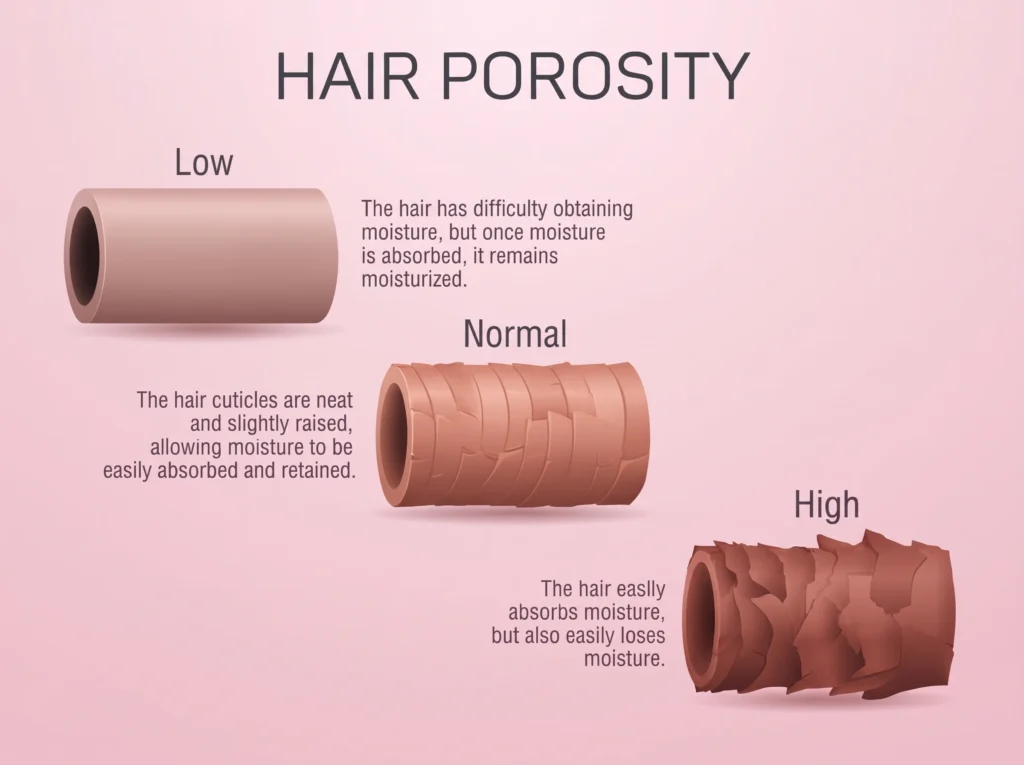
Every strand has an outer layer called the cuticle, made of overlapping scales, wrapped around a core called the cortex.
When those scales lie flat and tight, water has a harder time getting in. Lifted or chipped, and it gets in easily and leaves just as easily.
There’s more to it than the cuticle, though. The term also covers microscopic spaces inside the fiber itself. A 2022 study in the International Journal of Cosmetic Science measured this directly and found that surfactants diffuse in, dissolve protein, and increase both pore volume and internal surface area. So washing itself changes the number.
One more thing. Even healthy hair absorbs water, and its water content shifts with the humidity around it. A smooth cuticle isn’t waterproof.
The Three Types Of Hair Porosity
| Type | What’s happening | How it behaves |
|---|---|---|
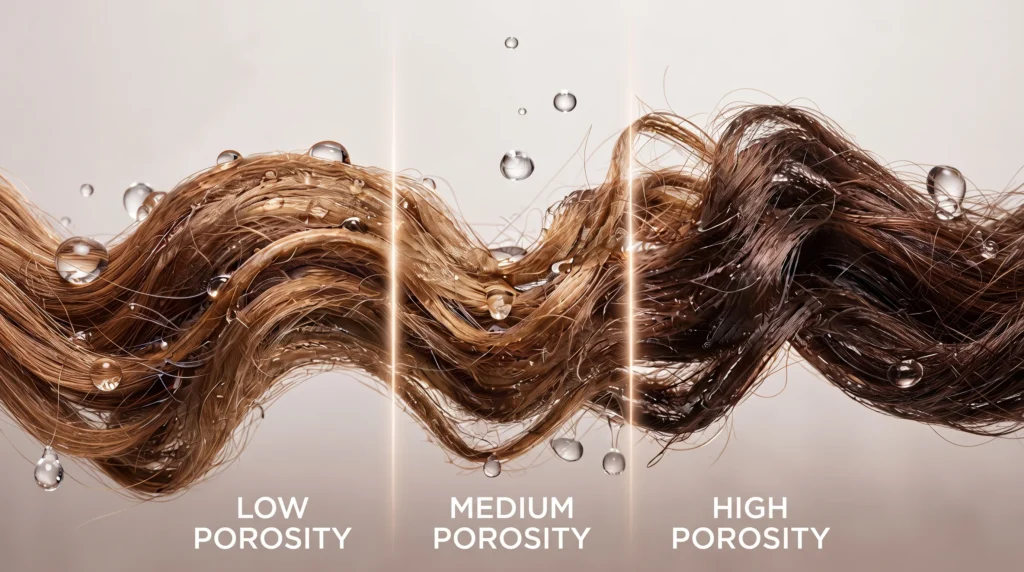
| Low | Cuticle lying flat and tight | Slow to get wet, slow to dry, product sits on top |
| Medium | Cuticle intact but not tightly sealed | Takes water and holds it, easy to manage |
| High | Cuticle lifted or damaged | Soaks water up fast, dries fast, dry again within hours |
Two things nobody mentions.
It isn’t the same all the way down a strand. Research on damage found more of it nearer the tips than the roots, which makes sense, since the ends are years older and have been through more.
And it isn’t a grade. High isn’t bad. It’s usually what happens after coloring, bleaching or heat, and the fix is handling rather than a label.
How to Tell Which One You Have Hair Porosity
Skip the float test. Dropping a strand in water and watching whether it sinks tells you about surface tension and whatever oil is on it, not about the pores inside.
What does tell you something:
- How long it takes to get wet in the shower. Beading and rolling off points low. Soaking through right away points high.
- How long it takes to dry. Hours points low. Very fast points high. This one’s soft evidence, since airflow and technique affect it too.
- How products behave. Sitting on the surface and feeling coated points low. Disappearing and leaving hair dry again by afternoon points high.
- How the ends feel compared to the roots. Rough, snagging ends with smoother roots is the normal pattern and tells you the damage is where you’d expect.
- What you’ve done to it. Bleach, permanent color, relaxers and daily heat all push it up. That’s the most reliable indicator on this list.
Look for the pattern across a few washes rather than deciding after one. And be specific with yourself. “The ends snag when I comb them” is a useful observation. “My porosity is wrong” isn’t.
What Changes Your Porosity
Bleach does most of it. Research comparing untreated and bleached fibers measured real changes in pore volume and pore size, with more change the longer the bleaching went on.
UV exposure does it too, through a different chemical route than bleach but with a similar result on the pore structure.
Then the mechanical stuff. Excessive heat, rubbing dry with a towel, forcing a brush through knots. The American Academy of Dermatology names all three as damaging habits.
If your routine involves regular lightening plus frequent hot styling, cut back on one of them before you buy another repair product. Prevention belongs in the routine alongside conditioner.
Care Tips for Each Type
Low
- Buildup is the problem, not dryness.
- Use less, not different. That’s the first adjustment and it fixes most of these complaints on its own. A lighter conditioner, or a smaller amount of your usual leave-in, beats replacing your whole shelf.
- Keep washing. AAD guidance is to wash based on how oily it gets and to concentrate shampoo on the scalp. Skipping shampoo to protect moisture is how you end up coated.
- Warm water helps absorption. So does applying to damp rather than soaking wet.
For a fuller walkthrough of what happens when a rich product meets a tight cuticle, the Cantu question covers the same mechanism in detail.
Medium
- If your routine works, leave it alone. There’s no mask you need to add to complete a set.
- Condition after washing. AAD advises concentrating it on the ends for fine or straight textures, and through the lengths for dry or curly ones.
- Reassess after a big change. Bleach, a new color service, a heat-styling habit. Respond to what you see, not to what a quiz called you.
High
- How you handle it counts as much as what you put on it, because damaged strands break more easily.
- Detangle with conditioner in, using fingers or a wide-tooth comb, and never force a comb through a knot.
- Blot or wrap it wet instead of rubbing with a towel.
A small amount of leave-in on the ends usually helps combing. Start small and adjust the amount before deciding the product type is wrong.
Lower the heat setting and use a protectant. And if you’re coloring, know that more extensive lightening needs more peroxide and does more damage. Sun exposure weakens treated strands further, so a hat outdoors does real work.
What the Research Says About Oils and Protein
Coconut oil has the best evidence of any oil. The Rele and Mohile study in the Journal of Cosmetic Science, published in 2003, tested coconut against mineral and sunflower oil on undamaged, bleached and heat-damaged samples. Coconut oil reduced protein loss where the other two didn’t. The mechanism is that lauric acid penetrates the shaft and limits how much the cuticle swells during washing, which limits the chipping that causes protein loss.
Two details from that study people skip. Pre-wash application worked better than post-wash. And mineral oil didn’t penetrate at all, it just coated.
The catch is low porosity, which may not absorb it and ends up with buildup instead. If that’s you, use a fraction of what the label suggests or skip it.
Protein depends entirely on the formula. A study on chemically relaxed textured hair found certain hydrolyzed keratin peptides reduced breakage, with results varying by peptide size. A specific finding about specific molecules, not evidence that everyone high on the scale needs a weekly protein mask.
Follow the directions, then judge by how your hair combs and feels. If a treatment keeps leaving it stiffer and harder to manage, stop.
Judging Whether It’s Working
Forget the label and ask practical questions.
Does it comb more easily? Do the ends snag less? Is it comfortable after washing? Are you getting there with fewer products than before?
Change one thing at a time and keep everything else steady. That’s the only way to know what did the work.
If you’re in Columbus, our hair department can look at your ends and tell you what’s going on, which beats guessing from a home test.