
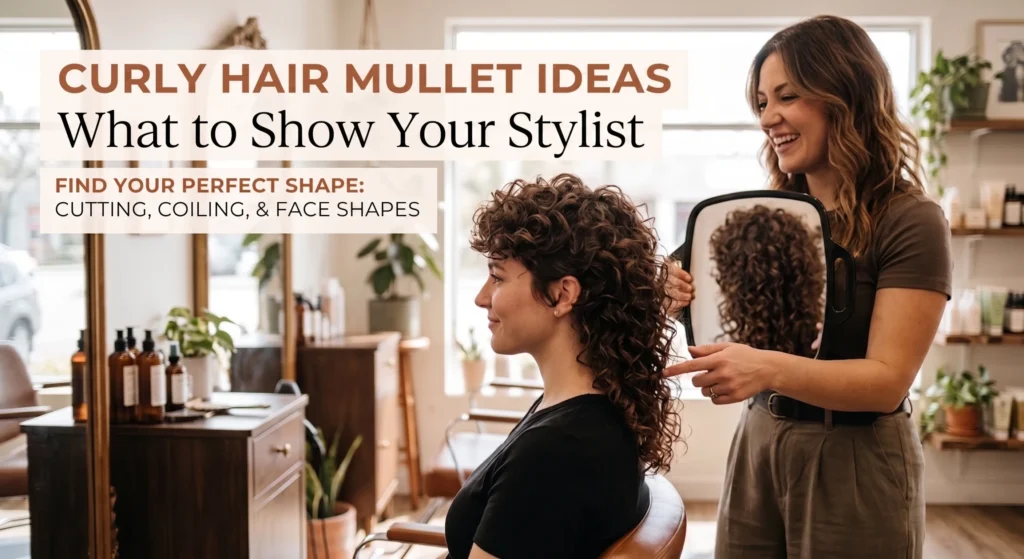
The mullet hairstyles has changed considerably from the sharply disconnected haircut it was once known for. Today’s versions are softer, more textured and easier to adapt to different hair lengths and natural textures. Instead of following one fixed shape, women are wearing mullets with blended layers, messy shag-inspired finishes, natural curls and shorter cropped proportions.
Among the variations currently getting the most attention, four stand out: the modern mullet, shaggy mullet, curly mullet and short mullet. Each keeps the recognisable shorter-front, longer-back idea, but the finished look can be very different depending on how the layers, texture and length are handled.
Trending Mullet Hairstyles Are Modern, Shaggy, Curly & Short Styles
| Version | Shape | Suits | Trim every |
|---|---|---|---|
| Modern | Blended, softest transition | Straight to loosely wavy, most face shapes | 8 to 10 weeks |
| Shaggy | Heavily layered, deliberately messy | Wavy hair, medium density | 8 to 12 weeks |
| Curly | Volume does the shaping | 3a and tighter | 8 to 12 weeks |
| Short | Cropped, most visible contrast | Fine to medium hair, strong jawline | 4 to 6 weeks |
The mullet stopped meaning one haircut a while ago. What follows is what separates these four, and how to tell which one your hair will hold.
Modern Mullet Hairstyles for Women
Shorter at the front and sides, longer at the back, and the transition between them blended rather than disconnected.
Layers do the work. Shorter pieces around the crown lift and move, longer layers through the back keep the silhouette without leaving an obvious tail. Around the face the hair gets lightly feathered or left slightly longer, which takes the severity out of it.
From the front this can read as a heavily layered cut and nothing more. The mullet shows up from the side and back, where the length increase becomes clear. That’s why it’s the easiest version to wear into an office.
You can dial the contrast up or down. Keep more length around the ears and blend it gradually and you get something subtle. Take more off the sides and crown and the longer nape becomes the point of the cut.
Shaggy Mullet Hairstyles for Women
Looser, messier, and the hardest of the four to get right, instead of a smooth transition between lengths, this one uses uneven layers and visible texture to break the shape up. Crown short and full, wispy pieces down the sides, longer hair at the back. It sits between the relaxed texture of a shag and the proportions of a mullet.
The appeal is that it isn’t meant to look finished. Natural bends, ends flicking in different directions, pieces falling where they land. A shaggy mullet styled too carefully stops being a shaggy mullet.
Where it goes wrong is density. This cut removes a lot of weight, so it needs hair that has weight to spare. On fine hair the layers separate into strands rather than pieces and the ends look thin by the second week. If your hair is fine, ask for the layering kept internal, under the surface, so the top layer stays intact.
Wave pattern helps enormously here, because the movement separates the layers on its own. Straight hair can carry it but needs texture cut through the crown and ends, or the whole thing lies flat and reads as a bad haircut rather than a deliberate one.
Layer length changes the result more than anything else. Long soft layers give you a relaxed version. Short crown layers with thinned ends give you something much more dramatic, and much harder to grow out.
Curly Mullet: Volume Does the Shaping
Curls create the volume that scissors have to create on straight hair, so the transition between lengths blends on its own.
Crown kept shorter to let the curls lift, more length preserved through the back. It also takes weight off curly hair that’s been worn all one length, which is often the reason it was sitting round and heavy.
The thing to plan around is shrinkage. Curly hair reads much shorter dry than it measures stretched, so the finished length has to be judged on where the curls sit, not on how long it looks wet.
Curl pattern changes the result enough that it needs its own conversation. Our full breakdown of curly mullet ideas by curl type and face shape covers what works from loose waves through to tight coils, plus what to say in the chair so it doesn’t come out short.
Short Mullet Hairstyles for Women
Same idea compressed. Crown and sides cropped close, the nape left just long enough to show a difference, and the back finishing around the neck instead of heading for the shoulders.
More compact and more defined than the longer versions, which cuts both ways.
Texture carries this one. There’s less hair available to make movement, so the crown layers get separated or tousled to stop it sitting flat. The longer section at the back can stay straight, flick out, or get lightly textured depending on how sharp you want it.
Side length is the main variable. Leave enough to partly cover the ears and it stays soft. Crop them close and the silhouette gets much louder. The shorter the sides, the more obviously it reads as a mullet.
The real trade-off is upkeep. Every shape on this list grows out, but the short mullet depends on the crown and sides staying short, so it loses definition faster than the others. Four to six weeks between shape-ups, against eight to twelve for the longer versions. Budget for that before you commit, because a short mullet three months out isn’t a softer version of itself, it’s a different haircut.
Choosing a Curly Mullet Based on Face Shape
Fine hair does better with the modern or short versions, both of which keep more weight in the shape. Heavy layering on fine hair removes bulk you can’t afford to lose. Thick hair suits the shaggy and curly versions, where the layers are removing weight that’s causing a problem anyway.
Face shape decides where the volume sits:
- Round. Height on top, less width at cheek level. All four help with this since the shape pulls the eye up and back, but keep the sides shaped closer through the middle rather than left full.
- Oval. Most things work. The reference photos you’re comparing yourself to were probably cut on this shape.
- Square. Face-framing pieces falling just past the jawline soften the corner. Skip blunt ends landing exactly at jaw level.
- Heart. Less volume up top, more weight lower down. A fringe covers some forehead width and the longer back balances the narrower chin.
- Long. Height on top makes a long face longer. Keep the crown shorter and flatter, let the sides stay wider, and a fringe shortens the face more than any other single change.
How to Ask Your Hairstylist for a Curly Mullet
Say the version by name, then describe the transition, because that’s the part stylists interpret differently.
- Blended, not disconnected. No hard line between the sides and the back.
- Keep the weight at the back. Don’t thin it out to blend.
- Shape the top so it sits forward instead of puffing up.
- Feather the pieces around my face, past the jaw.
Bring two or three reference photos rather than one, and make sure at least one shows the back. Most people bring three front-facing shots and then get a back they didn’t choose.
If you’re in Columbus, our hair department can walk you through which version your density will hold. Cuts start at $35, and book the consultation if you’re going from long hair to a short mullet in one appointment. Book a consultation so we can look at your pattern and density first, and mention the dry cut when you call so we block enough time. Cuts start at $35, with dry curly cutting above that for the chair time.