

We cut a lot of Curly Hair Mullet, and almost every one that goes wrong goes wrong in the same place. The back gets thinned. So the sentence to bring with you, before any photo, is keep the weight in the back.
Five versions of this shape hold up well on curls.
| Version | Best for | Tell your stylist |
|---|---|---|
| Soft curly mullet (start here) | A blended shape with no visible line, and an easy grow-out | Keep the back full, blend the sides, no hard line |
| Curly shag mullet (most requested) | Movement and layers without losing the back length | Interior layers only, the back keeps its length |
| Curly wolf cut (trending) | A shorter, spikier crown with the length still behind it | Crown longer than the reference photo |
| Curtain fringe curly mullet (face-framing) | Softening a strong jaw, and something to do with the front | Fringe last, and longer than you think |
| Tapered curly mullet (boldest) | Dense curls and coils that can carry real contrast | Taper low at the ears, don’t thin the back |
What separates them is how much length leaves the sides and how visible the line is where the sides meet the back. Bigger contrast, bigger statement.
What Is a Curly Mullet Haircut
Shorter through the top and sides, longer through the back, with the transition between the two either blended away or left deliberately visible depending on which version you pick.
On straight hair that back length reads as a flat curtain. On curls it reads as mass, which is why the shape suits texture far better than it ever suited the eighties. The back isn’t only longer, it’s carrying the weight the sides gave up. Take that weight out with thinning shears and what you’ve got is a bob with a tail.
Why Curly Hair Works Beautifully With a Mullet
Texture does most of the work a stylist would otherwise have to fake. The shape needs volume up top and weight at the bottom, and curls turn up with both built in already, so the cut becomes a question of removing what’s in the way rather than building a silhouette from nothing. Layers that would look choppy on straight hair vanish into the pattern. Grow-out is kinder as well, because the line blurs instead of hardening into a shelf, and you get eight or ten weeks out of it instead of five.
That’s the case for it. The honest counter is that all of this depends on having the density to support it. Fine hair, or hair that’s thinned with age or heat, ends up with sides that are short and a back with nothing to answer back with. We would much rather say that at the consultation than halfway through. If the answer turns out to be no, everyday curly styles will do more for you than a cut built on weight.
Curly Hair Mullet Ideas for Women
1. Soft Curly Mullet
The sides come in slightly, the back stays full, and the transition is blended enough that nobody clocks the cut before they clock the hair. We suggest it to anyone who has never had one, because if you decide against it after a month there’s no visible line to hide while it grows. Works on nearly every pattern. Very little goes wrong here.
2. Curly Shag Mullet
More layers, more movement, and by some distance the most requested of the five. The difference from a plain shag is that the back keeps its length while the crown and sides come up, so the silhouette still reads right even with all that layering going on. Surface layers separate and can read thin, and once they’re cut you’re waiting on them.
3. Curly Wolf Cut
Shag through the top, mullet at the back, shorter and spikier at the crown than either. It’s the trend-forward pick, and the one people bring a photo of without checking whose hair is in the photo. A wolf cut on 3c hair and one on 2b hair are two different haircuts wearing the same name. Much of the volume you’re admiring in that picture is coming from the texture, not from anything the stylist did.
4. Curtain Fringe Curly Mullet
The face-framing option. Two longer pieces at the front falling either side of your face, with the shape carrying on behind them. It softens a strong jaw, and gives you something to work with on days the rest of your head is misbehaving. That fringe springs up more than any other section on your head. Every stylist who has cut one too short has done it exactly once.
5. Tapered Curly Mullet
The sharpest of the five, and the contrast against the back does all the talking. It needs density behind it. Thick 3b and 3c curls carry it, coils carry it easily, looser patterns mostly don’t. We turn this one down occasionally and that’s why.
Choosing a Curly Hair Mullet Based on Face Shape
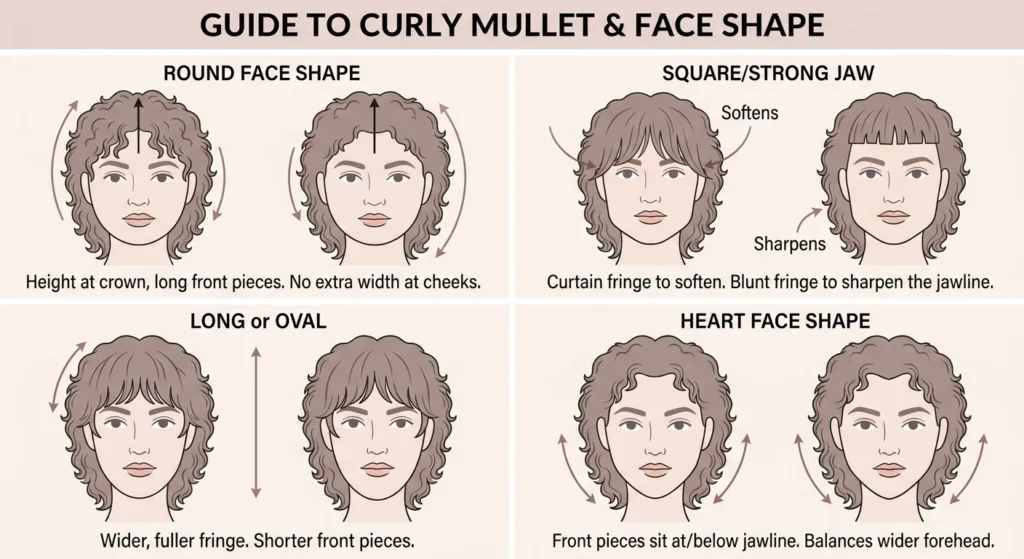
Face shape matters less here than most guides pretend. Density and pattern decide whether the cut works at all. Face shape decides where the front pieces sit, which is a smaller question, though a real one.
- Round face: keep height at the crown and let the front pieces run long. Anything that adds width at the cheek works against you.
- Strong jaw or square: a curtain fringe softens the line, a blunt one sharpens it further.
- Long or oval: you can carry a fuller fringe, and the front pieces can come up shorter without the whole thing looking stretched.
- Heart shape: length sitting at or just below the jaw balances a wider forehead.
How to Ask Your Hairstylist for a Curly Hair Mullet
Bring two or three photos rather than one, with at least one showing the back, and choose them for the curl pattern instead of the styling. If the texture in the photo isn’t close to yours, the finished cut won’t be either.
Then bring the words. A photo shows where you want to end up, it doesn’t tell anyone how to get there, and forty minutes in is a bad time to find out you meant something different.
Say these at the start, not once you’re worried:
- “Cut it dry, so you can see where my curls actually fall.”
- “Keep the back full. The weight at the bottom is the point of the cut.”
- “Keep the taper low, around my ears. Nothing above the temple.”
- “Cleaner sides, not disconnected. I don’t want a hard line.”
- “Please don’t thin or texturize the back.”
- “Cut my fringe last, and start it longer than you think.”
Ask for a hand mirror partway through, before the sides go any shorter. Length comes off in seconds and grows back at roughly half an inch a month, the American Academy of Dermatology’s average, and it’s a slow month when you’re waiting on it.
If someone wets you down and starts cutting immediately, what you’re getting is a straight-hair haircut performed on curly hair. That’s how these end up too short. A stylist who works with texture regularly will want to know your density, your usual routine, and what your second-day hair looks like before anything opens. Mention frizz too if that’s your main fight, because the styles that hold up in humidity are a separate conversation from the cut.
Dry cutting takes longer than a standard appointment, so it prices above the women’s cut and design rate. In Columbus, we take walk-ins for regular cuts, though not for this one. Book a consultation so someone can look at your pattern and density first, and mention the dry cut when you call so we block enough chair time.