
Simple Kids Mehndi Designs, Plan around the sitting, not the pattern. A young child gives you maybe five to ten cooperative minutes with a hand held still, and everything about kids henna follows from that number. One main shape. Big clean lines. A spot that’s easy to keep still. Done fast.
All five of the classic kids shapes fit inside that window, so the real work is picking one before the cone comes out and managing the twenty minutes after you finish. That’s how this guide is arranged.
Pick the shape before the cone comes out
Offer the child a choice of two, not an open menu. Deciding takes longer than drawing with most kids.
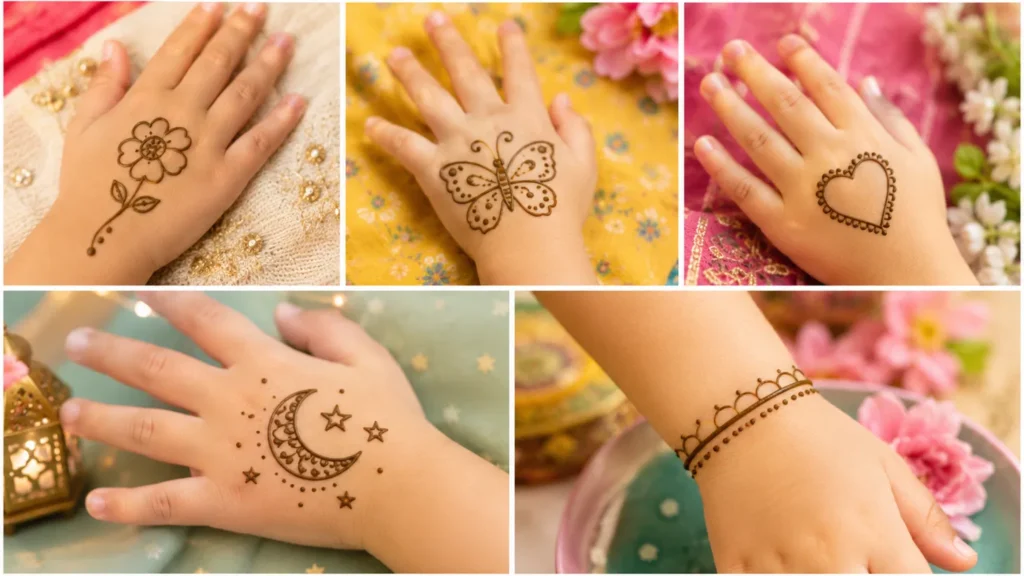
- A single flower. The default, and it earns it. One medium bloom on the palm or the back of the hand, a few dots, two or three leaves if you want more. Works for Eid, Diwali, school functions, all of it. Keep the petals medium sized, because tiny petals turn to mush on a small hand.
- A butterfly. Two wings, a small body, some dots. The birthday party favorite. Big open wings hold their shape after the paste dries. Small detailed ones don’t.
- A heart. The two-minute option, for the child who’s already halfway off the chair. A clear heart with a few dots around it, maybe a short curved vine on one side, and you’re done.
- Moon and stars. The Eid pick. One crescent, two or three stars near it, dots if you want it softer. Keep the stars open and simple so they read from a distance.
- A wrist bracelet. One thin line around the wrist, small dots, a tiny flower, a hanging drop or two. This is the answer for kids who won’t hold a palm open, and it layers nicely with bangles at festive events. Thin lines only. A thick band overwhelms a small wrist.
The back of the hand wins for most kids
Kids love seeing the design on their own palm. The palm is also where designs die.
An open palm has to stay open until the paste dries, and the first time the child forgets and closes a fist, the design smears into a blob. The back of the hand can rest relaxed on a table the whole time, and it survives eating and playing much sooner.
So the honest split: palm for the genuinely patient kid, back of the hand for almost everyone, wrist for the one who can’t stop moving.
And skip full coverage entirely on small hands. One shape with a few finger dots looks better than a packed pattern, and the open skin around it is what makes the shape pop.
While you’re drawing
Hand flat on a table, child seated comfortably, tissues within reach before you start. Draw faster and looser than you would on an adult. Perfectionism loses to wiggling every time.
And if the child is done, stop, even mid-pattern. A finished small thing beats a smeared big thing, and a good first experience matters more than the second leaf.
The twenty minutes after are the whole game
The paste goes on wet and stays fragile while it dries, which is the exact window a child wants to touch their face, grab a toy, and pet the cat.
This is the one time screen time is a parenting tool with no downside. A show that runs the length of the drying window solves the problem better than any instruction will.
A few honest expectations for this part:
- Even a short set leaves a cute light stain. An hour is a win. Overnight is not happening with most kids, and forcing it ruins the fun.
- Scrape the dried paste off rather than washing, and keep the hand away from water for a bit if you can.
- Most people skip the lemon-sugar trick on kids. Sticky fingers touch everything, and the stickiness invites picking.
Drawing after dinner, before a favorite show, is the timing that tends to work.
The color shows up tomorrow, then leaves quickly
The stain lifts off orange and looks underwhelming at first. It deepens to a warm brown over the next day, so judge it in the morning, not at bedtime.
Then it fades faster on kids than it ever does on adults, because handwashing, sand, and pool water all eat henna. A few days to a week is normal. That’s fine. The point was the fun, not the longevity.
Safety rules that aren’t optional with kids’ skin
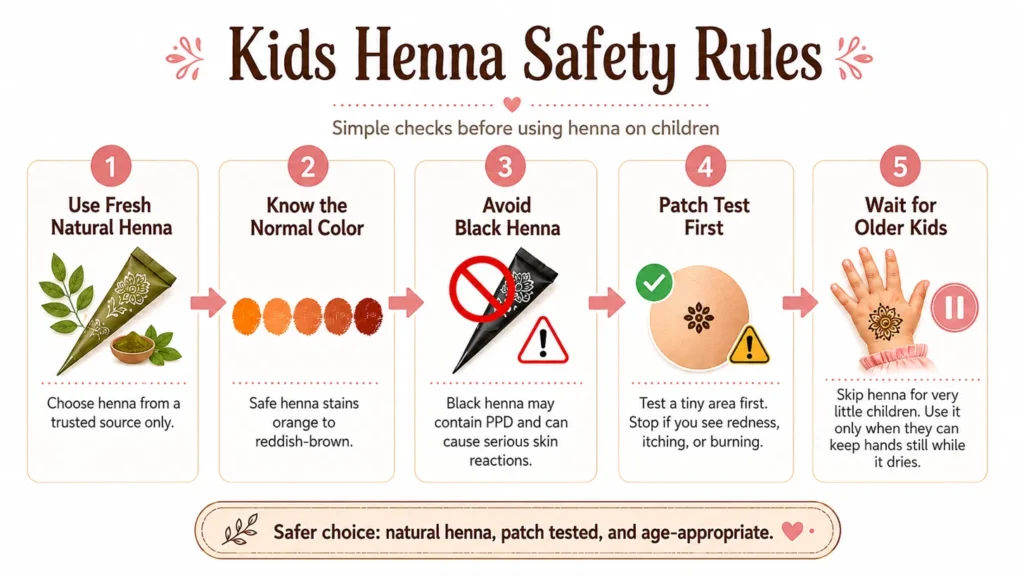
Fresh natural henna from a source you trust, and nothing else. The real stain range runs orange through reddish brown.
It never runs black. Cones sold as black henna usually get their color from PPD, a hair dye chemical, and the FDA has logged adverse reactions to henna and black henna temporary tattoos, some bad enough to blister and scar. On a child, that’s a hard skip, no matter how good the cone smells or how dark the promise.
First time on this child? Dab a tiny amount on a small patch of skin and wait before doing the full shape. Any redness, itching, or burning means you stop, wipe it off, and don’t use that cone.
And for the very little ones, hold off. Young children have thinner, more absorbent skin, and henna is best saved for kids old enough to understand keeping their hands off it while it dries.