
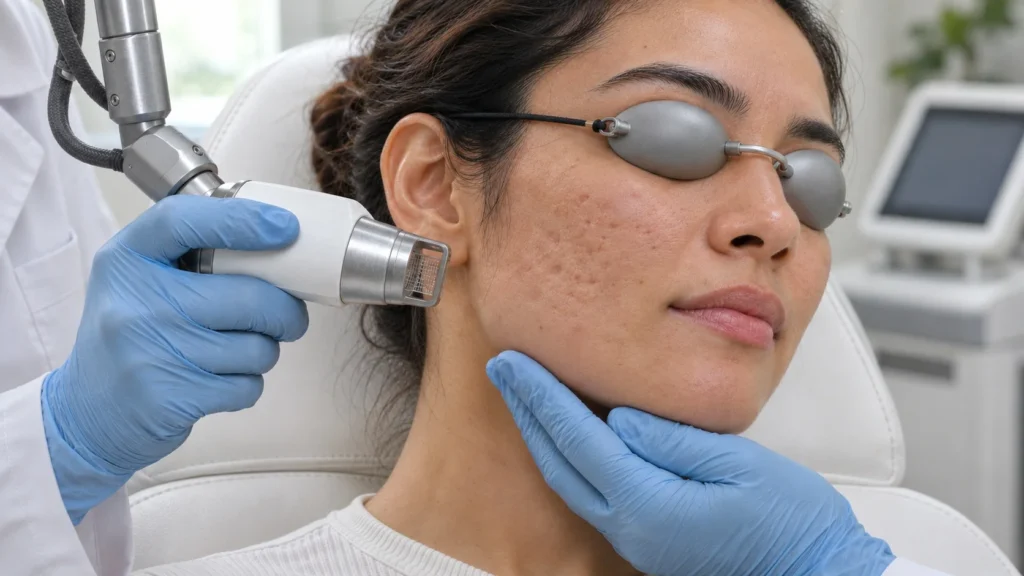
Clearing up active breakouts only to find an uneven terrain of pitted depressions across your cheeks feels a lot like deploying clean code on broken server infrastructure. Even after the inflammation subsides, the underlying structural collagen remains tethered and depleted.
Restoring an even skin surface requires matching specific energy and subcision modalities to distinct scar depths rather than relying on a single resurfacing pass. If you are evaluating a comprehensive acne scar treatment protocol, understanding how subcision releases fibrous tethers beneath rolling scars while targeted lasers rebuild lost dermal volume gives you an objective baseline for your care plan. Mapping out your scar architecture early protects your skin barrier and keeps clinical progress steady.
The Mechanics of Atrophic Scar Depressions
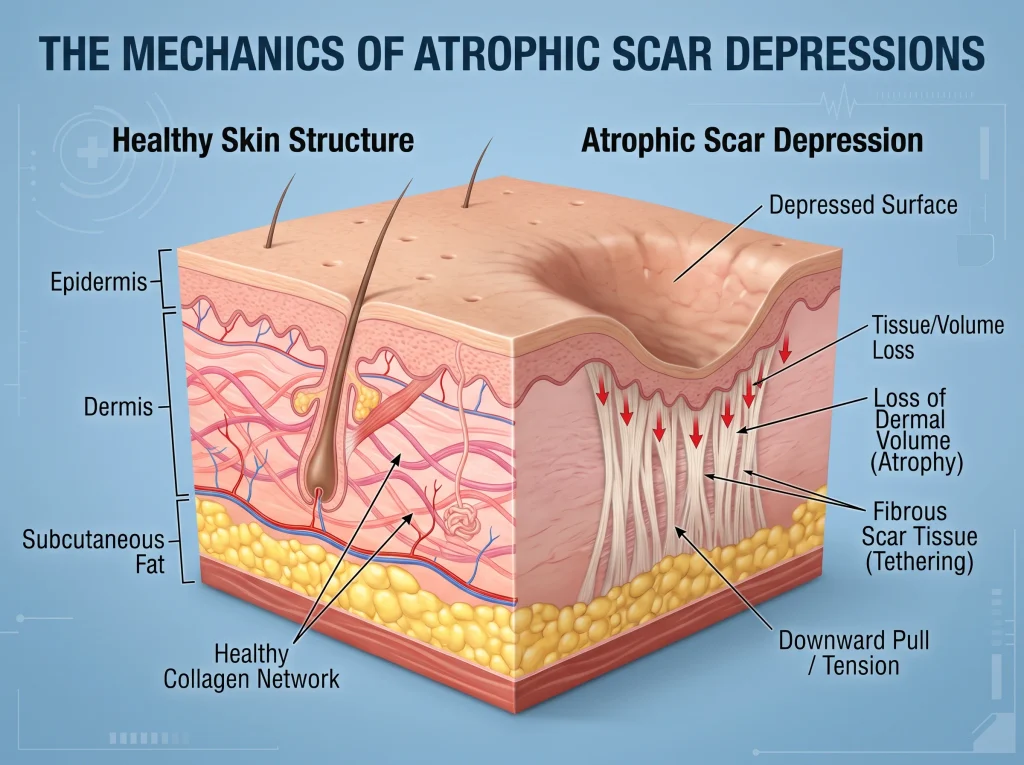
When deep cystic inflammation ruptures within the dermis, your body scrambles to lay down emergency repair tissue. In severe inflammatory acne, white blood cells destroy surrounding collagen bundles faster than fibroblasts can replace them.
As the wound heals, dense fibrous anchor bands form beneath the surface, physically tethering the upper dermal layer down to the underlying subcutaneous tissue. This downward pull creates visible rolling dips, while localised tissue loss leaves sharp-edged boxcar troughs or narrow, deep icepick punctures that cannot bounce back on their own.
The Laser Resurfacing versus Subcision Trade Off
Standard skincare guides often claim that powerful fractional lasers are a universal cure for every type of indented scar. The non-obvious trade-off is that firing high-energy lasers over rolling scars merely thins the superficial skin without addressing the deep structural tether below.
Choosing manual subcision trades three to five days of mild pinpoint bruising for genuine structural release. By sweeping a specialised surgical needle beneath the skin, a dermatologist mechanically snaps the fibrous tethers pulling down the skin surface. Once the tether is severed, the floor of the scar springs upward, allowing subsequent collagen-building lasers to fill the remaining shallow deficit safely.
The Single Device Resurfacing Fallacy
A very common and expensive mistake patients make is buying multi-session packages focused on a single laser machine treatment. People fall into this trap because aesthetic salons market one hero device as a complete solution for facial texture.
In reality, acne scars are almost always polymorphic, meaning a single cheek can host deep icepick pits, wide boxcar depressions, and tethered rolling scars simultaneously. Blasting deep icepick scars with a surface fractional laser yields zero improvement because the thermal beam cannot reach the narrow pit floor, while leaving the patient vulnerable to post-inflammatory dark marks.
Calculating Two Year Texture Recovery Economics
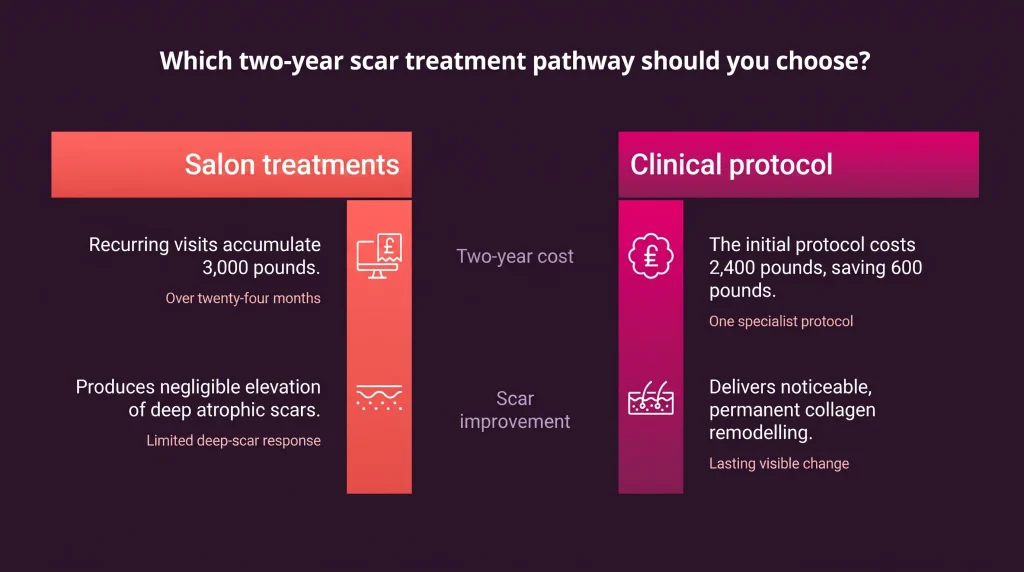
Let us examine a concrete worked example comparing trial-and-error salon treatments against a multi-modal clinical pathway over two years. Consider an individual who spends 250 pounds every two months on generic salon micro needling and mild chemical peels.
Over twenty-four months, recurring salon visits accumulate 3,000 pounds with negligible elevation of deep atrophic scars, because salon-grade needles cannot break deep fibrous tethers. In contrast, an initial specialist dermatological protocol costing 2,400 pounds combines focal TCA CROSS for narrow pits, cannula subcision for rolling scars, and two targeted fractional laser passes. Sourcing a targeted multi-modal clinical protocol saves 600 pounds while delivering noticeable, permanent collagen remodelling.
Core Daily Habits for Barrier Recovery
Supporting your skin’s collagen synthesis between clinical sessions requires establishing simple, repeatable operational habits at home. Protecting your delicate healing barrier prevents post-treatment pigmentation issues.
Incorporate these practical operational habits into your daily routine:
- Apply physical zinc oxide sunscreen daily:Shield freshly treated skin with broad-spectrum SPF 50 to prevent ultraviolet rays from triggering dark marks.
- Pause harsh active exfoliants temporarily:Stop using glycolic acid, salicylic acid, and strong retinoids for seven days after any energy treatment.
- Support lipid barrier restoration:Use ceramide-rich barrier creams twice daily to keep healing dermal tissue well hydrated.
A Clear Rule for Scar Categorization
You do not need a dermatology degree to understand which treatment approach matches your scar types. You can apply a straightforward decision rule called the lateral tension test in your bathroom mirror.
Look closely at an indented scar under directional overhead lighting, then gently stretch the surrounding skin sideways between your index finger and thumb. If the depression completely flattens and vanishes when the skin is pulled taut, the scar is tethered by underlying fibrous bands and requires subcision to release it. If the depression remains sharply visible with steep vertical walls despite skin stretching, you are dealing with a fixed boxcar or icepick scar that requires focal chemical reconstruction or targeted laser ablation.
Rebuilding smooth facial texture is ultimately about pairing the right clinical tool with each specific dermal defect. By avoiding single-device marketing traps, balancing surface resurfacing against deep subcision, and using simple self-checks to classify your scars, you protect both your skin barrier and your finances. Approach your textural recovery with calm strategy, rely on solid biological facts, and move forward with quiet confidence in your personal care plan.