
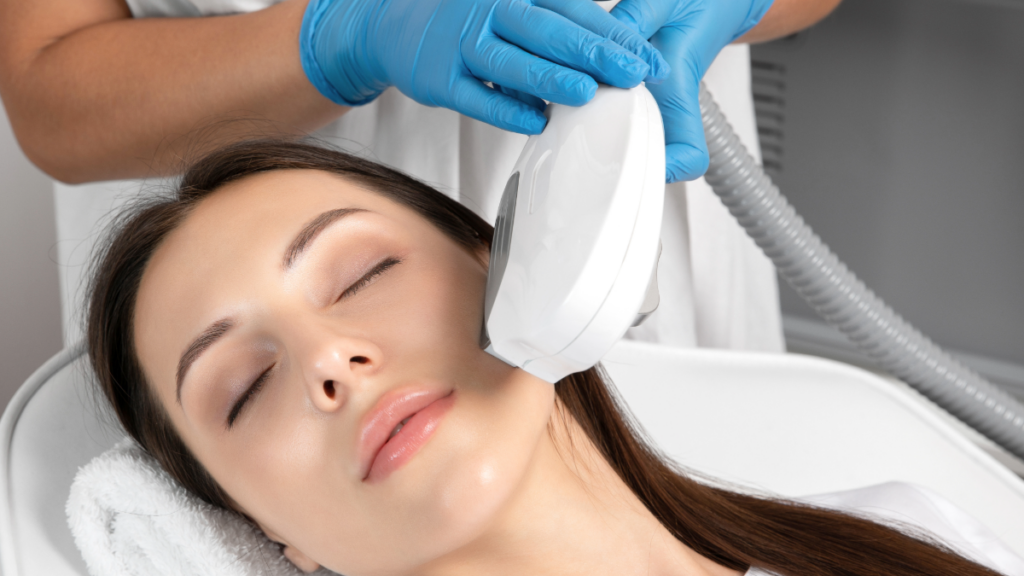
The most useful thing to know about IPL Laser Treatment isn’t what it treats. It’s who it can’t treat, and how much depends on the person holding the handpiece.
Intense Pulsed Light (IPL) treatment started in medicine, clearing port-wine stains and vascular birthmarks, and it’s now everywhere from dermatology clinics to salons that bought a machine last year. That spread is the whole story of IPL right now, both the good and the bad of it.
It isn’t technically a laser either, whatever the signage says. Lasers fire one wavelength. IPL fires a broad spectrum, and that single fact explains both its range and its restrictions.
Considerations and Limitations
Starting here because this is the part that decides whether the rest of the article applies to you.
Skin tone is a safety issue, not a preference: IPL targets dark pigment. On deeper skin tones the device can’t reliably tell the pigment you want treated from the melanin in the surrounding skin, and the outcome can be burns, blistering, and lasting hyper or hypopigmentation. Most practitioners restrict IPL to Fitzpatrick types I through III. A provider who offers it for deeper skin without raising this at all has told you something important about their training.
Fair hair can’t be treated: The light needs melanin in the follicle to work, so white, grey, blonde, and red hair are effectively invisible to it. No number of sessions changes that, and it’s the most common reason people finish a course disappointed.
A tan disqualifies you temporarily: More surface melanin means more absorbed heat and a real burn risk. Four weeks clear of sun and self-tanner before treatment is standard, and the same applies after.
Some medications don’t mix: Isotretinoin, doxycycline and similar antibiotics, St John’s wort, other photosensitising drugs. Disclose everything, supplements included.
Melasma is the trap: It looks like ordinary pigmentation and behaves nothing like it, heat can aggravate it, and IPL sometimes worsens it. Correct diagnosis matters more here than anywhere else on this list.
Two practical realities on top of all that. Courses run three to four weeks apart with results building over months, and nothing about IPL is permanent, so maintenance sessions are part of the deal rather than an upsell.
How IPL Works: Power of Light for Skin Enhancement
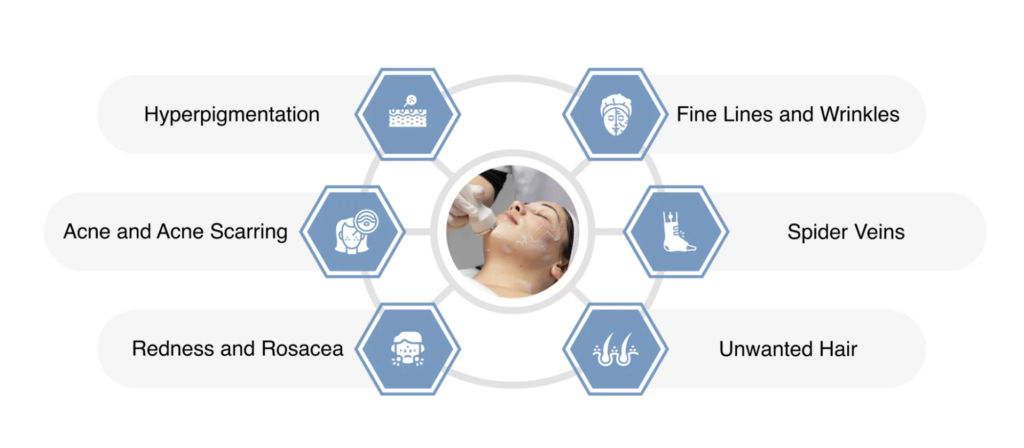
The device emits multiple wavelengths in pulses. Pigments absorb them, melanin in freckles and follicles, haemoglobin in vessels, and the light converts to heat.
The heat then works three ways depending on what it hits:
- Breaks up clusters of excess melanin so the body clears them.
- Collapses small blood vessels so redness fades.
- Damages hair follicles enough to slow regrowth.
One handpiece covering three mechanisms is why a single session can address more than one concern.
More Than Just Hair Removal

- Pigmentation: Age spots, sunspots and freckles lighten substantially over a course. Complete clearance happens sometimes and isn’t what an honest clinic promises, and sun exposure brings pigment back.
- Vascular concerns: Broken capillaries, spider veins, and rosacea redness all fade as treated vessels break down over the following weeks.
- Acne: The light hits acne bacteria and calms inflammation, with patients often reporting improving skin texture alongside fewer breakouts.
- Rejuvenation: Collagen stimulation is the quiet one, softening fine lines and evening tone with no surgical step involved.
- Hair removal: Melanin in the follicle absorbs the heat, growth slows, and the fair-hair limitation above applies in full.
Benefits of IPL: Non-Invasive, Versatile and Effective
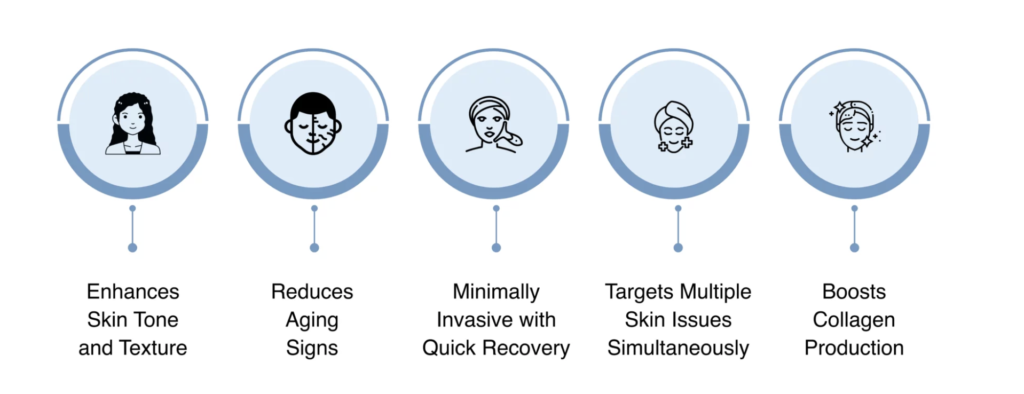
No cutting, no injections, no anaesthetic, and most people go straight back to their day with some redness that settles in hours.
Whether it’s hair removal, pigmentation, redness, or general refreshing, one technology handles several things in one appointment. That’s the pitch, and for the right candidate it holds up.
Comparison of IPL, RF, and LED Light Therapy for Skin Treatments
| Feature | IPL | RF | LED Light Therapy |
|---|---|---|---|
| Mechanism of Action | Broad-spectrum light targeting various skin conditions | Radiofrequency energy heats skin and stimulates collagen | Specific wavelengths targeting different concerns |
| Primary Applications | Hair removal, pigmented lesions, vascular lesions, wrinkles | Skin tightening, wrinkle reduction, cellulite | Acne, anti-aging, wound healing |
| Wavelengths | Broad-spectrum | Multiple wavelengths | Various, depending on application |
| Treatment Time | Typically shorter | Slightly longer | Shorter |
| Number of Treatments | Multiple usually required | Multiple usually required | Multiple usually required |
| Downtime | Minimal, some redness and swelling | Minimal, some redness and swelling | Minimal |
| Pain Level | Well tolerated, cooling sensation | Well tolerated, cooling sensation | Typically painless |
| Cost | Varies by provider and session count | Varies by provider and session count | Varies by provider and session count |
The row that matters most is the last one nobody prints: operator skill. Same machine, same settings, wildly different outcomes.
Preparing for a Session and Recovering After
- Stop retinoids and exfoliating acids five to seven days ahead, they thin the skin surface and raise irritation risk.
- No sun or self-tanner for four weeks before.
- Shave the area for hair treatments. The target sits below the skin, not above it.
- Treated spots darken and look like coffee grounds before flaking off over one to two weeks. That’s the treatment working, not a reaction, and it panics people who weren’t warned.
- Sunscreen after is not optional. Fresh treated skin burns easily and sun undoes pigmentation results faster than anything else.
Combining IPL with Other Treatments

Common in modern skincare regimes, though sequencing and spacing belong to a clinician rather than a DIY plan.
Chemical peels work at the surface where IPL works underneath it. Microneedling adds mechanical collagen stimulation to IPL’s light-driven version, useful for scarring and texture. RF reaches the deeper layers IPL doesn’t, covering tightening alongside tone.
Retinoids and antioxidant serums extend results between sessions, and honestly the ordinary habits behind healthy skin protect your investment better than any add-on procedure. Just observe the retinoid pause around appointments.
The Rising Popularity of IPL in Aesthetic Treatments
The machines got better, cheaper, and easier to buy, and IPL laser treatment reached people who’d never have walked into a clinic ten years ago.
The same accessibility put medical-grade equipment in rooms with no medical oversight. Training standards between a dermatology practice and a salon that financed a device vary enormously, and the device doesn’t know the difference.
Four questions sort this out fast. Who operates the machine and what’s their training. Do you patch test. What’s your protocol if a burn happens. How many sessions before I should expect to see anything. Vague answers to any of those are your answer.