
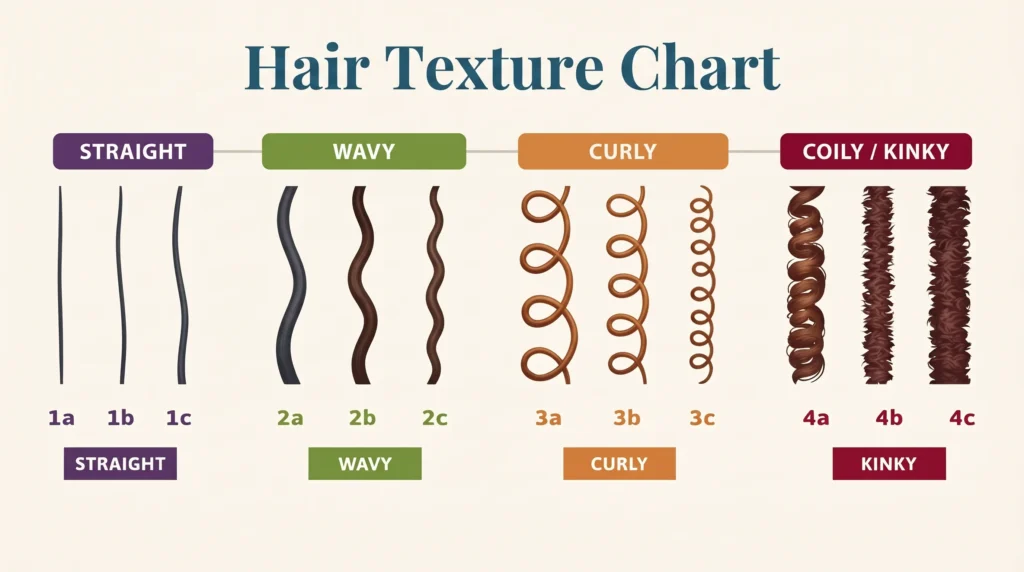
Most people find the hair texture chart, land on a number, and stop there. Fair enough, that’s the obvious thing to do with it. But the number only tells you what shape your hair makes. Not how thick each strand is, not how many you’ve got, not how they handle water. Those three do more to your routine than the number ever will.
The 1A To 4C Chart, Type By Type
Four families, three subtypes each. The number is the pattern, and the letter runs from A, loosest and widest, to C, tightest.
The letters come with a catch. Measuring curl width only works if the curl loops around. Types 1 and 2 never do, and 4B and 4C bend in angles rather than circles, so you read those by shape instead.
Type 1: Straight
- 1A. Pin-straight and fine, no bend anywhere. The rarest of the lot. Shiny, and stubborn about holding a curl.
- 1B. Straight with a bit more body, and a slight bend toward the ends.
- 1C. Straight but thicker and coarser, usually with a bend at the bottom.
Type 2: Wavy
- 2A. Soft, loose waves. Barely there.
- 2B. A clear S-shape that starts around mid-length, with flatter roots. Our 2B guide goes deeper on this one.
- 2C. More defined waves starting closer to the root, sometimes with a few loose spirals mixed in.
Type 3: Curly
- 3A. Large, loose spirals with a wide circumference.
- 3B. Tighter ringlets, springier, with more volume.
- 3C. Tight corkscrews packed close together. Curly, but not coily yet.
Type 4: Coily
- 4A. Defined coils about the width of a crochet needle, with a visible S-pattern once you stretch a strand out.
- 4B. Sharp Z-shaped bends instead of round coils. Less defined.
- 4C. The tightest pattern, with very little visible definition. Shrinkage can hit 75%, so hair can look a fraction of its real length.
Most people aren’t one number. A looser pattern up top with something tighter at the nape is completely normal, and the crown often does its own thing.
What the Hair Texture Chart Doesn’t Measure
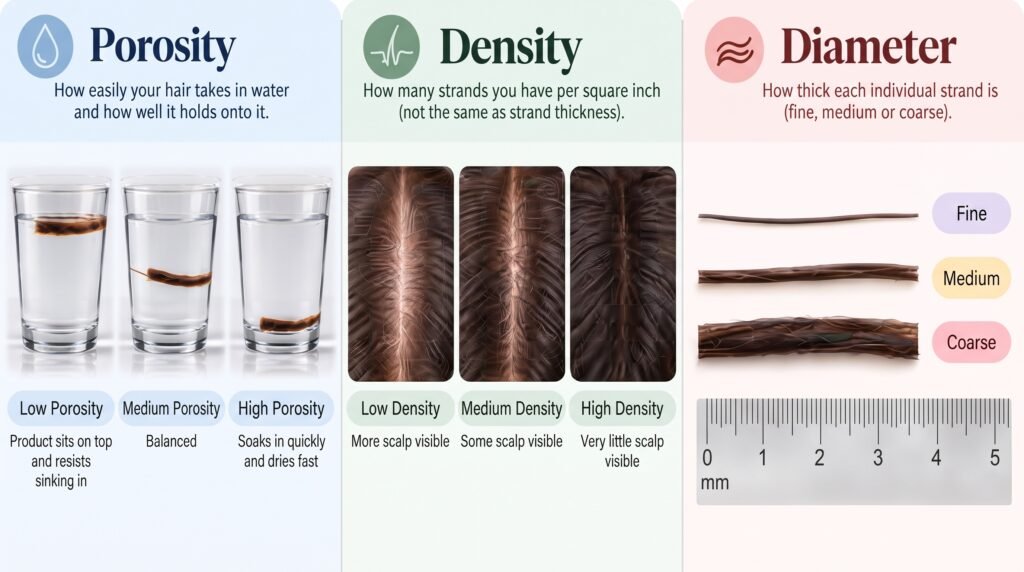
Porosity is how easily your strands take water in and how well they hold onto it. This is the one that decides whether a rich product sinks in or sits on top. Go easy on the home tests, though. Dropping a strand in a glass measures surface tension and whatever product is still clinging to it, not the structure underneath. Real porosity gets measured in a lab. Our porosity guide covers the signs that do tell you something.
Density is how many strands you have per square inch, which isn’t the same as how thick each one is. Part your hair over a mirror and see how much scalp shows through. Plenty visible means lower density. Barely any means high.
Diameter is the thread test above, and the reason it earns its ten seconds.
None of it is locked in either. Hormones move things around, pregnancy and thyroid changes included, and damage from bleach or heat changes the behavior no matter what the chart says.
I’d treat the number as shorthand, useful for talking to a stylist or scanning a product label. What yours does on an ordinary week will tell you more.
Hair Texture And Curl Type Are Two Different Things
Almost everyone uses these two words for the same thing, including plenty of articles with “texture chart” sitting right there in the title.
Curl type is the pattern your hair makes. Straight, wavy, curly, coily. That’s the chart above.
Texture is how thick a single strand is. Fine, medium or coarse.
They don’t track together. Fine 4C coils are common, so are coarse 1A strands. Coily patterns especially can look dense while the strands themselves are thin and fragile, which is how people end up piling on heavy products that flatten the whole thing.
Finding your texture takes about ten seconds. Pull a shed strand and hold it against a piece of sewing thread.
- Thinner than the thread, fine.
- About the same, medium.
- Thicker, coarse.
Fine strands break easily and get weighed down fast, so heavy creams and butters tend to flatten them. Coarse ones handle more product and more manipulation but fight you on styling. Medium is the forgiving one.
Fine 3B and coarse 3B want different products even though they share a box on the chart, which is why you want both, not one or the other.