

Self-care gets talked about constantly right now, and there’s a real reason for that.
Instead of delivering that aim of convenience, providing a smorgasbord of choice and information, the modern age has left many people feeling scattered and quietly worn down, neglecting themselves without quite noticing it happening. it’s not surprising that self-care is a growing priority for many.
Self-care is a priority for many people and that’s a good thing.
It’s actively saying no to the race, it’s slowing down enough to actually check in with your own physical, mental and emotional wellness. The eight ideas below aren’t a strict program; they are just an initial set that you can apply to your own life without blowing up your responsibilities to get there.
1. Invest in Loungewear That Supports Your Self-Care

Old tees and worn-in shorts do the job fine. Nothing wrong with that.
But there’s a real difference once you try genuinely good women’s lounge pants, the kind cut from real fabric instead of whatever’s cheapest. Something changes when the thing touching your skin all evening actually feels good, a small signal to your body that this time is different from the rest of the day.
If you can avoid disposable products altogether, it will be a small investment that elevates everything on this list.
2. Start Your Day with Mindfulness
A few minutes before the day properly starts, still in whatever you slept in or already changed into for comfort, feels a lot different than immediately checking your phone.
Deep breathing is one option. A few quiet minutes setting an intention for the day works too; no formal meditation needed. The point is you want to come into your first real task a little centered, not already behind.
3. Set Boundaries to Protect Your Time and Your Mental Health

Boundaries are the least glamorous part of self-care, and probably the most important.
So look at both your personal life and your work life, and see where you’re saying yes out of habit rather than desire. It takes practice not to get it wrong, and most people won’t get it right from the get-go. Setting boundaries is essential for loving yourself and avoiding burnout. Identify areas in both your personal and professional life where you need to say “no” or limit commitments so that you have sufficient time for self-care activities.
4. Establish a Calming Evening Routine

An evening routine makes for a nice line in the sand, flipping you from “still working” to “actually resting,” whether it’s fifteen minutes, an hour, or two.
A scented candle. A warm bath. Something soft to settle into rather than what you wore all day. The particular clothing matters less than the ritual of the change itself, being someone who steps out of the day’s clothes and into something soft and nice for the evening.
5. Do More of What You Love
One thing done for its own sake, and not because it’s productive.
Reading. The gym. A collection of vinyl played in its entirety. Or, in part. So long as you choose it because you actually want to, not because you think it looks good on a routine.
6. Start a Journaling Practice
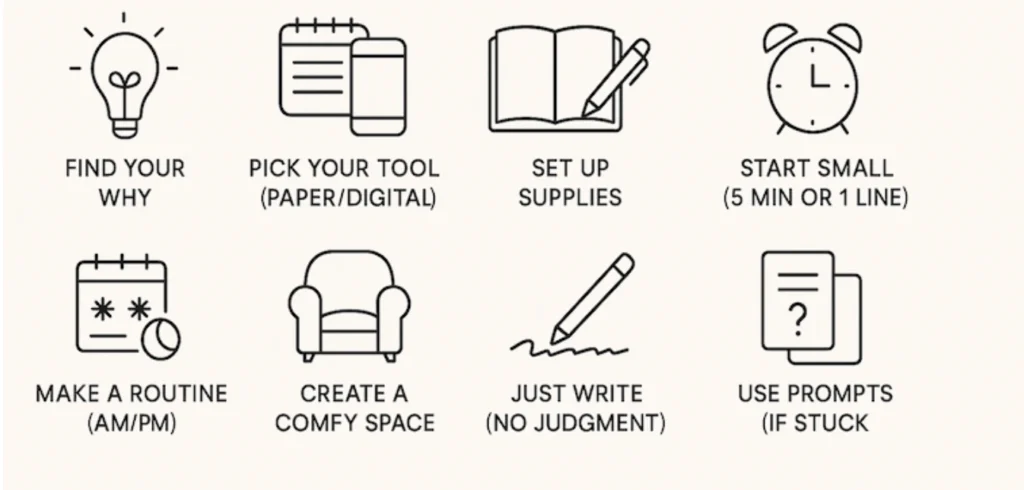
If you can’t quite put your finger on the root of whatever it is that’s bothering you, writing it down often speeds things along.
Just your thoughts, feelings, a few things you’re grateful for. No editing needed. The point is not to produce something readable.
7. Schedule “Me Time” to Unwind Without Distractions

Loving the people around you doesn’t mean you owe them every hour.
A few genuinely uninterrupted hours, on purpose, regularly, do more for your baseline mood than people expect. Tea and stillness. Gentle yoga if that’s more your speed, and the physical practice does real, measurable things for the body beyond just feeling relaxed in the moment. If you’re doing this at home, good loungewear turns “me time” from a concept into something your body actually settles into.
8. Embrace Nature

A University of Michigan study published in the journal Frontiers in Psychology found that the largest decrease in concentrations of cortisol, the body’s main stress hormone, was found in participants who spent twenty to thirty minutes in nature, with maximum effects visible from twenty minutes onwards.
This does not have to be a wilderness trek. A good neighborhood park, walked slowly, will suffice. In urban areas, weekly or monthly nature breaks could be planned well, since one does not need a lot of time for the effect to set in.
Make self-care a priority
Self-care done properly makes you better at showing up for the people who matter to you too, so it’s rarely just a selfish use of time.
None of this requires a dramatic shift in lifestyle, better loungewear, a boundary held, twenty minutes outside, small pieces stacked over time settle into something that actually holds.