
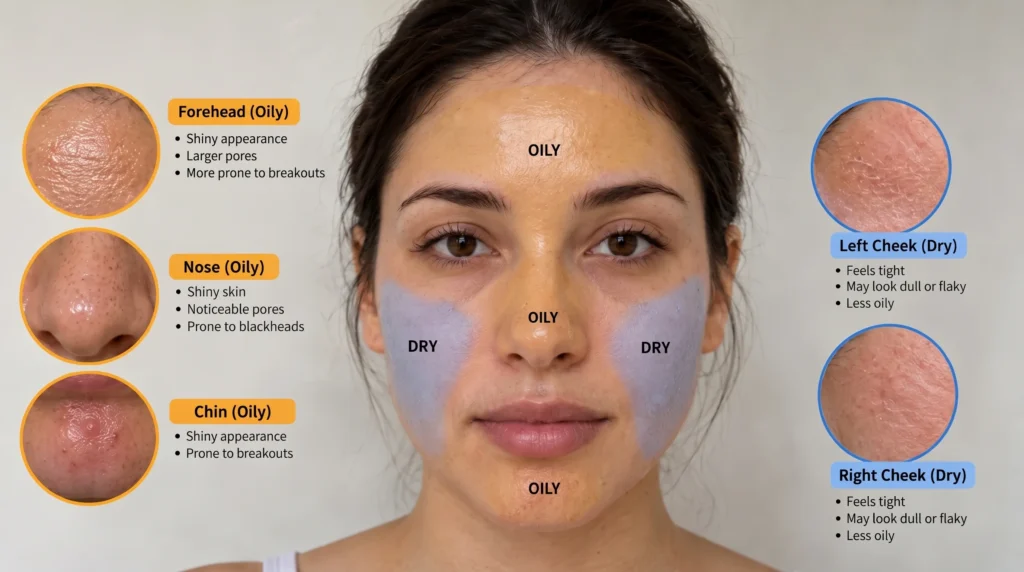
Combination skin means your face is running 2 skin types at once. Oily down the middle, through the forehead, nose and chin. Normal or dry around the outside, across the cheeks and along the jawline. One face, 2 sets of needs, and that’s the whole problem in a sentence.
Most people who tell me they have oily skin have combination skin. They have been treating the whole face for a problem that only exists on about a third of it, and the dryness on their cheeks is something they have come to think of as normal.
So before you buy another thing with oily skin on the label, it’s worth 2 minutes working out which one you’ve actually got. Nearly every bad call people make here traces back to the same mistake. Treating the face like it’s all one surface.
Why Your Face Has 2 Skin Types In The First Place
Oil glands aren’t spread evenly. There are way more of them packed across the forehead, nose and chin than out on the cheeks and along the jaw. That’s all the T-zone is. Not a marketing word, just a map of where the glands happen to sit.
So the middle of your face makes more oil than the outside does. For plenty of people the gap is small enough that nobody notices. For others it’s wide, and you end up with a nose that’s shining by lunch sitting right next to cheeks that go tight the second you towel off.
Neither zone is misbehaving, by the way. They’re both doing what the glands underneath them were built to do.
The annoying part isn’t the oil, and it isn’t the dryness either. It’s that whatever fixes one zone tends to wreck the other. Something strong enough to cut the shine off your T-zone hits your cheeks with the exact same treatment they never needed. Go the other direction, load up a rich cream because the cheeks are flaking, and your nose has nowhere to put it.
How To Tell If It Is Combination Skin And Not Just Oily Skin
The confusion runs one direction almost every time. People clock the shine, decide they’re oily, and never really register that the rest of the face is telling a completely different story.
What I’m looking at when someone sits down:
- Shine on the forehead, nose and chin by midday. Cheeks still matte, or tight.
- Makeup sliding around on the nose, then catching on dry patches across the cheeks.
- Blackheads and big pores on the nose and chin. Cheeks mostly clear.
- Cheeks that feel tight a couple minutes after washing, while the T-zone feels fine.
- Flaking cheeks in January, nose still shining right through it.
- A drawer full of stuff that fixed one thing and broke something else.
3 or more of those and you’re combination, not oily. Which matters, because the aisle you’ve been shopping in is the wrong one.
The Blotting Test
This is the cheap version of what I do with imaging and you can run it tonight.
Wash your face with something plain. Then put nothing on it. No moisturizer, no serum, nothing at all. Wait 2 hours. Press a tissue to your forehead, press a separate one to your cheek.
Oil on the forehead, nothing on the cheek, that’s combination. Oil on both, you’re oily. Nothing on either and the whole face feels tight and fresh, you’re dry.
It’s rough and it’s not imaging. It does settle the question for most people in an afternoon though, and it costs nothing.
Why The Season Throws People Off
Combination skin shifts with the weather more than any other type, and that’s half of why people misread it.
August, the T-zone runs the show and you’re sure you’re oily. January, the cheeks flake, so you decide you’re dry. Same skin both times. The ratio moved, that’s all that happened. If your answer to this question changes twice a year, that’s your answer.
A Simple Routine That Treats Both Zones Without Running 2 Of Them
Most people’s instinct is to run 2 routines on 2 halves of their face. Don’t. It’s tedious, you’ll quit inside a fortnight, and you don’t need to.
Think about the timing instead. Your cleanser sits on your face for 30 seconds and then it’s down the drain. Your moisturizer stays put for hours. So wash the whole face the same way, and let the stuff that stays on do the zone-specific work.
Morning Routine
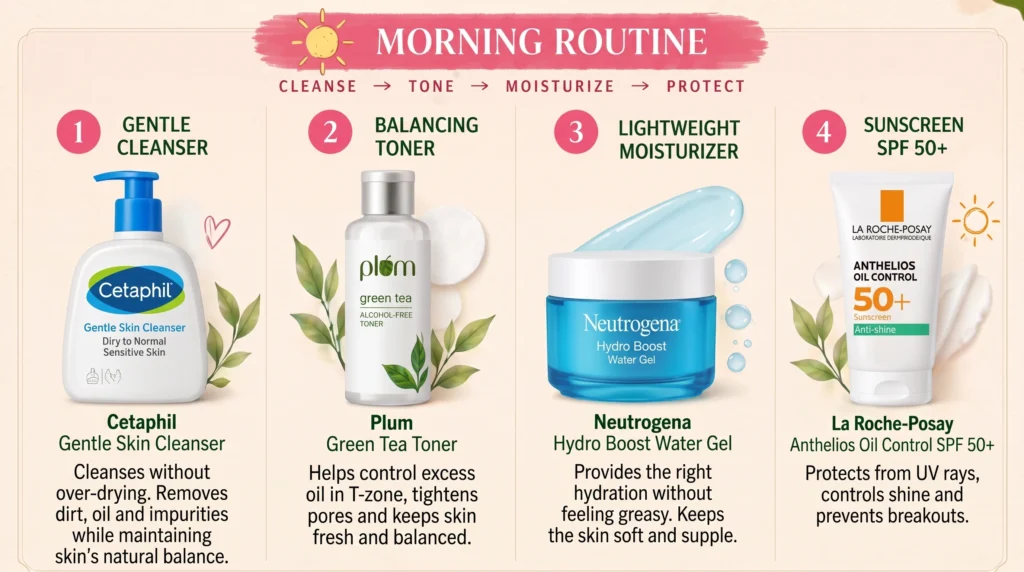
Lukewarm water, or a gentle gel cleanser if you wake up greasy. Skip anything that foams hard enough to leave your cheeks squeaking.
Light moisturizer over everything. Then a bit more, patted onto the cheeks and anywhere that feels tight. Not a second product. Just more of the first one where you actually need it.
Sunscreen over all of it, every day, including days you’re mostly indoors. I know. Everyone skips this one and it’s the step that pays off most over 10 years.
Night Routine
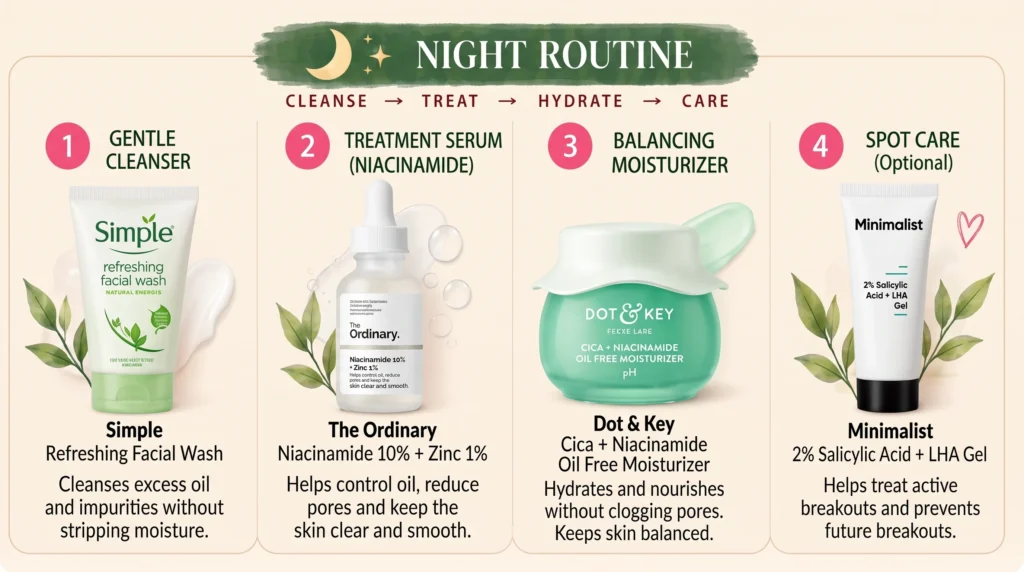
Cleanse properly, especially after makeup or sunscreen.
If you’re using an active, and for combination skin that usually means something to keep the T-zone clear, put it on the T-zone. Forehead, nose, chin. Off the cheeks entirely. Start at 2 nights a week and build from there instead of going nightly from day 1, which is how people end up with a wrecked barrier and a month off everything.
Moisturize after. Heavier on the cheeks than through the middle.
What To Stop Doing
Shorter list than the one above, and it matters more.
- Foaming cleanser twice a day. Once is plenty.
- Skipping moisturizer on the T-zone because it’s oily. Strip the oil off and your skin makes more of it. A lot of the shine people are fighting is coming out of that loop.
- Clay masks across the whole face. Nose and chin, that’s it.
- Swapping your entire routine every October. You want to change the amount, not the products.
When A Facial Is Worth Booking, And Which One
Here is the part that trips people up when they look at our menu. Mattify + Clear is built for oily skin. Refine + Hydrate is built for dry. If your face is both, the menu is asking you to pick a side your skin has not picked.
My honest answer is that combination skin is the case where guessing from a list is least likely to work. We run an OBSERV Skin Analysis for $50, which images beneath the surface and shows what each zone is doing rather than what it looks like it is doing. It is also the one assessment that will tell you whether that tightness on your cheeks is genuine dryness or dehydration, which look identical in the mirror and need completely different treatment.
Consultations with us are free, so if you want someone to look at your skin before you spend anything, that costs you nothing but the trip to our skin services at 2929 N High St. If getting here is the obstacle, we also work in homes within 30 miles of Columbus.
Whatever you decide about treatments, the routine above is the part that does the work. A facial is 1 hour. Your routine is every day between them.