
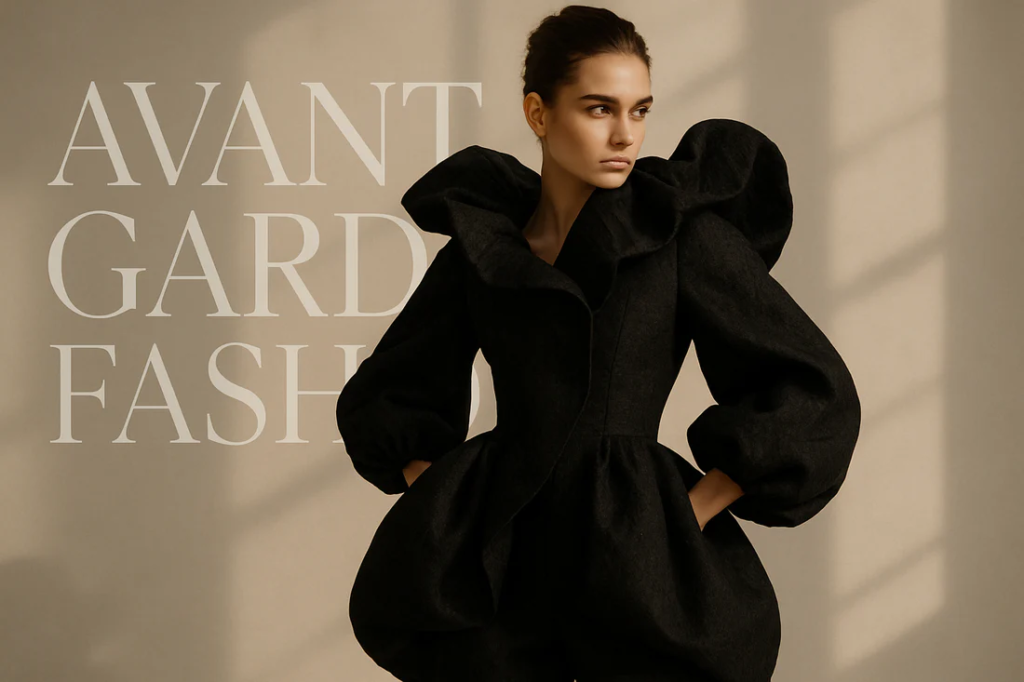
Avant-garde fashion is clothing made as art rather than product. It prioritizes ideas, proportion, and provocation over wearability, and it treats the body as a canvas instead of a shape to flatter.
The word comes from French military language, the advance guard, the soldiers sent ahead of the main force. That’s the whole philosophy in one borrowed phrase. Mainstream fashion follows trends. Avant-garde walks ahead of them, or ignores them completely.
Key Characteristics of Avant-Garde Fashion
- Unconventional silhouettes: Asymmetry, exaggerated volume, sculptural and deconstructed forms.
- Innovative materials: Metal, plastic, latex, 3D-printed elements, recycled and experimental fabrics.
- Deconstruction: Exposed seams, raw edges, linings on the outside, garments that look deliberately unfinished.
- Conceptual storytelling: Collections built around identity, gender, technology, mortality.
- Dramatic presence: Heavy use of black, architectural detail, texture doing the work color usually does.
Here’s the test that separates the real thing from costume, and it’s worth knowing because a lot of what gets called avant-garde is just loud. A piece is avant-garde because of an idea, not because it’s unusual. Kawakubo’s padded lumps had an argument behind them about where beauty is allowed to sit on a body, and a dress made of forks has a gimmick behind it, and the difference shows up the second you ask what the thing is actually saying.
A Brief History of Avant-Garde Fashion
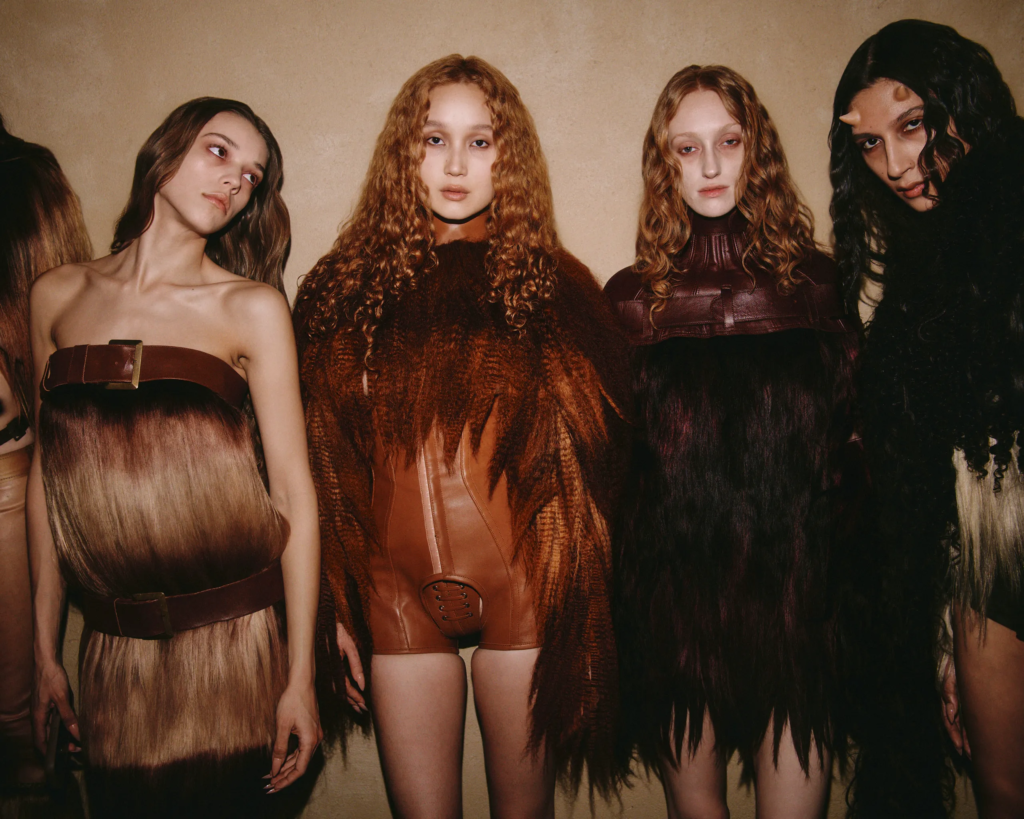
The roots sit in Surrealism and Futurism, and the timeline runs like this.
1930s: Elsa Schiaparelli collaborated with Salvador Dalí on the Lobster Dress and the Shoe Hat, a hat shaped exactly like an upturned high heel. Fashion and fine art in the same object, decades before anyone called it a crossover.
1960s and 70s: Paco Rabanne built dresses from metal discs and plastic rather than fabric. Pierre Cardin ran with space-age geometry. The material itself became the statement.
1981: The year everything shifted. Rei Kawakubo of Comme des Garçons and Yohji Yamamoto showed in Paris, and the reaction was hostile. Torn, oversized, monochrome black garments landed in a city that expected tailoring and color. Some critics called it Hiroshima chic, which tells you how badly the room misread it. Within a decade the entire industry had absorbed the ideas.
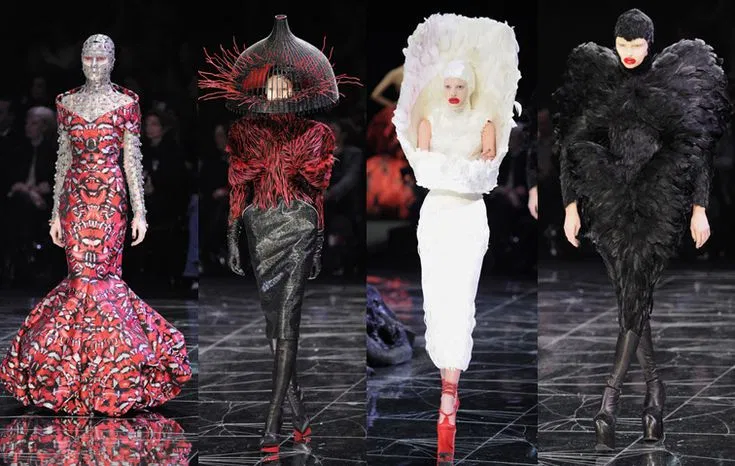
1990s and 2000s: Alexander McQueen turned runways into theater. Martin Margiela went the opposite direction, refusing photographs, dressing his team in white lab coats, and labeling garments with a blank white tag held on by four visible stitches. Anonymity as a design position.
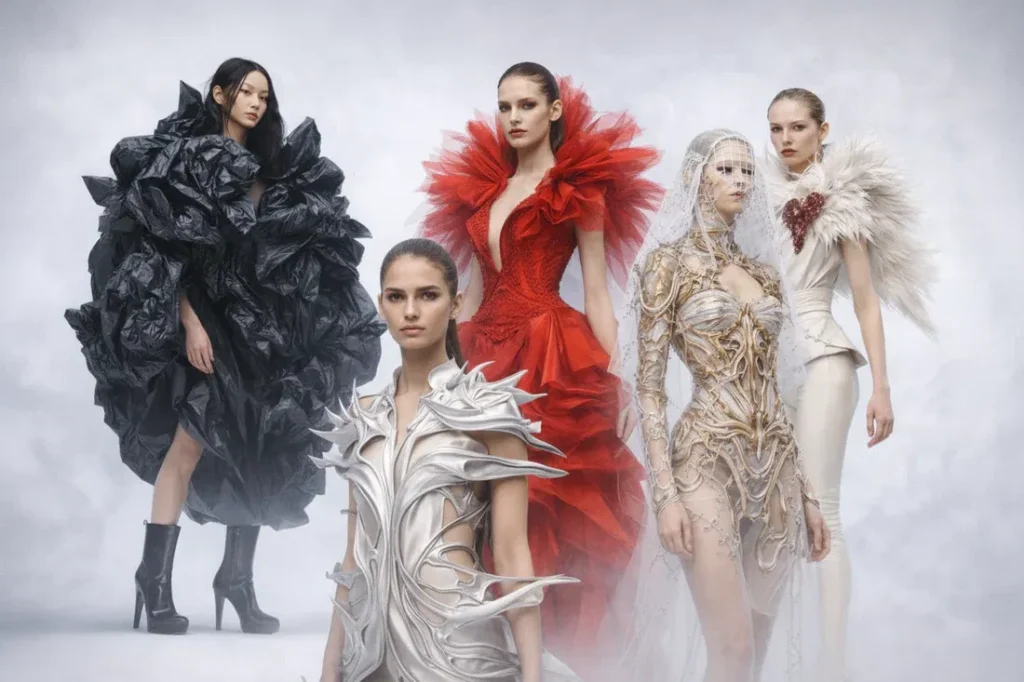
Now: Iris van Herpen builds couture with 3D printing and collaborations with architects and scientists, garments that would have been physically impossible to make twenty years ago.
Legendary Avant-Garde Designers You Should Know
Rei Kawakubo (Comme des Garçons): Her spring 1997 collection put padding in the wrong places, hips, shoulders, back, distorting the body on purpose. Nicknamed lumps and bumps, and still one of the most argued-about collections ever shown.
Yohji Yamamoto: Oversized, flowing, overwhelmingly black. He’s described black as modest and arrogant at the same time, and once you know that, his whole body of work reads differently.
Alexander McQueen: His spring 1999 show ended with model Shalom Harlow revolving on a turntable in a white dress while two industrial robot arms spray-painted it. Nobody who saw it forgot it, and it’s still the reference point for fashion as performance.
Iris van Herpen: The technologist. 3D-printed dresses that move like liquid, developed with engineers alongside pattern cutters.
Rick Owens: Dark, draped, architectural. For spring 2014 he replaced runway models with American college step teams, women stomping and scowling straight at the audience. A statement about who gets to be looked at.
How to Wear Avant-Garde Fashion in Everyday Life
You don’t need a runway piece. The principles translate down easily.
- Start with one statement item against neutral basics. An asymmetric jacket, a sculptural top, a dramatic coat.
- Go monochrome. All-black or all-one-color reads avant-garde instantly, because the eye stops reading color and starts reading shape.
- Play proportion. Oversized against fitted. Volume on top, narrow below, or the reverse.
- Let texture carry the outfit when color isn’t doing it.
The other half of the look sits above the neck and it’s where most people stop short. Severe center partings, wet-look slicked hair, sharp geometric cuts, strong graphic brows, all of it belongs to the same language, which is why a good hair service or a precise brow shape will change an outfit more than another garment will. Structure in the clothes wants structure in the styling.
One more thing worth knowing before you shop, because nobody tells beginners this. Several of these houses run secondary lines that are far more wearable and far cheaper, Comme des Garçons PLAY and Yohji’s Y-3 collaboration with Adidas being the obvious two, and they carry the design language at a fraction of the mainline price.
Where It’s Already In Your Wardrobe
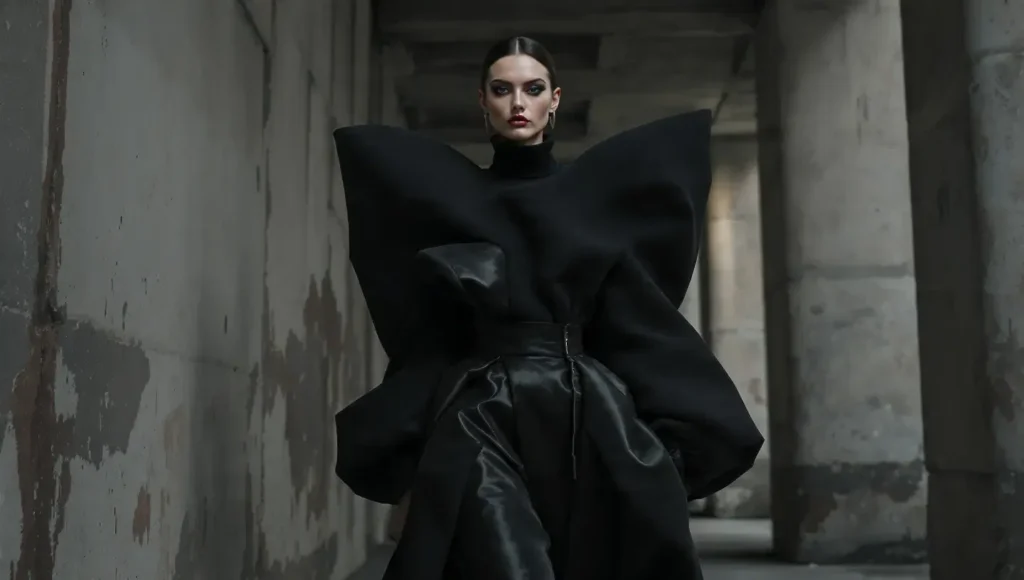
The trickle-down is the part people underestimate.
Deconstruction gave us exposed seams and raw hems on high-street denim. Kawakubo and Yamamoto’s oversized silhouettes became the whole slouchy, boxy shape of modern streetwear. Margiela’s Tabi split-toe boot got mocked for years and now sells out and gets copied constantly. Asymmetric hemlines, cocoon coats, sculptural shoulders, all of it started on a runway most people called unwearable.
The same thing happens in beauty, incidentally. Bleached brows, graphic liner, and glass skin were runway provocations before they were tutorials.
So that’s the actual function of the avant-garde. It works out what clothing can do while nobody’s buying, and everyone else catches up about a decade later, which means the strange thing on the runway this season is probably hanging in a mall in ten years.