The right eyelash treatment depends on two things most guides skip: what your natural lashes are actually like, and how much daily upkeep you’ll realistically tolerate.
Most people get this backward. They book the dramatic option when the simple one suited them, or they pay every month for extensions that are quietly thinning the lashes they started with.
Here’s the honest version of the five eyelash treatments worth knowing, what each one costs, and who it actually suits.
Why Bother with Eyelash Treatments?
Lashes do a real job beyond looks. They keep dust and debris out of your eyes and act as a trigger that makes you blink when something gets too close. That’s the practical part.
The reason people spend money on them is the other part. Lashes frame the eye, and darker, longer ones make the eye read as bigger and more awake, which is why a good lash look can carry a face with no other makeup on it.
A treatment can also just buy back time. The right one means you’re not fighting a curler and three coats of mascara every morning, which for a lot of people is the whole appeal, more than the drama of it.
That’s the case for bothering. Whether it’s worth it for you depends on which treatment you pick, and they are not equal.
Mascara
What it is
Mascara coats your lashes with pigment to make them look darker, thicker, and more defined. It’s the most common eyelash treatment because it’s the one almost everyone already owns.
The part people skip
The curl. A lengthening or volumizing formula works best on lashes curled first with a metal curler. Mascara on uncurled lashes just makes straight lashes darker instead of opening up the eye.
Cost and downsides
- Ten to thirty dollars.
- Washes off at night.
- Has to be reapplied daily.
- Smudges if you have oily lids or watery eyes.
Best for: if your lashes are already a decent length and you just want them darker and more defined, this is your answer. Most of the rest of this article is about treatments you don’t strictly need.
False Lashes
What it is
Strip lashes and individual clusters sit on top of your natural lashes with a temporary adhesive. They exist for one job, a dramatic look for a specific occasion. A wedding, a shoot, a night where the eyes carry the whole face. They come in synthetic, silk, and mink, and the most natural DIY lash extensions are the ones that blend with your own lashes rather than sitting on top of them.
Where they fall short
They aren’t an everyday solution. People who try to make them one usually quit within a week, because the application takes practice and the band can show in daylight.
Best for: events, not Tuesdays. They’re the cheapest route to a genuinely dramatic result without spending anything at a salon.
Lash Extensions
This is the eyelash treatment with the widest gap between what it promises and what it costs you, in money and in lash health, so it gets the most space.
What it is and what it costs
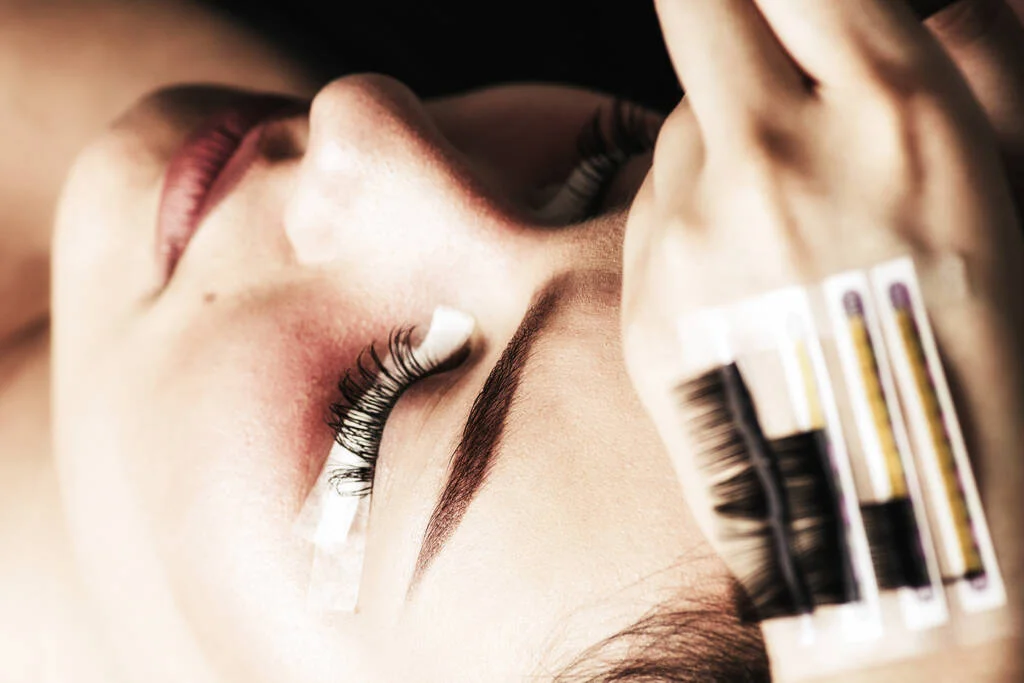
Extensions are individual synthetic lashes attached one at a time to your individual natural lashes by a technician, over about two hours, with your eyes closed.
- A full set in the US runs $150 to $400.
- Fills every two to three weeks run $50 to $90.
- Year-round, most people spend $1,500 to $3,000 a year once fills are counted.
The damage question
This is the part the industry stays quiet about.
Done well, by a tech who isolates each natural lash so one extension sits on one lash, the damage is minimal. Done badly, where an extension bridges two or three lashes on different growth cycles, those lashes tug on each other and shed early, and you end up sparser than you started.
The adhesives are cyanoacrylate-based, related to surgical superglue. Some cheaper formulas contain formaldehyde-releasing preservatives that dermatologists flag as a cause of contact dermatitis around the eye.
None of this makes extensions a bad choice. It makes them a real commitment, suited to someone who wants a long-lasting mascara-free look, has the budget for upkeep, and goes to a competent tech rather than the cheapest one.
Doing them yourself
A kit costs twenty to eighty dollars and lasts several applications. The application is genuinely hard, though, because you’re working on your own open eye in a mirror and can’t isolate a single lash the way a tech does with your eye closed. Most kits get around this with pre-glued clusters, which apply more easily and damage more.
If you’ve weighed that honestly and still want to try, a usable kit has to include:
- Two separate tweezers, one for isolation and one for placement.
- Adhesive with a full ingredient list and a batch date.
- Lashes in varied lengths, not one uniform tray.
- An oil-removing primer.
A starter lash extension kit with those runs around forty dollars and lasts six to ten applications. The cheaper ones are cheaper because they’re missing one of those things.
Lash Lifts
What it is
A lift is a perm for your natural lashes, a chemical curl set from the base. Nothing is stuck to your lash line, so there’s no adhesive risk and no weight pulling on your lashes.
- Lasts six to eight weeks.
- Costs $60 to $150.
- Almost no daily upkeep after the first day.
What it won’t do
It won’t add length or volume. It works with what you have, lifting and curling so the eye looks more open. That’s exactly right if your lashes are a decent length but stubbornly straight, and not enough if they’re genuinely short and sparse.
Best for: a lot of people who think they want extensions actually wanted this. Paired with a tint, it gives wide-awake eyes that survive swimming and sleep with no morning routine.
Lash Growth Serums
What it is
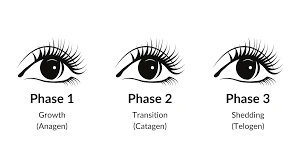
Serums are the slow option, and the only one that changes your actual lashes instead of sitting on top of them. They work by extending the growth phase of the lash cycle, and over two to three months of nightly use they can make a visible difference.
The catch
They only work while you keep using them.
The prescription route, Latisse, is the only FDA-approved option for lash growth, and it carries documented side effects including darkening of the eyelid skin and, rarely, a permanent change to iris color. The over-the-counter peptide serums are gentler, and their results subtler.
Best for: a long game, on their own or alongside another treatment. As a quick fix before an event, they’re useless, because there’s nothing quick about them.
How to choose your eyelash treatment
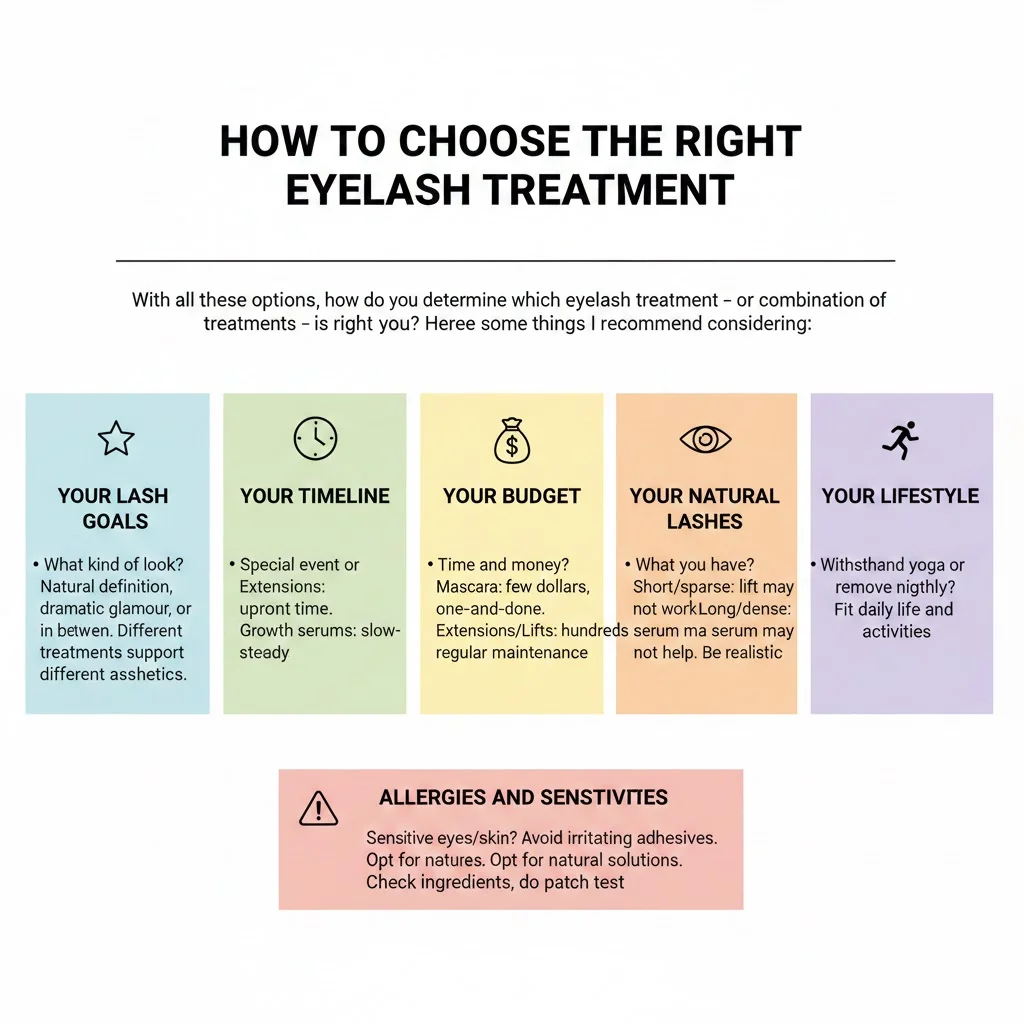
Start with your natural lashes, honestly.
- Decent length, just need definition: mascara with a curler. Stop there.
- Good length but straight: a lift is probably what you’re really after.
- Short and sparse: extensions give the most dramatic change, but go to a competent tech and budget for fills, or start a serum and play the longer game.
- One-off event: false lashes.
And if you’re drawn to doing extensions yourself, patch-test the adhesive forty-eight hours ahead on your inner wrist, practice on a partner before your own eye, and know the first attempt won’t look like the kit photos.
The right eyelash treatment is almost always the simplest one that gets you the look you actually want, not the most dramatic one you can book.