
Skincare routine for your 30s questions tend to start at the mirror, when a cleanser that worked at 25 now leaves your cheeks tight and a breakout on your chin shows up in the same week as a faint line by your eye, and that mix is why a skincare routine that felt easy a few years ago stops working.
Here’s what’s going on. Cells turn over more slowly in your 30s, which leaves dead ones hanging around and your face dull. Collagen, the protein that holds it firm, declines year by year. That’s why the first fine lines show up around the eyes. Old sun damage comes up as dark spots, and adult acne is still common.
None of that needs 12 steps. Products cover it, and you add them one at a time.
Products Cover A Skincare Routine For Your 30s
A gentle cleanser, a moisturizer, a broad-spectrum sunscreen, a vitamin C serum and a retinoid. Retinoids are the vitamin A family that includes retinol, and they’re the one product on the list that works on both fine lines and breakouts. The other four support it. For the longer view on why these steps hold up over decades.
Mornings Take Four Steps
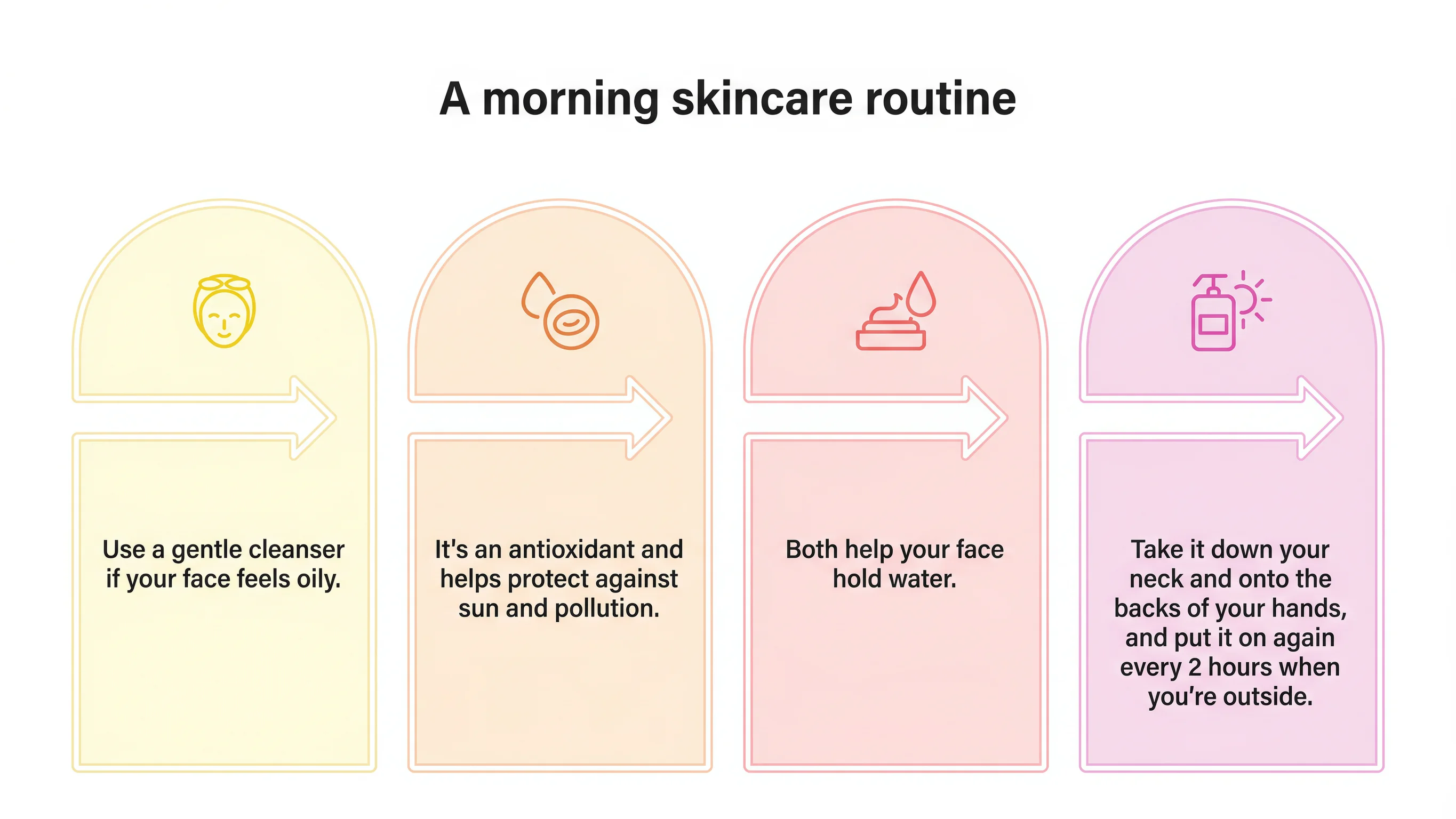
- Rinse with water, or use a gentle cleanser if your face feels oily.
- Put on a vitamin C serum. It’s an antioxidant and helps protect against sun and pollution.
- Moisturize with something that lists ceramides or hyaluronic acid on the label. Both help your face hold water.
- Finish with broad-spectrum SPF 30 or higher. Take it down your neck and onto the backs of your hands, and put it on again every 2 hours when you’re outside.

Sunscreen does the most work in this routine. Cloudy days and car rides count. Once you start a vitamin A product at night, your face also gets more sensitive to sun, which makes daily SPF count even more.
Nights Take Three Steps
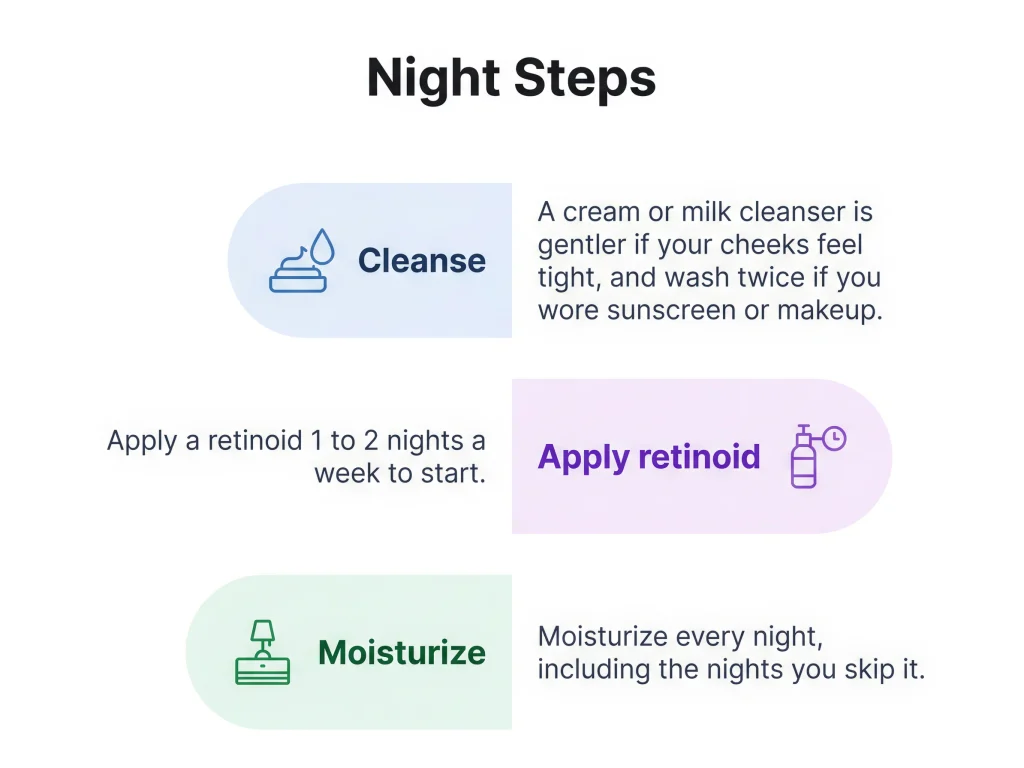
- Cleanse. A cream or milk cleanser is gentler if your cheeks feel tight, and wash twice if you wore sunscreen or makeup.
- Apply a retinoid 1 to 2 nights a week to start.
- Moisturize every night, including the nights you skip it.
Start A Retinoid Slowly And Skip It If You’re Pregnant
Dab a pea-size amount on your jaw first and wait 7 to 10 days. If it doesn’t sting, use a pea-size amount over your whole face 1 to 2 nights a week, then go to 3 nights after a few quiet weeks. Give it months, not weeks, because it works on collagen and cell turnover slowly. Redness, peeling or burning mean a few nights off.
These products aren’t recommended skincare routine during pregnancy, while breastfeeding or while trying to conceive. The 30s are the years many people are doing one of those. Check with your doctor first. If you’ve seen NAD+ creams pitched as a replacement, our NAD+ vs retinol comparison covers how the two differ.
Breakouts And Fine Lines Can Share One Skincare Routine
That same night step is used for both acne and fine lines. You don’t need an anti-aging product and a separate acne product fighting for space on your face.
If you still break out, add a salicylic acid cleanser in the morning and leave the retinoid for night. That way the two don’t stack up on your face at once. Skip face scrubs and drying spot treatments, because they strip the outer layer and make your night step sting more. Give any acne product about 2 months before you judge it.
Match The Moisturizer To How Your Face Feels

A dry face does best with a richer cream that has ceramides, plus a cream cleanser at night. An oily or breakout-prone face still needs moisturizer, but a gel works better, and the label should say non-comedogenic, meaning it’s made not to clog pores. Sensitive faces are different again. Buy fragrance-free products, then stay at 1 night a week with the retinoid until your face settles. When a product stings, stop it for a few days before you try it again.
Drop Harsh Scrubs And Anything That Stings

Gritty face scrubs and heavy exfoliating wear down the outer layer that holds water in. Your face answers with redness, flaking and more breakouts. A chemical exfoliant like glycolic or salicylic acid needs 2 nights a week at most, and not on the same night as the retinoid.
Products left over from your 20s deserve the same question. Is it still doing anything for you? If you’d like someone to look at what your face needs before you buy more, our skin services page lists the facials we offer.
Add One Product At A Time
Start with sunscreen and a moisturizer you like. Add the night product next, then the vitamin C, spacing the additions about 2 weeks apart. If something stings or turns your face red, you’ll know which one did it.
If a product pitches itself as medical-grade, our guide to medical-grade skincare explains what that term does and doesn’t promise.
Get Changing Moles Checked
Skin cancer can look like an ordinary dark spot. Any new or changing mole should be checked by a doctor before you try a brightening product.