
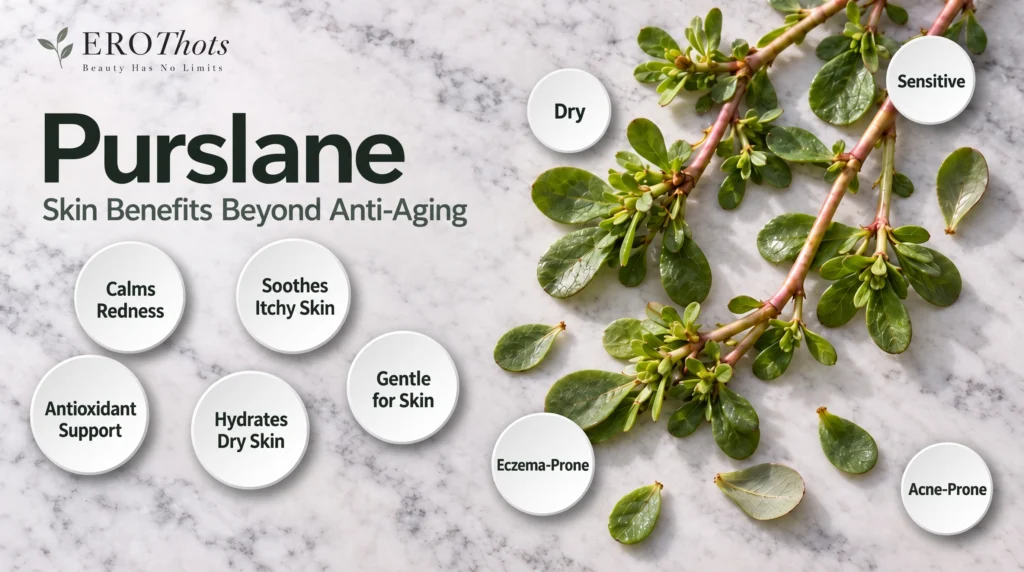
Purslane benefits for skin go well past the anti-aging promise printed on most jars. That promise rests on thin proof for human skin, while the plant does its more useful work on skin that is red, itchy, dry or easily upset. Its extract calms redness and stinging, eases itching on eczema-prone skin, adds antioxidant cover against sun and pollution, and keeps skin hydrated without a heavy feel. It may also help small wounds heal, settle the redness around breakouts and make foaming cleansers gentler on the face.
Purslane (Portulaca oleracea) is a small succulent plant with thick, fleshy leaves, and its extract is used in skincare mainly as a soothing ingredient.
Purslane Benefits For Skin That Is Red And Stinging
Calming redness is the job this plant does best, and it is the reason the extract shows up in so many creams made for sensitive skin.
Why It Calms Red Skin
The extract carries a few compounds that work on irritation from different sides:
- Omega-3 fatty acids, which help turn down inflammation.
- Flavonoids, plant antioxidants that also soothe irritated skin.
- Norepinephrine, which makes tiny blood vessels near the surface tighten, and that may be why redness fades after the extract goes on.
The companies that sell the extract describe most of these effects themselves, so it makes sense to read them as a likely explanation rather than settled science.
How Strong The Proof Is
Small human studies have found less redness and stinging on skin that was stressed by cosmetic procedures. Those studies had few people in them, and large controlled trials have not been done yet.
The extract can help calm red skin, but it should not replace a treatment your dermatologist has prescribed.
If your cheeks turn pink after a strong exfoliant, a cream with it could take some of the sting out.
How Purslane Helps Eczema And Itchy Skin
The plant has a long history as a remedy for eczema and itchy skin, and newer lab work is now testing it in gels made for flare-ups. The reasons are the same ones that make it good for redness. It cools inflammation, and it soothes the itch that dry, irritated skin brings with it.
The modern proof is still thin, though. Most of the work so far has been done in labs rather than in large trials on patients, so there is no clear answer yet on how such a cream would compare with a standard eczema treatment.
Where It Fits In An Eczema Routine
A moisturizer containing the extract can sit alongside the treatment your doctor gives you, as a soothing layer between flare-ups. You will want to be careful when skin is cracked or weeping, because broken skin lets in more of any ingredient. Test it first on a small patch that is not flaring.
Can Purslane Help Cuts And Burns Heal Faster?
Healing is where the plant looks promising, and it is also where the proof is the least ready for people.
What The Animal Studies Showed
- An ointment made with 50% extract shrank small cuts on rats faster than leaving them untreated over 14 days.
- A gel made from it healed deep burns in rats faster than the standard burn cream, though the new skin only partly grew back.
- Fresh crushed leaves on wounds in mice made the wounds smaller and left the healed skin stronger.
So it does seem to help skin knit back together, at least in animals. These results have not been repeated in large studies on people, and for an open cut or a burn you should stick with proper wound care.
Antioxidant Protection For Skin Exposed To Sun And Pollution
The leaves are rich in antioxidants, including vitamins C and E, beta-carotene and omega-3 fatty acids. Antioxidants mop up the unstable molecules that sun and pollution create in the skin, the same ones that break down collagen and leave skin dull over time. Some sunscreens and daily creams add the extract for that reason, as extra support.
Suppliers also say it can reduce skin damage from UVA light, the part of sunlight that reaches deepest into the skin.
It adds protection on top of sunscreen, but it does not block UV light on its own.
This is the most honest version of its anti-aging role. It may help slow some of the damage that ages skin, rather than reverse age that is already there.
Hydration For Skin That Feels Dry Or Tight
Formulators list the extract as a hydrating ingredient, and its omega-3 fatty acids are the kind of fats the skin barrier uses to hold water in. When the barrier holds, skin feels less tight after washing and less rough by the end of the day.
The extract itself is a clear, water-based liquid with no real scent or color, so it sinks in without leaving a greasy film. You will often find it paired with hyaluronic acid, which pulls water into the skin while the extract helps calm it.
- Dry skin may notice less tightness.
- Combination and oily skin can use it without a heavy feel.
- Dry skin that is also sensitive gets hydration and soothing from one ingredient.
Most of this comes from supplier testing. It works best as a support ingredient inside a good moisturizer, rather than as the main hydrator.
Purslane Benefits For Skin Prone To Acne
Extract suppliers market it as an anti-acne ingredient, mostly because of its calming and antibacterial properties. In practice it works on the redness and swelling around a breakout more than on the breakout itself. It does not clear clogged pores, so it fits best next to your acne treatment, where it can calm the irritation that strong acne products often cause.
It may help angry, red breakouts look calmer, but the evidence for treating acne itself is weak.
A Gentler Wash For Skin Irritated By Harsh Cleansers
Foaming cleansers rely on cleansing agents called surfactants, and some of them strip and irritate the skin. Its makers say the extract can lower the irritation those surfactants cause, which is why it turns up in face washes and body washes meant for sensitive skin.
Its own risk of irritation is low, so it suits oily, dry, combination and sensitive skin alike. If your face feels tight or stings after washing, a cleanser with purslane is worth trying before you give up on foaming washes altogether.