
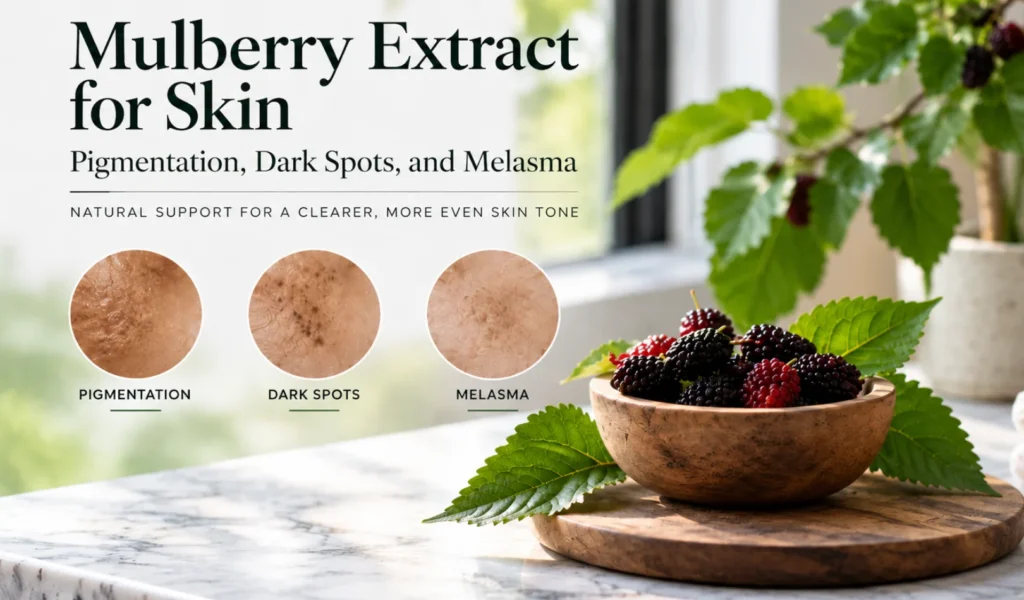
Brands sell mulberry extract for skin with loose promises like glow, radiance and “natural whitening.” The research is much narrower. Nearly all of it is about pigment.
The extract comes from Morus alba, the white mulberry tree. Several of its compounds slow tyrosinase, the enzyme your skin needs to make melanin. Melanin is the pigment behind your skin color and every dark patch on it. So the useful question is whether it can fade pigmentation, dark spots and melasma, and how strong the proof is for each.
| Concern | Human evidence | Fair expectation |
|---|---|---|
| Melasma | 1 trial, 50 people, 8 weeks | Modest fading, alongside sunscreen and prescribed care |
| Dark spots from acne or sun | None yet, lab studies only | Slow help at best, still unproven |
| General uneven tone | None yet | The same |
Mulberry Slows The Melanin Enzyme
Cells called melanocytes make melanin, and tyrosinase runs the first 2 steps of that process. Each melanocyte then passes its melanin to about 36 neighboring cells, which is the color you see. Slow the enzyme down and less new melanin forms.
Two compounds from the tree stand out:
- Oxyresveratrol. In lab tests, it blocked mushroom tyrosinase 32 times more strongly than kojic acid. It was far weaker against the enzyme from mouse pigment cells, so lab numbers don’t carry straight over to skin.
- Mulberroside F. This one comes from the leaves. Early lab work showed it slowing the enzyme, and a later study found no effect.
Brightening Means Fading Extra Pigment
On labels, this effect goes by the name “brightening.” It means fading patches that are darker than the skin around them, and nothing in the research shows a change in anyone’s natural color. Be wary of anything sold as fast “whitening,” since some imported lightening creams contain steroids or mercury.
Pigmentation Has Different Triggers
Hyperpigmentation means skin that has turned darker than the area around it. The trigger shapes how well any ingredient works.
- Sun-related discoloration. Sunlight tells skin to make more melanin, which shows up as sun spots and blotchy tone.
- Post-inflammatory pigmentation. This is the dark mark left when a pimple clears or a bite, cut or burn heals. An irritating product can cause it too.
- Melasma. Dark patches, mostly on the face, tied to hormones and sunlight.
- Uneven tone. Usually a mix of the three.
Research on mulberry extract for skin pigmentation covers these very unevenly.
Mulberry Extract For Dark Spots
A dark spot forms when something pushes one small area of skin to make extra melanin. With acne marks the trigger is inflammation, and with sun spots it’s light. Tyrosinase is involved either way, so slowing it makes sense on paper.
Lab results back that up. In tests on human melanocytes, oxyresveratrol cut melanin by about 31% and lowered the proteins that move it into surrounding cells. Human trials on acne marks or sun spots are still missing, so the fair claim is that the extract may help slow new pigment.
Results would be gradual in any case. A spot a few shades darker than your skin usually takes 6 to 12 months to fade, and deeper color can take years.
Mulberry Extract For Melasma
Melasma differs from an ordinary dark spot. Sunlight triggers it, and so do hormones, which is why pregnancy and birth control pills can set it off. It runs in families, and it can last for years.
One Trial Showed A 29% Drop
The one human study is a randomized trial from 2011. Researchers split 50 patients into 2 groups. One applied 75% mulberry extract in coconut oil to their patches twice a day, and the other applied a placebo. After 8 weeks:
- Melasma severity scores fell about 29% with treatment and under 3% with placebo.
- Melanin readings showed lighter patches in the treated group and slightly darker ones in the placebo group.
- 4 people in the treated group reported mild itching.
The Trial Was Small And Short
The study proves less than product pages suggest. Each group had 25 people, the design was single-blind, and no one tracked what happened after week 8. A 75% extract oil is also a long way from a serum that lists the plant near the bottom of its ingredients.
Sunscreen And Treatment Come First
Melasma care starts with daily sun protection, and hydroquinone is still the gold standard among treatments. Mulberry fits in as an extra alongside that plan, so mention it to your dermatologist if you’re being treated.
Root, Leaf And Fruit Extracts Differ
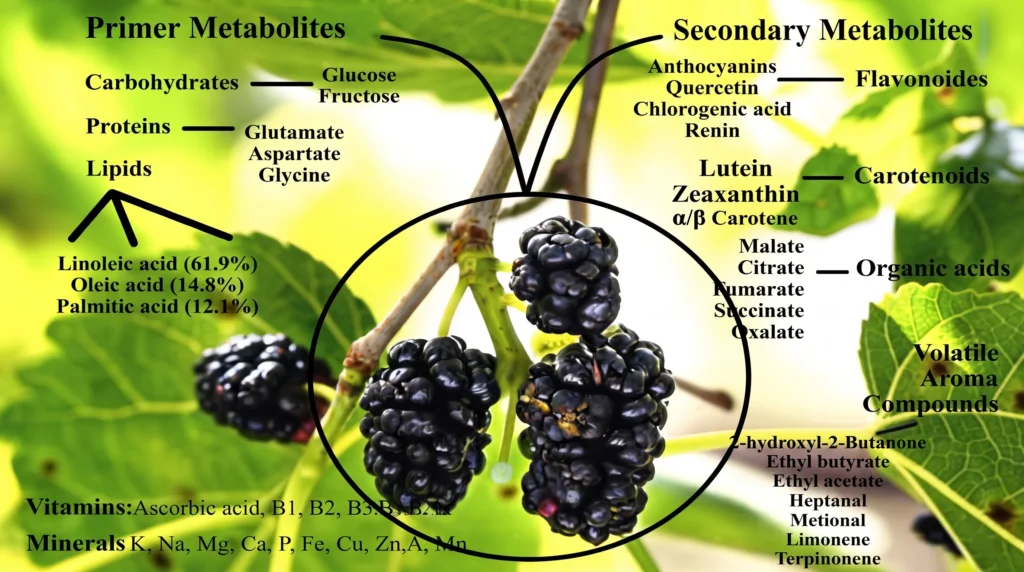
“Mulberry extract” on a label can mean several things, because each part of the tree has its own chemistry.
| Plant part | Main compounds studied | Relevance to fading |
|---|---|---|
| Root and root bark | Oxyresveratrol, mulberroside A | Strong anti-tyrosinase activity in lab tests |
| Leaf | Mulberroside F, moracins, flavonoids | Also strong in lab tests, with mixed results for mulberroside F |
| Fruit | Anthocyanins, rutin, chlorogenic acid | Mostly an antioxidant, and generally weaker for lightening |
Details count even within one part. Mulberroside A is a bound form of oxyresveratrol, and in one enzyme test it was about 100 times weaker. The human trial’s summary doesn’t say which part its extract came from.
Most Proof Comes From Lab Tests
| Type of evidence | What exists | What it tells you |
|---|---|---|
| Enzyme tests in a dish | Many, mostly on mushroom tyrosinase | The compounds can block the enzyme |
| Cell and animal models | Mouse and human cells, zebrafish | Melanin drops in living cells |
| Human trials | 1 trial, 50 people with melasma | Modest fading over 8 weeks at 75% |
The mechanism has solid support. The effect you’d see in a mirror has one small trial behind it.
Mulberry Vs Other Brightening Ingredients
| Ingredient | How it works | Human evidence |
|---|---|---|
| Mulberry | Slows tyrosinase | 1 melasma trial of 50 people |
| Niacinamide | Blocks the handoff of melanin to surrounding cells | A few small studies |
| Vitamin C | Interferes with tyrosinase at its copper site | Several small studies |
| Arbutin, including alpha-arbutin | Slows tyrosinase, reversibly | Small melasma studies |
| Kojic acid | Slows tyrosinase | Several studies, with hydroquinone ahead in a 12-week comparison |
| Licorice | Glabridin slows tyrosinase, liquiritin disperses melanin | Small studies |
None of these is a clear winner, and mulberry has one of the thinnest human records in the table. Niacinamide works on a different step from the tyrosinase blockers. Vitamin C is the one you’ll also find in treatment rooms.
Apply Twice Daily For 8 Weeks
- Timing. The study measured results after 8 weeks of twice-daily use, so treat that as the first checkpoint. Melasma treatment in general takes 3 to 12 months to show results.
- Placement. Apply it morning and night, after cleansing and before moisturizer. Sunscreen goes on last in the morning.
- Formula over percentage. You can’t shop for the study’s 75%. Ingredient lists run from most to least, so Morus alba near the bottom means very little of it. Oxyresveratrol also breaks down in heat and light, which makes packaging and formulation count for more than a number on the box.
- Sunscreen. Use a broad-spectrum, tinted SPF 30 or higher with iron oxide, and reapply every 2 hours outdoors. Without it, sunlight keeps telling your skin to make melanin while your serum tries to slow it.
Add Other Actives Slowly
Studies that test it alongside niacinamide, vitamin C, alpha-arbutin, retinoids or exfoliating acids are hard to find. So there’s no proof these pairings boost results, and none that they clash.
Niacinamide, vitamin C and alpha-arbutin each act on pigment in their own way, which makes them reasonable partners. Retinoids and acids are the ones to add slowly, because they can leave skin sensitive or peeling, and irritation can darken spots. Add one new product at a time.
Itching Is The Main Side Effect
In the study, 4 of the 25 treated patients reported mild itching, and that covers only 8 weeks of use. A botanical label doesn’t lower the risk, since plant extracts can irritate or trigger allergies like any other ingredient. Stop if you get itching or redness, because irritation can leave new dark marks.
Patch test first, on a quarter-sized spot, twice a day, for 7 to 10 days. If you have melasma or reactive skin, mention it when you book a facial.
Claims The Research Doesn’t Support
The one human trial measured melasma. These claims go beyond it:
- Treating acne. Fading the mark a pimple leaves is a separate question from stopping the pimple.
- Removing wrinkles or shrinking pores. Neither was measured.
- Permanent whitening. The study ran 8 weeks with no follow-up, and melasma can last for years.
- Instant results. The measured change took 8 weeks of twice-daily use at 75%.
- Replacing sunscreen. Some UV protection in a cell study is a long way from an SPF rating.
Check The Plant Name And Part
- The plant name. Look for Morus alba. Broussonetia, sold as paper mulberry, is a different plant with its own research.
- The plant part. Root, bark, leaf or fruit should appear in the name, as in “Morus Alba Root Extract.” Fruit is the weakest bet for fading.
- Its place on the list. Higher is better.
- The packaging. Opaque, airtight containers protect compounds that break down in light and air.
- The claims. “Whitening,” “instant” and “replaces hydroquinone” are red flags.
What Mulberry Extract Can Realistically Do for Your Skin
Mulberry has a real scientific basis for pigmentation. Its compounds slow the enzyme that starts melanin, and one small trial showed modest fading of melasma. It may help with dark spots too, though human trials for that are missing, and root, leaf and fruit extracts shouldn’t be treated as the same ingredient. Think of it as a supporting ingredient in a routine built on sunscreen and proven treatments.