
By Cody Oscar, Skin and Makeup at EROthots
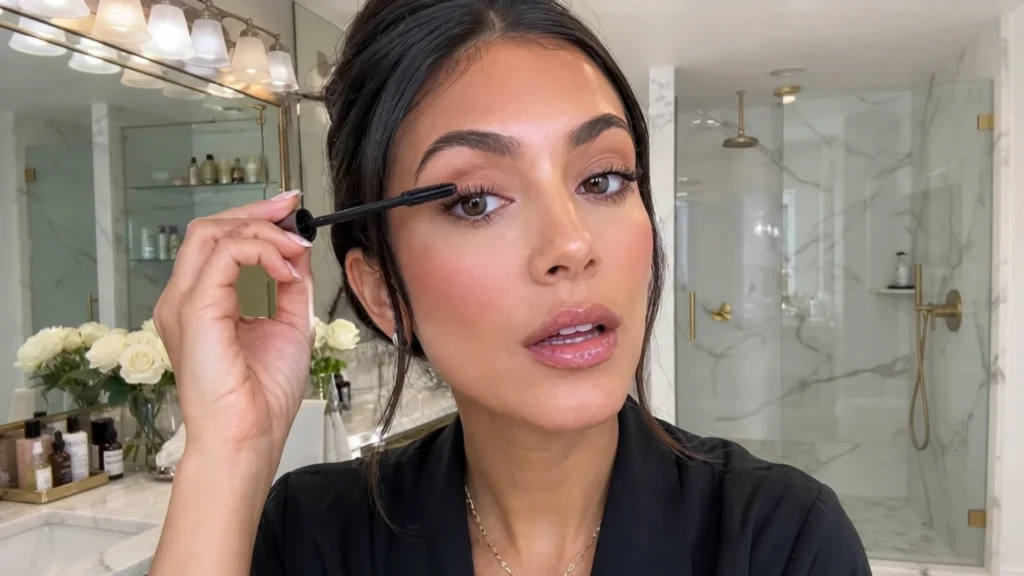
Here is the thing nobody says out loud in a Mascara ad. Most of the length you are trying to buy is already on your face. The last 2 millimeters of every one you own are pale and half transparent, so they disappear against your skin, and a good chunk of the rest are stuck to a neighbor and reading as one thick hair instead of 2 thin ones. Mascara does not grow anything. It darkens what is invisible and it separates what is stuck, and that is the entire trick.
Which means the tips below are not equal. A few of them change the result. Most of what gets published changes almost nothing. And a couple of the popular ones are quietly working against you.
| Why lashes look shorter than they are | What fixes it |
|---|---|
| Pale, see-through tips | Coating the last 2 mm, or a tint |
| Lashes stuck together in clumps | Separating them, which reads as more lashes |
| Lashes growing down and forward | Curl before mascara, never after |
| Too much product weighing them flat | Wiping the wand |
The Moves That Do Most of The Work
Wipe the Wand Before It Goes Near Your Face
The wand comes out of the tube carrying far more product than a hair can hold, and the excess is what clumps, what flakes by 3pm, and what makes one heavy enough to drop its curl by lunchtime.
Wipe it on the inside rim on the way out, or on a tissue. Both sides. You want the bristles visible and a thin film on them, not a loaded brush.
This single habit does more for separation than any technique underneath it, because separation is what “fuller” means optically. 40 separated hairs read as more than the same 40 glued into 12 spikes.
Curl First, and Never After
A curler works by bending the hair while it is still flexible. Once the product has dried on it, that hair is wearing a film that has set, and clamping a set film means it cracks and takes some of what is underneath with it.
So the order is curler, then mascara. If you have already applied and the curl has dropped, the fix is not the curler. It is to leave it and do better tomorrow.
On heated curlers, the American Academy of Ophthalmology flags the burn risk directly and says to check the exact temperature of each setting and start with the lowest one available. That is a device sitting a few millimeters from an open eye, and the lowest setting is usually enough for a hair that has not been coated yet.
Get to the Base, and Know the Caveat
Every tutorial on the internet tells you to push the wand into the roots and wiggle. There is a reason for it. The base is the thickest part of the hair, and coating it dark creates a shadow along the lid that reads as density, which is where most of the “fuller” comes from.
Here is the part those tutorials leave out. The AAO’s instruction on eye makeup is the opposite one: “Always apply makeup outside the lash line, away from the eye, to avoid blocking the oil glands.” Those glands sit along the rim of the lid and they produce the oil layer that keeps the tear film from evaporating. Block them often enough and you get the gritty, dry-feeling eyes that a lot of people put down to screens.
Both things are true, and the answer is not to pick a side. It is to aim. Start the wiggle at the base of the hairs and not on the rim of the lid behind them, which is a difference of about a millimeter and is entirely doable once you know it is the thing you are aiming for. The waterline is not a place mascara belongs at all.
Layer While the First Coat Is Still Wet
A second coat over a dry first one sits on top as a separate shell, which is how you get flaking and that spiky look.
Go back in within about 15 seconds, while the first coat is still tacky, and the 2 merge into a single thicker film on the same hair. Thicker coating is the only mechanism mascara has for “fuller,” so this is the tip that does the most for volume.
More than 2 coats is where it usually stops helping and starts adding weight.
The Ones That Barely Move The Result
These come up in nearly every list. They are not wrong. They are small.
- Warming the tube in your hands. Slightly looser product, slightly smoother application. A wiped wand does more.
- Zigzagging the wand versus pulling it straight through. The wiggle at the base is doing the work. What the wand does on the way up makes very little difference.
- Powder between coats. The idea is that loose powder gives the second coat something to grip. It can add a little thickness. It also adds something dry to a film that already flakes, and around the eye that ends up as specks under the lower lid.
- Bottom lashes. A light pass looks balanced, a heavy one drags the whole eye down and transfers to your under-eye by mid-afternoon. Use whatever is left on the wand and stop.
- Buying a lengthening formula instead of a volumizing one. The wand shape is doing more than the name on the tube. A thin wand with short bristles separates. A big fluffy one deposits. Look at the brush, not the marketing.
The Ones Working Against You
Adding Anything to a Drying Tube
This is the most common “get more from your mascara” advice online, and it deserves its own warning. Saline, eye drops, water, contact lens solution. All of it gets recommended.
Here is why it is a bad trade. A study that followed 33 women using their own mascara found that 36.4% of the tubes had microbial growth after 3 months of daily use, mostly Staphylococcus epidermidis, Streptococcus species or fungi. The researchers recommended a 3-month maximum on a tube used every day, and noted that more frequent replacement may be warranted with further study.
That is a tube being used normally. Now add liquid to it, which dilutes whatever preservative system the formula had and gives everything already living in there something to grow in, and do it at the 3-month mark when contamination is at its highest. You are not reviving a tube. You are extending the life of a tube that was already on the clock.
The AAO’s line on this is one sentence: throw eye makeup away after three months and get new products.
Sleeping In It
The AAO calls this out specifically, noting mascara that can stick to the lashes. A coated hair rubbed against a pillow all night is one that snaps, and it takes months to come back, so the damage from a few careless nights is not visible until it is.
Take it off with something that dissolves the coating instead of something that drags it. Anything that involves rubbing is taking hairs with it.
Reaching for Waterproof by Default
Waterproof Mascara holds a curl better and it does not run, which is why it exists. The trade is that the same film that resists water resists removal, so getting it off takes more solvent and more rubbing than the regular version of the same product.
Save it for the day it is needed, a wedding or a long humid afternoon, and run the regular formula the rest of the time.
When The Tube Is Done
3 months from the day you opened it, whatever is left inside. Write the date on the bottom in marker if you are the kind of person who cannot remember, because most people are.
The other signs it is finished: it smells different, it has gone stringy, or it dries mid-stroke before you have finished the second eye. None of those are fixable and all of them are your tube telling you the formula has changed.
If you find yourself fighting the same 2 things every morning, the curl dropping by noon and the tips still reading pale, those are the 2 problems that have a permanent answer. A lash tint at the salon runs from $20 and darkens the see-through ends that mascara is mostly there to hide, and a lash lift from $65 sets the curl for weeks so the curler comes out of your routine entirely. Extensions start at $75 for classic and $95 for volume if you want the density too.
None of that is necessary and the technique above is free, so run the technique first. But if you have been buying a new mascara every few months hoping the next one solves it, the thing you are trying to fix might not be a mascara problem.