Henna tattoo meanings grew out of generations of weddings, holidays and household custom, and even though a henna tattoo is a temporary plant stain instead of ink pushed under the skin, the shapes artists draw with it have stood for hopes like love, luck and safety for a very long time. Once you know the story behind a shape, picking a design stops being guesswork.
Fair warning before the list. There’s no rulebook for any of this. A motif can carry a different shade of meaning in Marrakech than in Mumbai or Muscat, something our look at mehndi design across different cultures gets into. The meanings below are the ones you’ll hear most.
Henna Marks The Days That Change A Life
Weddings get the lion’s share, with the bride’s henna night falling right before the ceremony. Families also bring out the cones for Eid, Diwali and engagements. In parts of North Africa and the Middle East, a woman who has recently given birth gets decorated to welcome the baby and guard the mother. Which motifs end up on the skin depends a great deal on which of these days it is.
Paisleys And Lotus Blooms Speak For Love
Paisley Signals Fertility And Prosperity
That curled raindrop shape, known as a mango or boteh, has decorated Persian and South Asian textiles for centuries. On henna it hints at fertility and prosperity, and bridal palms tend to be stuffed with them.
The Lotus Means Purity Rising Above Hardship
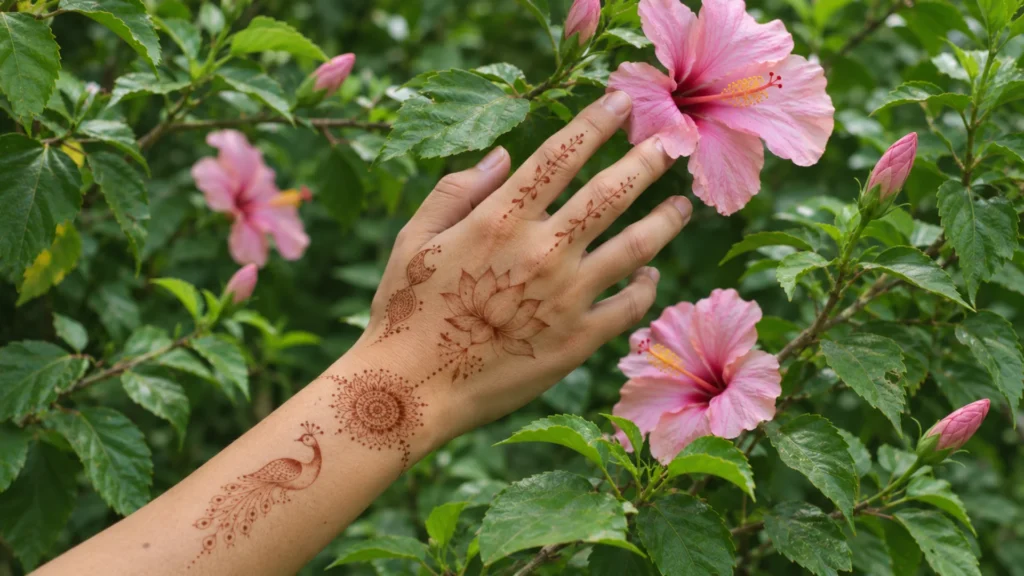
A lotus pushes up through murky pond water and unfolds untouched by the mud. Hindu and Buddhist traditions turned that into a sign of purity, grace and inner awakening. A single bloom in the hollow of the palm says a lot without crowding the hand.
Wedding henna can also tell the couple’s story outright. Some Indian bridal designs feature a pint-sized bride and groom, or a doli, the carriage that carries the bride off to her new home. Others slip the pair’s initials into the linework as a game for the groom. That touch suits even the new mehndi designs for the minimalist bride.
Eyes, Hands And Knots Are Drawn To Ward Off Harm
Much of henna’s folklore revolves around the evil eye, the belief that a jealous glance can bring misfortune.
- An eye drawn on the skin is meant to bounce the envy back where it came from.
- The open palm called the hamsa or khamsa, familiar across North Africa and the Middle East, works as a shield.
- Old Persian knotwork was thought to snare evil before it touched the wearer, and sweethearts traced knots on one another to stay tied together while apart.
Moroccan artists layer on diamonds, triangles and crosshatching linked with baraka, a blessing of good fortune. Expectant mothers and new moms in some regions are painted with these for the same protection.
Vines, Flowers And Butterflies Celebrate Growth
Creeping vines and leaves read as devotion and lasting vitality, lives woven together and still growing, and you’ll see them snake from fingertip to wrist. Flowers in general signal happiness. Buds suggest a fresh start, fitting for a birthday or a new chapter. The butterfly, a newer favorite, marks change and transformation.
A Mandala Holds The Whole Universe In A Circle
The word itself is Sanskrit for circle. In Hindu and Buddhist practice the mandala maps the cosmos and the idea of completeness, every ring balanced around a single center. People drawn to it are frequently after calm more than a celebration.
Animals Carry Wisdom, Beauty And Freedom
Creatures show up in henna for their own reasons:
- The elephant brings good fortune and wisdom, tied to Ganesha, the Hindu deity who clears obstacles, and it’s a common choice before a move or a new job.
- The peacock stands for beauty and romance, and its sweeping tail fans across countless bridal palms.
- Birds in flight suggest freedom and messages carried between heaven and earth, while the dove keeps its familiar meaning of peace.
Choose A Symbol For The Story Or For The Shape
Neither choice is wrong. Some people build an entire design around 1 motif that means something to them, an elephant before a big move or a lotus for a wedding. Plenty of others go purely by what catches their eye. That’s a tradition of its own, because henna has always been as much about beauty as belief.
Heading to a religious or cultural celebration? Let the hosts guide what goes on your skin. A deity or a sacred sign can feel out of step at a casual get-together.