
If your eyes are the sensitive sort, ypu must know about hypoallergenic eye makeup you already know the drill. A mascara looks perfect going on and it’s flaking down your cheek by lunchtime. A liner glides on like a dream and has you blinking back tears an hour later. Even a soft, innocent-looking eyeshadow can sting the moment a bit of powder drifts somewhere it shouldn’t. It wears you down after a while, and it’s why half the people who sit in my chair say they’ve started buying anything that says “hypoallergenic” on it.
I get the appeal. The word sounds like a promise. It just isn’t one. Over in the US there’s no fixed legal meaning for “hypoallergenic” on cosmetics a brand can stamp it on to suggest the product is less likely to upset you, but nobody’s making them pass a particular test first. Treat it as a gentle hint, not a guarantee, and you’ll save yourself a lot of disappointment.
Honestly, after years of looking at irritated eyes for a living, my advice is far less glamorous than the packaging: read the ingredients, watch how a product behaves on you, keep the stuff clean, and bin anything that keeps misbehaving. Your eyes are a better guide than any label.
What Hypoallergenic Eye Makeup actually means
When a mascara, liner, shadow, primer or brow product gets called hypoallergenic, it usually just means it was put together with easily irritated people in mind. It does not mean allergy-free. I’ve watched the exact same product be perfect on one person and leave the next one red, itchy and swollen everyone’s different, and even a carefully made formula can hide the one thing your eyes happen to hate.
People also tend to hear more in the word than it’s actually saying. Hypoallergenic doesn’t automatically mean fragrance-free, or preservative-free, or safe in contact lenses, or ophthalmologist-tested, or fine for every sensitive-eyed person on earth. Those are all separate claims, and a product only carries the ones it actually earns. So turn it over and read the whole list instead of trusting one word on the front.
Irritation and allergy aren’t the same thing
This is the one I end up explaining most. When someone shows me a “reaction,” it’s usually not an allergy at all. More often it’s mechanical loose powder or mascara flakes getting in, glitter fallout, a bit too much rubbing at removal time, or an old product that’s gone quietly rancid. Dry eyes make the whole lot worse, which is why a makeup that was fine all summer suddenly feels like sandpaper in a dry, over-heated flat come January.
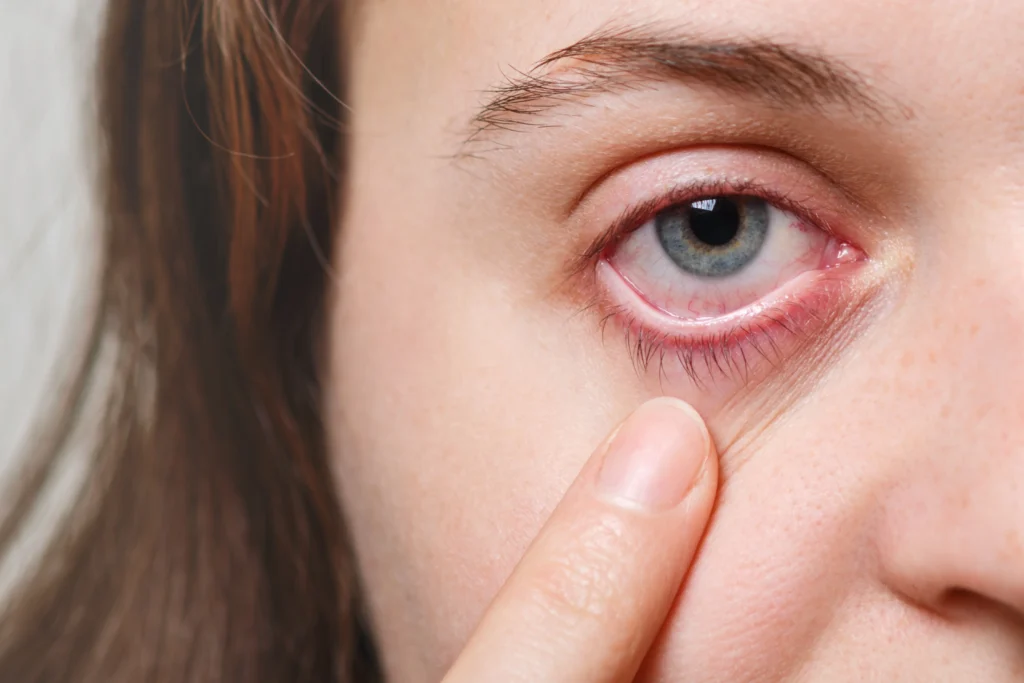
Whatever the cause, your eyes aren’t shy about telling you. You’ll get some mix of redness or watering, itching, a burning or stinging feeling, puffy lids, dry flaky skin around the eye, or discomfort that starts up soon after you’ve put something on. If those same symptoms turn up every time you reach for one particular product, that’s your answer stop using it. The catch is it points the finger at the product, not necessarily at which ingredient inside it is the troublemaker.
Let the Ingredient List Talk
The back of the box is usually more useful than the claims on the front. Use this simple comparison method whenever a product causes a reaction.
| Step | What to Do | Why It Helps |
|---|---|---|
| 1. Save the ingredient list | Take a clear photo before throwing the product away. | You may need it later for comparison. |
| 2. Record the reaction | Note what happened, when it started, and how long it lasted. | This helps you spot repeated patterns. |
| 3. Compare safe products | Check the ingredients in products you use without irritation. | It helps separate possible triggers from ingredients you already tolerate. |
| 4. Look for repeats | Identify ingredients that appear in several products that caused problems. | Repeated ingredients can give you a useful lead. |
| 5. Keep the evidence | Save the photos and notes in one folder on your phone. | You will have clear information to show a dermatologist or eye-care professional. |
A repeated ingredient does not prove that it caused the reaction, but it gives you a sensible place to start.
Go for formulas that stay put
With sensitive eyes, how a product behaves matters every bit as much as what’s in it. Loose glitter, shimmer and powder fallout drift straight into the eye and set it off, even when the formula itself is perfectly innocent. So I usually steer sensitive-eyed clients toward things they can actually control pressed or cream shadows over loose powder, a mascara that won’t flake, a liner that doesn’t drag, formulas that hold steady when your eyes water instead of bleeding into them. It’s the same “match it to your skin” thinking behind our everyday makeup routine for all skin types.
Here’s one that catches people out: waterproof and long-wear aren’t always the gentle option. They last, sure, but a lot of them need a heavier remover and a good rub to shift, and for touchy eyelids the removal is usually where the real harm happens. If you’re scrubbing to get something off, it’s probably the wrong formula for you, full stop.
Try one new thing at a time
Throw three new products on at once and working out which one wronged you becomes impossible. Keep everything else in your routine exactly the same and trial one new item on its own. Give it a few hours first rather than betting a whole day on it.
As you wear it, just notice the obvious stuff how it feels going on, whether your eyes start watering, whether it flakes or shifts about, how things feel a few hours in, whether taking it off stings, and how your lids feel when you wake up. Tap a quick note into your phone: name, date, what happened. It feels fussy until you’re stood in a shop six months later trying to remember which mascara turned your eyes into taps.
Keep it clean
Good hygiene counts everywhere, but it really counts this close to the eye. Wash your hands before you start, give reusable brushes a regular clean, and never, ever share mascara, liner or eye brushes that’s about the fastest way to pass an infection back and forth between two people.
Mascara’s the one to watch. That wand goes in and out of the tube over and over, bringing a little more bacteria back with it each time. Most should be swapped out every two to four months, though follow whatever the maker says, and ditch it sooner if it smells off, the texture’s changed, it’s dried up, the wand looks grubby, you used it through an eye infection, or it’s simply started annoying you. And whatever you do, don’t revive a dry tube with water or spit it feels resourceful, but you’re piping bacteria straight in and knackering the preservatives that were keeping it usable.
Apply and remove gently
Technique matters too. Clean tools, and keep everything away from the inner eye if lining your waterline sets off watering or burning, just keep to the outer lash line and leave it at that. Don’t do your eyes in a moving car either; one speed bump and a pencil ends up somewhere genuinely nasty.
Removal is where I see most of the self-inflicted damage. Don’t scrub at it. Hold the remover on a closed lid for a few seconds, let it actually dissolve the makeup, then wipe gently. If a formula demands a hard scrub to budge, take the hint: it isn’t built for sensitive eyes.
When to stop, and when to get help
Don’t bargain with mild discomfort. If something’s burning, itching, swelling or staying red, take it off. There’s no medal for “letting your eyes get used to it,” because they won’t they’ll just get crosser.
And learn the difference between a nuisance and something that needs a professional:
- Eye pain
- Blurred vision
- Sensitivity to light
- Discharge
- Severe swelling
None of those are normal makeup reactions, and none should be waited out get them looked at. Same goes if you keep breaking out in rashes around the lids; that’s worth proper allergy testing to nail the actual trigger rather than burning through brand after brand on guesswork.
How we handle sensitive eyes at EROthots
This “trust your eyes, not the label” thing is basically how we work at EROthots anyway. Beauty has no limits, but it has to be informed the right eye makeup for you comes down to your eyes and your skin, not a comforting word on a box. There’s no one product everyone with sensitive eyes should own. There’s only the one that sits happily on your lids and comes off without a wrestling match.
It’s why we lean toward well-made, easy-to-control products over big claims, and why we built a free, AAD-aligned skin-type assessment because knowing whether your skin runs dry, oily or sensitive tells you a lot more about how your lids will behave than any front-of-pack promise. Our lash and brow team works around sensitive eyes all day long, so if mascara, liner or extensions have let you down before, we can help you find something that actually agrees with you in the salon or at your door. And if the trouble is really the skin around your eyes rather than the makeup itself, our take on skincare for sensitive skin is a useful next read.
So what do sensitive eyes really need?
Not a perfect label. They need products that feel comfortable, stay clean, behave themselves, and come off easily. “Hypoallergenic” can help you narrow things down, but it should never be the only reason you trust something.
Read the list. Test one thing at a time. Replace tired mascara. Steer clear of loose fallout. Take it all off gently. And more than any of that, pay attention to what your own eyes are telling you because when it comes down to it, you’re the one who knows what they can and can’t put up with.
Jerusa Cesar, Dermatologist I’m Jerusa Cesar, and I love helping people understand their skin better through my articles on erothotsd.com. As a skin expert, I share the real truth about skincare without all the fancy talk. My years of working with different skin types have taught me what truly works, and I enjoy breaking down complex skin problems into simple solutions. In my writing, I focus on everyday skin issues, from acne to aging, and share tips that actually help. I believe everyone deserves healthy skin, and I’m here to guide you through your skincare journey with advice you can trust and use right away.
This article is for general information and isn’t medical advice. If you’ve got eye pain, changes in your vision, or a reaction that won’t settle down, see a doctor, optometrist or dermatologist.