
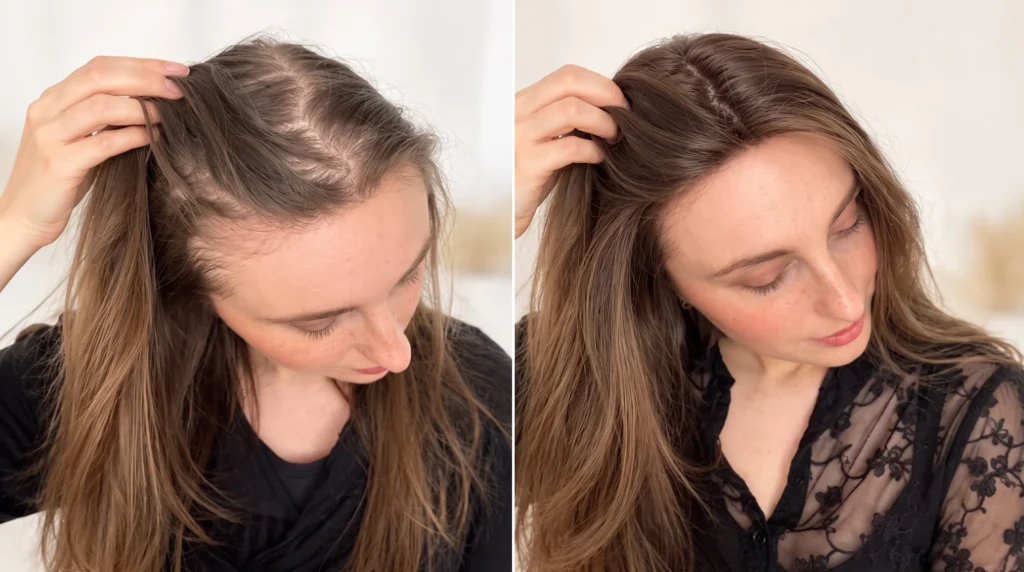
You catch a glimpse of yourself in an overhead mirror, and something looks different. Your part seems wider than it used to. The hair around your crown lies flatter, and under bright lighting, more of your scalp is visible.
Yet the rest of your hair still looks perfectly fine.
You like your current length, your usual part, and the way your hair frames your face. You don’t necessarily want a shorter haircut, a dramatic colour change, or a completely new hairstyle.
You just want the top of your hair to look a little fuller.
Fortunately, there are several ways to make thinning hair less noticeable without changing the style you already love. The best option depends on where the thinning occurs, how much coverage you need, and how much effort you’re comfortable putting into your daily routine.
Why Hair Thinning on Top Is So Noticeable
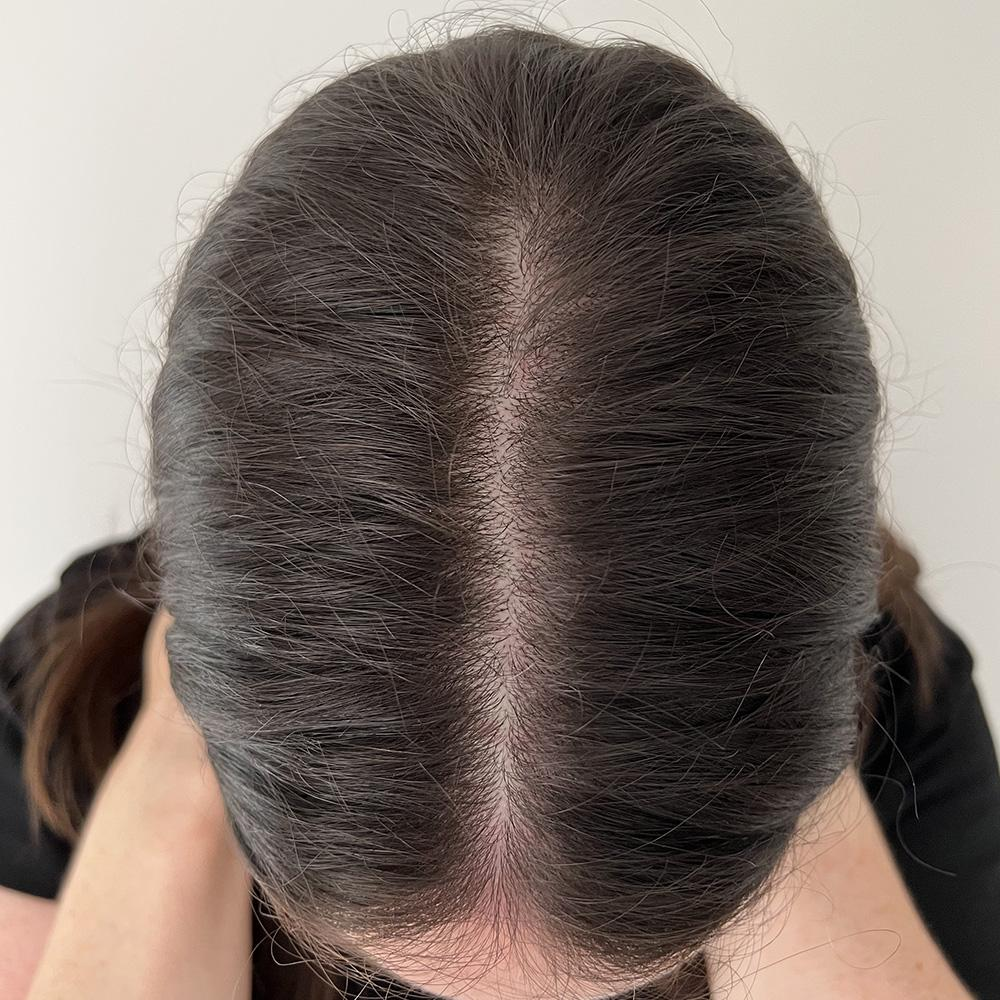
Hair thinning doesn’t always happen evenly.
For many women, changes become particularly noticeable around the parting line or crown. A widening part may reveal more scalp, while reduced volume at the roots can make the entire hairstyle appear flatter.
Lighting often exaggerates the effect.
Overhead office lights, bathroom spotlights, and direct sunlight can make scalp visibility more obvious than it appears in softer lighting.
Hair texture can also play a role. Fine, straight hair may separate into sections more easily, exposing the scalp even when there is still considerable hair coverage.
It’s worth remembering that visible scalp doesn’t always indicate significant hair loss.
However, if you’re experiencing sudden shedding, patchy loss, scalp irritation, or progressive thinning, a dermatologist can help identify possible causes and appropriate treatments.
Cosmetic solutions can improve appearance, but they don’t address the underlying reason for hair loss.
1. Start With Root Volume for Mild Thinning
If your hair is only slightly thinner around the crown, you may not need additional hair at all.
Sometimes, changing how you style the roots can create enough lift to reduce scalp visibility.
Try a Volumising Blow-Dry
Apply a lightweight volumising product to damp roots, following the product instructions.
Use a round brush or your fingers to lift sections of hair while drying.
Direct the airflow away from the scalp to encourage volume, using a comfortable heat setting.
Once the hair cools, gently arrange it into your usual style.
This technique can make fine hair appear fuller without changing the length or overall shape.
Avoid Heavy Products at the Roots
Rich oils, heavy conditioners, and excessive styling creams can weigh down fine hair.
When the roots become flat or separated, the scalp may appear more visible.
Concentrate heavier conditioning products on the mid-lengths and ends, unless the product is specifically designed for scalp use.
Best for: Mild thinning, naturally fine hair, and temporary flatness.
Limitations: Styling adds volume but cannot replace missing hair. Results may also fade in humidity or throughout the day.
Suggested before-and-after photo: The same person with mildly visible crown thinning, photographed before and after a root-lifting blow-dry. Keep the part, lighting, camera angle, and hair colour consistent.
2. Use Hair Fibers to Conceal a Visible Scalp

Hair fibers can be useful when you have thinning hair but still retain enough natural strands for the fibers to cling to.
These products generally contain tiny fibres that adhere to existing hair, creating the appearance of greater density.
They’re often used around widening parts, the crown, and small areas where the scalp shows through.
How to Apply Hair Fibers Naturally
Start with dry, styled hair.
- Apply a small amount to the areas where your scalp is most visible.
- Build coverage gradually rather than applying a thick layer immediately.
- Choose a shade that closely matches your roots.
If necessary, use a compatible holding spray according to the manufacturer’s instructions.
The goal is to soften the contrast between the hair and scalp, not create an unnaturally solid-looking patch.
When Hair Fibers Don’t Work Well
Fibers need existing hair to attach to.
If an area has very little hair, the result may look uneven or fail to provide adequate coverage.
They can also be affected by washing, rubbing, perspiration, and weather, depending on the formula.
Best for: Mild to moderate thinning with sufficient existing hair.
Limitations: Temporary coverage that requires reapplication and doesn’t add actual hair length or volume.
Suggested before-and-after photo: A close-up of a widening part before and after hair fiber application, using identical lighting and part placement.
3. Try a Hair Topper for More Noticeable Thinning
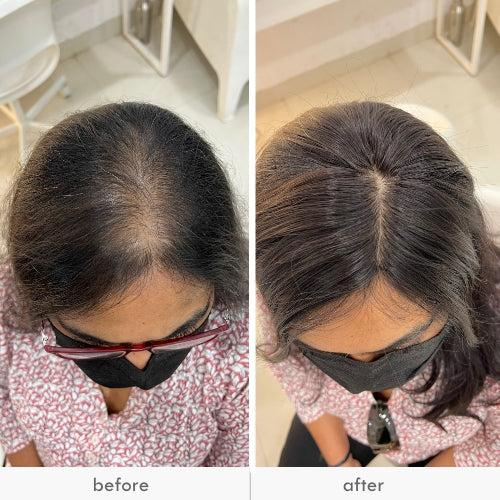
When root-lifting products and hair fibers no longer provide enough coverage, a hair topper may be worth considering.
A hair topper is a partial hairpiece designed to cover a specific area of the head, commonly the crown or parting region.
Unlike a full wig, it doesn’t necessarily cover all your natural hair.
Instead, it blends with the hair you already have.
That makes it particularly appealing if you want to preserve your current hairstyle.
You can continue wearing your usual length, colour, and general shape while adding coverage where you need it.
How Hair Toppers Create a Fuller Appearance
A topper typically includes a base with hair attached to it.
Depending on the construction, it may be secured using clips or another attachment method.
Once positioned, the topper’s hair blends with your natural hair to create a fuller appearance around the top of the head.
The result depends on selecting the correct base size, density, texture, and colour.
For someone whose thinning is concentrated around the part, a smaller topper may provide enough coverage.
More extensive crown thinning may require a larger base.
When comparing hair toppers for thinning hair, focus first on the size of the thinning area rather than simply choosing the longest or fullest-looking product.
A topper should extend sufficiently beyond the area you want to cover, with attachment points positioned on hair that can safely support them.
Best for: Moderate to more noticeable thinning concentrated on the crown or top of the head.
Limitations: Requires careful colour matching, blending, and secure attachment. Clip-in styles may not be suitable for very fragile hair.
Suggested before-and-after photo: A woman with visible crown thinning wearing her natural shoulder-length hairstyle, followed by the same hairstyle with a correctly fitted topper. Show both a top-down and front-facing view.
4. Choose the Right Topper Without Changing Your Hairstyle
The biggest concern for many first-time topper buyers isn’t whether the hairpiece will add volume.
It’s whether the added hair will look different from their own.
A topper that is too dense, too long, or noticeably different in texture may attract more attention than the thinning it was intended to conceal.
Match Your Existing Hair Length
If you wear a shoulder-length bob, you don’t need a waist-length topper.
Choose a length that blends with your current cut, or have a qualified stylist trim the topper to match.
A small amount of shaping around the face may help the added hair blend more naturally.
Match Texture, Not Just Colour
Two hairpieces can have almost identical colours but behave very differently.
Straight hair may not blend convincingly with naturally wavy hair unless you’re willing to style both together.
Similarly, a very glossy topper can stand out against naturally matte hair.
Consider how your hair looks on an ordinary day, not only immediately after a salon appointment.
Avoid Excessive Density
More hair isn’t always better.
If your natural hair is fine, an extremely dense topper may create a noticeable difference between the crown and the lengths.
A softer density often blends more naturally.
Pay Attention to the Base
Topper bases vary in construction, including lace, monofilament, silk-style designs, and combinations of materials.
Each has different characteristics relating to appearance, breathability, flexibility, and maintenance.
If you’re exploring the hair topper selection at TopUnique Hair, start by checking the individual product’s base dimensions and attachment method. Then compare its available colour, texture, and density with your own hair. These details will usually matter more to the finished appearance than a product photograph showing a perfectly styled model.
5. Which Method Works Best for Your Level of Thinning?
Not every woman with thinning hair needs the same solution.
The following comparison can help you narrow down your options.
| Hair concern | Option to consider | Main advantage |
| Slightly flat crown, little scalp visibility | Root-lifting styling | Uses your existing hair |
| Widening part with plenty of remaining hair | Hair fibers | Quick cosmetic scalp coverage |
| Noticeable thinning across the crown | Hair topper | Adds actual hair and coverage |
| Extensive thinning with limited secure attachment areas | Full wig or professionally assessed alternative | May avoid relying on fragile hair for clips |
These categories are general guidelines, not medical classifications.
Your preferred method also depends on comfort, lifestyle, budget, and the condition of your natural hair.
6. How to Make Crown Coverage Look Natural
Whether you’re using fibers or a topper, the small details often make the biggest difference.
Check the Result From Above
Most people style their hair while looking straight into a mirror.
But crown thinning is often most noticeable from above.
Use a handheld mirror or take a photograph of the top of your head to see how the coverage looks from another angle.
Test Different Lighting
A style that looks seamless in a softly lit bedroom may appear different outdoors.
Check the result near a window and under overhead lighting.
You don’t need perfection in every photograph, but you should feel comfortable with how the style looks in everyday conditions.
Keep the Hairline Soft
If you’re wearing a topper near the front of your head, avoid creating a harsh transition where the hairpiece begins.
Depending on the base construction, blending a little natural hair over the edge may help.
Don’t force fragile hair to cover an attachment point if doing so creates tension.
Don’t Ignore Comfort
A topper should feel stable without pulling painfully on your natural hair.
If clips cause soreness, breakage, or persistent tension, stop using that attachment method and consult an experienced stylist or hair-loss professional.
7. Think About Your Daily Routine Before Choosing
The most natural-looking solution isn’t always the most practical one.
Hair fibers may be convenient for someone who wants occasional coverage before work or a social event.
A topper may suit someone who prefers consistent volume and doesn’t want to recreate that appearance with styling products every morning.
But a topper also requires maintenance.
You’ll need to detangle it, clean it appropriately, and store it carefully.
Human hair toppers may offer styling flexibility, but they can still become dry or damaged through repeated heat styling.
Synthetic toppers may retain their shape more easily, although styling options depend on the fiber.
Before buying, consider how often you’ll wear the hairpiece and how much preparation you’re willing to do.
The right solution should simplify your routine rather than introduce another source of stress.
How to Photograph a Realistic Before-and-After Comparison
Before-and-after photos can be helpful when comparing crown coverage methods, but only if they’re presented fairly.
For an accurate comparison, use the same person, hairstyle, lighting, camera position, and hair condition in both images.
Avoid changing the part, adding extra styling products, or using different lighting between photographs unless those changes are explicitly part of the method being demonstrated.
A useful comparison would show three separate results: the untreated thinning area, the appearance after using hair fibers, and the appearance after fitting a topper.
Include a top-down view because that is often where the difference is most noticeable.
Realistic comparisons should help readers understand what each method can achieve—not promise that every person will get identical results.
Final Thoughts: You Don’t Have to Give Up the Hairstyle You Love
Noticing thinner hair around your crown or a widening part can be unsettling, especially when the rest of your hairstyle still feels like you.
But concealing thinning hair doesn’t have to mean starting over.
For mild concerns, a few changes to your styling routine may be enough.
Hair fibers can help reduce visible scalp where existing hair provides adequate support.
And when you need more coverage, a carefully chosen hair topper can add fullness while allowing much of your natural hair to remain visible.
The key is matching the solution to the actual problem.
You don’t necessarily need a different haircut, more dramatic volume, or a completely new look.
Sometimes, all you need is a little extra coverage in the right place.