
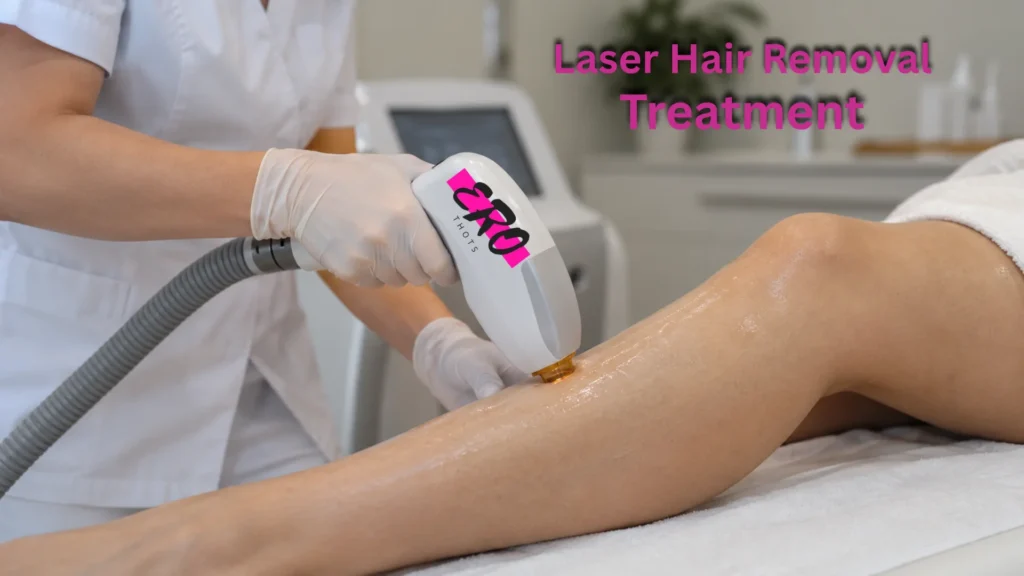
Laser hair removal only damages a follicle while the hair growth cycle affects inside it is actively growing. Every other hair on your body during that session is untouched, whatever the laser machine or the operator.
That one fact explains most of what confuses people. Why a single session isn’t enough. Why hair comes back between appointments. Why your legs cleared in six sessions and your face is still going after ten.
Different Areas Need Different Numbers of Sessions
Which follows directly from the ratios above:
- High proportion in anagen, fewer sessions. Each appointment reaches more follicles.
- High proportion in telogen, more sessions. Each appointment catches a smaller slice.
- Face is its own case. Hormones drive facial follicles, so they cycle less predictably than legs or underarms, and that usually means more sessions for the same reduction.
If a provider quotes one session count covering your whole body, that number is an average. Ask for it broken down by the areas you’re treating.
Laser Needs the Hair Growth Connected to Its Blood Supply
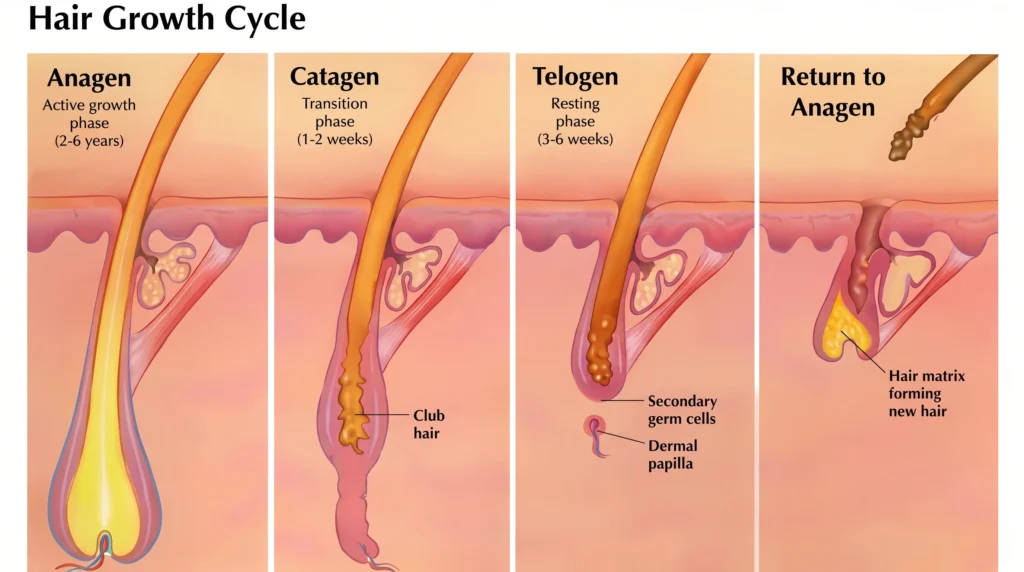
| Phase | What’s happening | Duration | Laser target? |
|---|---|---|---|
| Anagen | Actively growing, shaft attached to the dermal papilla, full of melanin | Varies by body area | Yes. The only one. |
| Catagen | Follicle regressing, hair detaching from the papilla | About two weeks | No. Connection is gone. |
| Telogen | Dormant, resting | Two to three months | No. Nothing to target. |
Laser light between roughly 600 and 1200 nanometers gets absorbed by melanin in the shaft, converts to heat, and the heat travels down to damage the structures that generate new hair. That path only exists in anagen.
So a session doesn’t treat your leg. It treats whichever hairs on your leg happened to be in anagen that morning.
The Gap Between Appointments Is Doing Work
The interval isn’t scheduling convenience, it’s waiting for the next wave of follicles to move into anagen, and there’s no proven way to hurry that along. Nothing you eat, apply or take moves hair from telogen into anagen on demand.
Go earlier than recommended and you waste a session on follicles that haven’t arrived. Go much later and some cycle through and out before you’re back in the chair.
Intervals differ by area, which is why the timing for a face is often different from the timing for legs.
Plucking and Waxing Between Sessions Removes the Target
The most actionable thing on this page, and the easiest to get wrong.
- Shave. Cutting at the surface leaves the shaft and follicle intact, which is exactly what the laser treatment needs.
- Don’t pluck, wax, thread or epilate. All four pull the hair out of the follicle, and the shaft is the only thing the laser can act on. Remove it and the follicle sits through your appointment untouched.
Stop waxing and plucking well before your first session, not the week of it.
The Cycle Doesn’t Help If There’s No Pigment to Target
Laser reads melanin. No pigment, no absorption, no result, regardless of timing.
Hair colors that respond poorly or not at all:
- Blonde.
- Red.
- Gray.
- White.
Health Canada frames it plainly. Laser hair reduction works best on light skin with dark hair, requires multiple sessions and carries no guarantees, with achievable permanent reduction put at around 30%.
If your hair is light, raise this at consultation rather than after a package is paid for. Electrolysis works regardless of hair color, since it doesn’t rely on pigment at all.
Laser Can Sometimes Increase Hair Growth, and It Has a Name
Paradoxical hypertrichosis. Fine vellus hairs in or around the treated area turn into thicker, darker terminal hairs, which is the opposite of the intended result.
Uncommon, but documented in the dermatology literature for decades;
| Study | Patients | Rate found |
|---|---|---|
| Systematic review and meta-analysis | 9,733 | 3% pooled |
| Range across individual studies | Various | 0.6% to 10% |
| Single-clinic retrospective | 7,381 | 0.34%, with 24 of 25 cases from alexandrite lasers |
Risk isn’t spread evenly. It runs higher on the face and neck, in Fitzpatrick skin types III through VI, and in people with hormonal conditions. In that single-clinic study, daily sun protection was associated with a significantly lower incidence, independent of skin type. Some clinics decline to treat facial hair at all because of this.
The leading theory is that heat below the threshold needed to destroy a follicle can instead stimulate nearby dormant ones.
Not every increase in hair is this, though. Aging, medication, pregnancy, menopause and normal cycling all produce new growth that would have appeared anyway, and telling them apart takes a proper assessment.
Three questions to ask at consultation:
- Which laser do you use, and why that one for my skin tone?
- Do you adjust settings by treatment area?
- What happens if I notice more hair after starting?
Hormonal Conditions Keep Making New Follicles
The whole cycle model assumes a fixed set of follicles rotating through phases. Hormonal conditions break that assumption.
PCOS, nonclassical congenital adrenal hyperplasia and similar conditions keep recruiting new growth, so hair can appear in treated areas after a completed and successful series. That’s new follicular activity, not the original treatment failing. These conditions also carry elevated paradoxical hypertrichosis risk, which puts them in both categories at once.
If you have a diagnosed hormonal condition, or suspect one, speak to your physician before starting a series.
The Biological Mechanism of Laser Hair Removal

From a dermatological perspective, patient education regarding the hair growth cycle is the single most critical factor in managing expectations and achieving long-term success. Laser hair removal is not a one-time treatment precisely because of human follicular biology.
The procedure relies on selective photothermolysis, where specific wavelengths of light target melanin within the hair follicle. This light energy converts to thermal energy, effectively disabling the germinative stem cells responsible for hair regeneration. However, this process can only permanently destroy the follicle during the anagen phase, when the hair shaft is physically connected to the dermal papilla.
Because only a fraction of body hair is in the anagen phase at any given time, a series of strategically spaced treatments is physiologically mandatory. Adhering to the clinical timeline recommended by your practitioner ensures that successive waves of hair are caught at their most vulnerable stage, maximizing overall clearance and efficacy.
Medical Reviewer: Dr. Cesar, Dermatologist, EROthots Salon. This section has been clinically reviewed for anatomical accuracy and medical alignment regarding selective photothermolysis and follicular biology.