

Most people are running the wrong routine for their hair and don’t realise it. They buy the product with the nicest bottle, or the one a friend swears by, and then wonder why it falls flat or frizzes up by noon.
Almost every hair problem I get asked about comes back to the same gap. People don’t actually know their hair type. Once you get that part right, most of the rest starts to sort itself out.
The four types, and the letter that matters
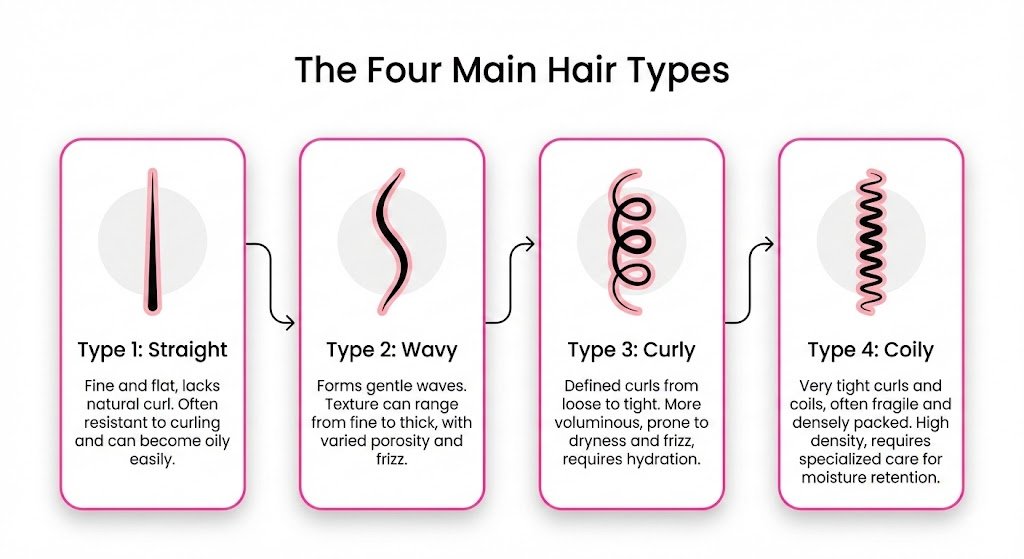
Hair falls into four broad families based on the shape of the strand.
| Type | Pattern |
|---|---|
| Type 1 | Straight |
| Type 2 | Wavy |
| Type 3 | Curly |
| Type 4 | Coily |
That much is well known. What actually changes your routine is the letter that comes after the number, the A, B, or C, which tells you how fine or coarse the strand is and how loose or tight the pattern runs.
A 2A and a 2C are both wavy, but they need almost opposite amounts of product. Miss the letter and you’ll keep buying things that suit your type on paper and do nothing for the head you’ve actually got.
Type 1: Straight Hair
Straight hair has no wave or curl to it. The cuticle lies flat, which is why it catches the light and looks shiny, and it ranges all the way from fine to thick and coarse.
For fine straight hair, the thing working against you is weight. People assume richer, heavier products mean healthier hair, and instead the whole thing goes flat by mid-morning. The fix runs against the instinct. You go lighter, not heavier.
- Use a gentle, sulfate-free shampoo.
- Condition the mid-lengths and ends, never the roots.
- Skip the heavy oil-based products that drag fine hair down.
- Always put heat protection on before any styling tool.
- Brush with a soft bristle so the scalp’s natural oils travel down the length.
Type 2: Wavy Hair
Wavy hair sits in the middle, a soft S-shape that runs from a loose bend to a properly defined wave. It tends to be thicker than straight hair, and it frizzes at the first excuse.
The main thing I tell wavy-haired people is that they’re handling it too much and piling on too much product. Waves do best when you leave them alone. Every time you run your fingers through while it dries, you break the pattern and swap the wave for frizz.
- Wash with a sulfate-free, moisturizing shampoo.
- Condition from the mid-lengths to the ends.
- Detangle it wet, with a wide-tooth comb, working up from the ends.
- Scrunch it dry with a microfiber towel or an old cotton t-shirt.
- Work a light product through damp hair, then air dry or diffuse, and leave it be.
Type 3: Curly Hair
Type 3 is a defined curl, anywhere from a loose spiral to a tight corkscrew. The cuticle lifts instead of lying flat, so curls dry out and snap more easily than straighter hair. With Type 3, moisture is more or less the whole job.
The damage I get asked about most is from daily straightening. It’s gradual, so nobody clocks it while it’s happening. Then one day the curl won’t bounce back in a few spots, because the strand has been cooked flat one pass at a time. If you straighten every day, that’s the first habit to change, ahead of any product.
- Cleanse with a sulfate-free, curl-friendly shampoo, or co-wash if your hair runs very dry.
- Deep condition weekly.
- Detangle it wet, with a leave-in for slip.
- Style with cream or gel on soaking-wet hair, scrunching upward.
- Diffuse on low or air dry, and keep your hands off it while it dries.
Type 4: Coily Hair
Type 4 is a tight coil or a zigzag, dense and springy, and it’s the most fragile hair of the four. It looks tough and it really isn’t. Those tight bends are weak points, and the coil shape keeps the scalp’s oil from travelling down the strand, so it dries out fast.
I’ll be straight with you here. I don’t have coily hair myself, and the deepest knowledge on Type 4 belongs to the people who live in it every day. What holds true across the board is simple enough: build the routine around moisture, and handle the hair as little as you can.
- Wash gently, sulfate-free, every one to two weeks.
- Deep condition with something rich after every wash.
- Detangle wet only, with oil or conditioner for slip.
- Seal the moisture in with a heavier cream or butter.
- Cover it with satin at night to stop friction breakage.
Problems that cross every type
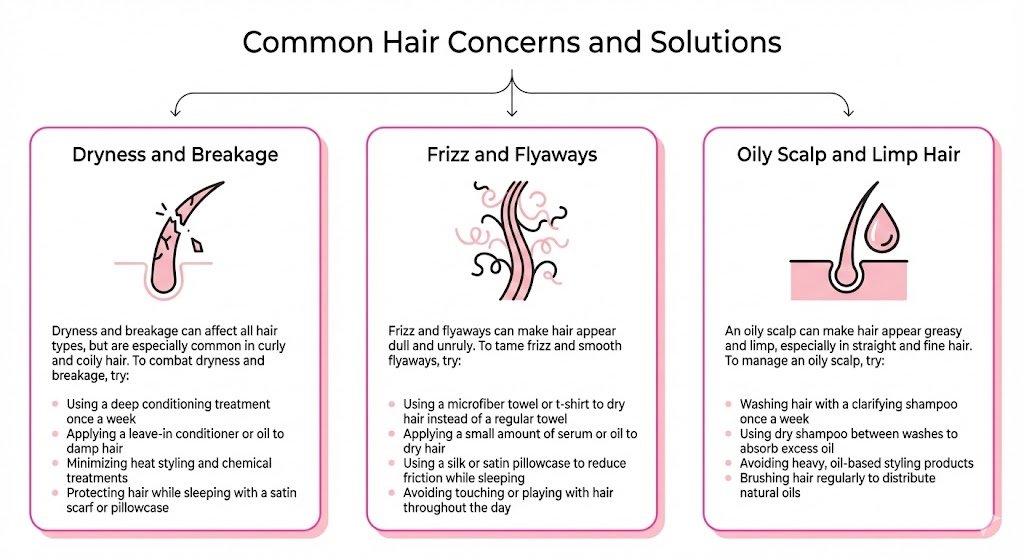
Some issues don’t care what type you have
Dryness and breakage hit curly and coily hair hardest, but any over-processed hair gets there in the end. Weekly deep conditioning, a leave-in on damp hair, less heat, and a satin pillowcase will handle most of it.
Frizz comes down to moisture and friction. Dry hair pulls water out of the air and swells, and that’s the frizz. Switch to a microfiber towel, work in a little serum, and sleep on satin.
An oily scalp with limp lengths is the fine-hair version of the same story. Clarify once a week, use dry shampoo to stretch the gap between washes, and ease off the heavy products. Brushing helps too, since it carries the oil off the scalp and down the strand where it’s actually doing some good.
A routine you’ll actually keep
Keep it simpler than you think it needs to be
| Step | What | How often |
|---|---|---|
| Cleanse | Shampoo or co-wash | Every two to seven days |
| Condition | Conditioner | Every cleanse |
| Deep condition | Mask or treatment | Weekly, or as needed |
| Style | Leave-in, cream, or oil | Daily or as needed |
| Protect | Heat protectant, satin scarf or pillowcase | Daily or nightly |
What works for your friend might do nothing for you, because their hair isn’t yours. The type system is really just there to point you in roughly the right direction so you’re not guessing in the dark.
Tools that matter more than people expect
Go for soft, stretchy ties. Satin or silk scrunchies won’t snag or dent the hair the way a tight elastic does, so keep clear of rubber bands and anything that bites in.
A wide-tooth comb suits most types on wet hair. A boar bristle brush adds shine on straight and wavy hair, while curly and coily hair generally do better with fingers or a flexible detangling brush.
If you blow-dry, keep the dryer moving and use a setting with some adjustability. A diffuser earns its place on wavy and curly hair. For irons, ceramic or titanium beats cheap metal, the lowest heat that gets the job done is the right one, and you never put a hot iron on damp hair, because that steams the strand from the inside.
Habits that beat any product
Most of healthy hair isn’t sitting on a shelf.
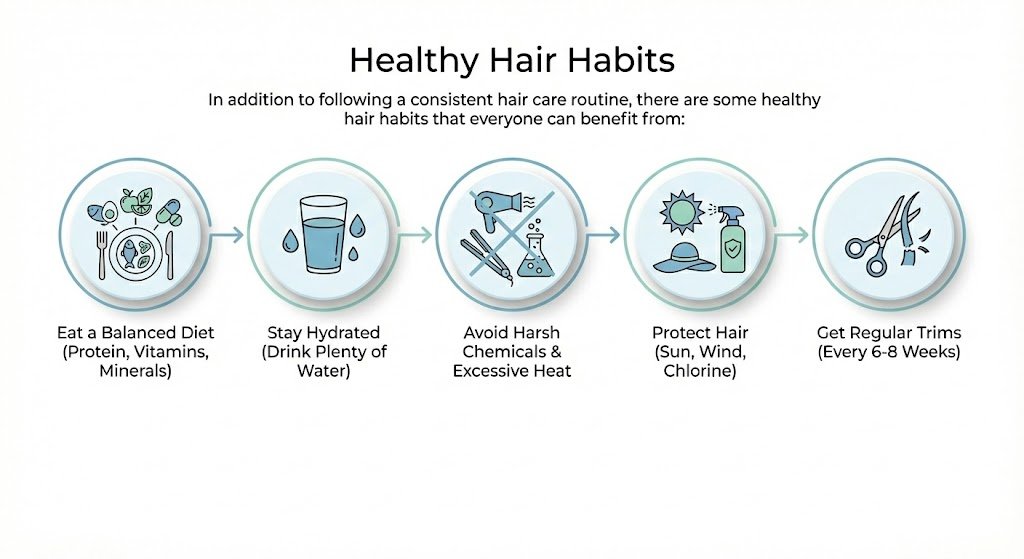
Eat enough protein, drink your water, go easy on chemical services and daily heat, and trim every couple of months so split ends don’t travel up the strand and cost you length.
Protective styles like braids, twists, and buns give the hair a rest from daily handling. They hold moisture and shield the ends. The one catch is tension, because a style pulled too tight stops protecting and starts wearing down the hairline. Gentle going in, gentle coming out.
Understanding your type was never about chasing perfect hair. It’s about stopping the small, daily damage you don’t notice you’re doing, and matching what you do to the hair you’ve actually got.