
Good makeup to cover up tattoos for a wedding you’re in, an interview that matters, a uniform that has rules, or just a day you’d rather your ink stayed nobody’s business but yours and all of a sudden you need a tattoo gone. The obvious move is to bury it under concealer until you can’t see it. And that’s precisely how you end up with a grey, cracking patch that announces “something’s being hidden here” louder than the tattoo ever did.
Here’s the thing nobody tells you up front: covering a tattoo well has almost nothing to do with how much makeup you use. It’s about the right products, in the right order, kept thin. Nail that and even dark, decade-old ink slips out of sight under what passes for ordinary skin. Miss it and you’re patchy by the time you’ve parked the car.
Why tattoos are hard to cover with makeup
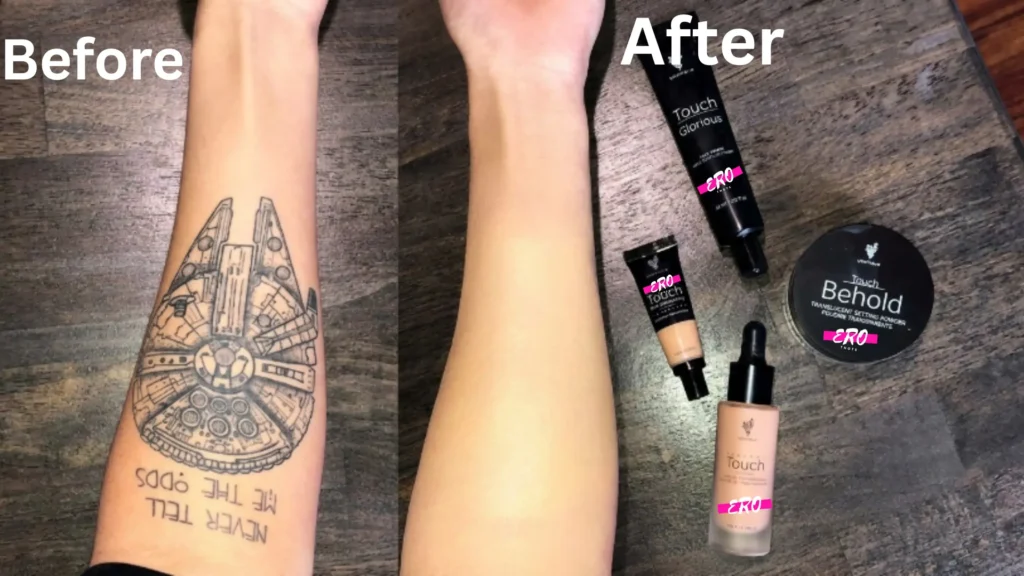
A couple of things are stacked against you. For one, the ink lives inside your skin rather than on top of it, so even a generous coat of concealer lets a faint blue or green shadow haunt through which is why piling on more never actually solves it. For another, ink tends to be dark and dense, and a skin-tone concealer on its own can’t cancel a dark colour. Smear it straight over black or blue-black and you just get a sad, muddy grey.
Both problems have the same answer, and it’s the step everyone races past: colour correction. Kill the colour of the ink first, and you’ll need barely any concealer over the top. That’s the actual trick to keeping the whole thing from caking.
What makes good makeup to cover up tattoos?
Before the technique, the products. Two qualities matter more than the brand on the tube pigment and grip. You want formulas dense enough to be opaque without going on thick, and ones that hold onto skin rather than sliding off the second you move.
That points you toward full-coverage, transfer-resistant concealers and dedicated body makeup. There are whole ranges built for this (Dermablend and KVD’s Lock-It come up the most), but for a smaller piece a heavy-duty full-coverage face concealer does the job fine. Sheer, dewy foundations are the wrong tool here they melt off fast, especially anywhere that rubs against clothing.
Prep the skin before you cover a tattoo
Cakey nearly always begins with thirsty or flaky skin, because makeup grabs onto every dry patch and shows it off. So before you touch any colour, clean the area and moisturise then wait a few minutes and let it properly sink in. You want the skin comfortable, not slick. If there’s still a sheen of moisturiser sitting on the surface, your makeup will slide around and split over it.
If the tattoo’s somewhere that sweats or rubs inner wrist, ankle, the edge of a neckline a thin coat of a grippy, oil-free primer gives everything something to cling to. Honestly, good prep does half the work, and it’s the same logic behind any makeup that lasts; our notes on skincare for sensitive skin walk through getting the surface right before a brush ever comes near it.
Colour-correct the ink first
This is the bit that decides whether you get a clean cover or a grey smudge. Colour correcting works on opposites from the colour wheel they cancel each other out so you’re matching the corrector to the tattoo’s colour, not to your skin.
| Tattoo ink colour | Corrector to use | Why it works |
|---|---|---|
| Black / blue-black (the usual) | Peach or orange | Warm tones knock out the cold blue cast that bleeds through concealer. Lighter skin → peach; deeper skin → true orange. |
| Green | Red | Red sits opposite green and cancels it. |
| Blue | Orange | Orange counters blue head-on. |
| Red / pink (or redness round fresh ink) | Green | Green neutralises red. |
| Purple | Yellow | Yellow sits opposite purple. |
| Faded grey/blue old tattoos | Peach | Still needs a hit of warmth to lift the dullness first. |
Put the corrector only on the ink itself, press it in with a fingertip or a small dense brush, and build it just enough to mute the colour you’re not chasing full coverage yet, only taking the loudness out of it. Then set it with a whisper of translucent powder before you carry on. That little powder beat between layers is a huge part of why the finish stays thin instead of turning to cake.
Build your concealer in thin coats
Right, the coverage proper. Grab your full-coverage, high-pigment concealer or body foundation and treat it gently. The rule that matters most: thin coats, set between each one. Pat never drag a light layer over the corrected patch, let it settle, dust with powder, see where you are, then add more only where the ink still peeks through. Two or three barely-there layers cover better and read far more like skin than one thick slab ever could. A damp sponge is your friend here for pressing product in and sheering the edges so there’s no obvious line where makeup meets bare skin.
Blend the edges so the cover-up looks like skin
A cover-up almost always gives itself away at the borders, where a patch that’s a shade off bumps into your real skin. Match your concealer or body foundation to your actual tone in proper daylight (shop lighting lies), and feather the outer edge outward with a clean damp sponge so it melts away rather than stops dead. And if the covered bit looks flatter or more matte than everything around it, that contrast screams “makeup” a touch of the surrounding skin’s natural sheen, or just a lighter hand with the powder, keeps it honest.
Set your tattoo cover-up so it lasts
Once it looks right, make it stay. Press don’t sweep translucent setting powder over the lot, then finish with a setting spray, which both holds the layers together and cuts the transfer. For anything that’s going to take a beating a bare arm against a car seat, an interview’s worth of handshakes transfer-resistant body makeup plus a setting spray is what keeps the colour on you and off your white shirt.
Cover up tattoos without the cakey finish
Everything above is really aimed at this, but to spell it out, cake comes from a short list of avoidable slip-ups:
- Skipping the colour correction, then overloading concealer to make up for it.
- One thick layer where several thin ones belong. Thin wins, every time.
- Dry, unprepped skin the product cracks over.
- Over-powdering go light, or matte tips straight into chalky.
- Leaving the edges unblended so they sit on top of the skin.
Correct the colour, keep it thin, set as you go, blend the borders. That really is the whole job.
What makeup can and can’t do here
Makeup can make a tattoo basically vanish for a day, but be clear-eyed about it: it’s a surface fix. It’ll rub off if something scrapes it hard, and it won’t survive a swim or a proper workout without a waterproof formula and a touch-up. For a one-off event, it’s genuinely brilliant. For hiding ink every single day, long-term, weigh up the daily faff and the product you’ll get through against other routes. Think of makeup as the flexible, commitment-free option just go in knowing it’s a day’s answer, not a forever one.
How we cover tattoos at EROthots
When someone comes in before a big day wanting their ink hidden, the chat is always the same: it isn’t about smothering it in product, it’s about correcting and layering until it just looks like skin. Beauty has no limits, and that runs both ways it’s as much about choosing what you show, and when, as it is about adding anything. Whether you want a tattoo gone for an afternoon or simply want makeup that sits well and holds, the principles don’t change, and they’re the same ones behind our everyday makeup routine for all skin types: match it to your skin, prep properly, build it thin.
And if you’d sooner have it done for you when it really counts, our team can handle the cover-up in the salon or at your door, with the right coverage products for your tone and the spot you’re hiding. Sometimes the shortcut to a flawless finish is just letting someone with a steady hand and the right kit take over.
This article is for general information. If your tattoo is new, healing, raised, or irritated, hold off on covering it and let it settle first and see a doctor or dermatologist if the skin looks infected.
Nika Mariana, Fashion & Style Writer; Nika Mariana is a passionate writer at EROthots, where she’s been sharing her expertise in fashion and style for over three years. Nika specialises in crafting insightful guides and tips that keep readers up to date on the latest trends in the ever-evolving world of fashion. Her goal is to inspire and inform fashion enthusiasts, giving them the tools to stay stylish and confident.