
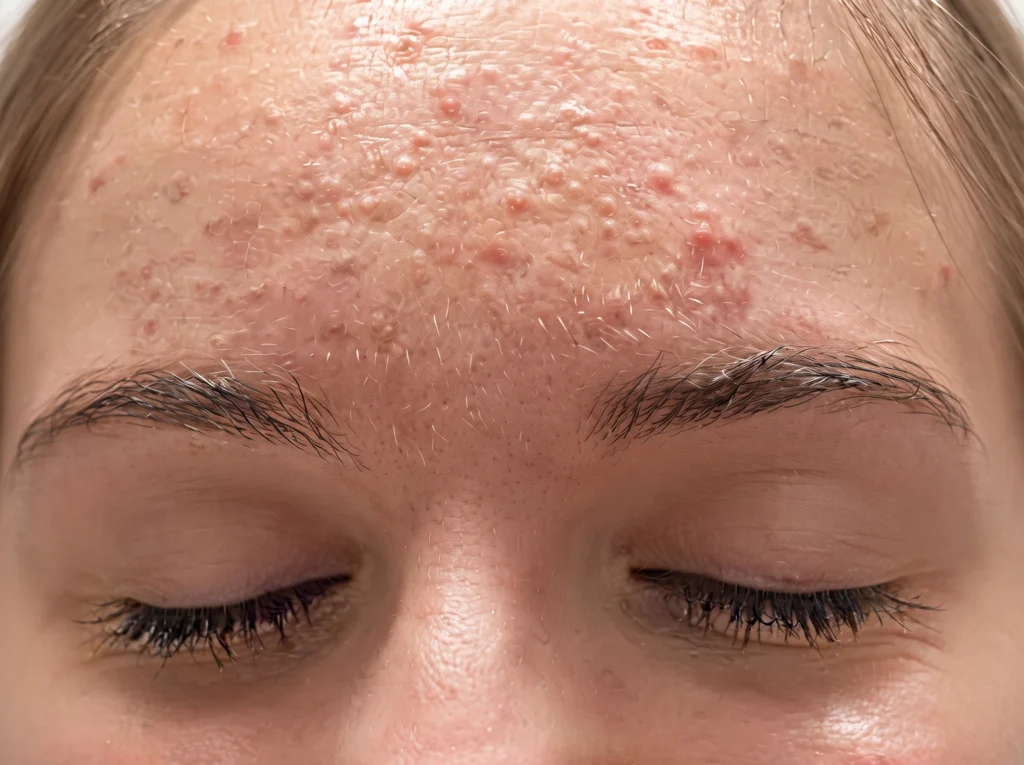
A fungal acne skincare routine has two parts, one for the morning and one for night. In the morning, you use a gentle cleanser, a light moisturizer with very little oil, and sunscreen. At night, you put an antifungal dandruff shampoo on your face, leave it for about 5 minutes, and rinse it off.
These bumps come from a yeast called Malassezia. It lives on everyone’s skin, and sometimes it grows too much inside the hair follicles. Acne washes and spot creams go after bacteria and oil, so they don’t do much against yeast. Below is the routine I would give someone starting today. The first month is a little different from the months after.
Make Sure The Bumps Are Fungal Acne Before You Start
First, check the bumps, because the shampoo does nothing for ordinary acne. The routine is only worth your time if the bumps fit. Fungal ones usually are:
- Small and nearly all the same size, around 1 to 2 mm across.
- Itchy, more so after sweating.
- Spread over the forehead, hairline, chest and upper back.
- Free of blackheads.
However, many people miss two other clues. The same yeast often causes flaking around the eyebrows, the sides of the nose or the scalp. If you already deal with dandruff, count that in favor. Also, a flare that started during a course of acne antibiotics counts. Those pills cut down the bacteria that normally keep the yeast in check.
When the signs are mixed, a dermatologist can settle it in one visit with a KOH test. They scrape a bump and check the sample under a microscope. In fact, I would get that done before committing to a month of shampoo. Plenty of people have fungal and regular acne at the same time, and both need treatment.
The Morning Routine for Fungal Acne Skincare
Wash with a gentle, low foam cleanser. Then apply a light gel moisturizer, or 2 or 3 drops of squalane if your skin runs dry. Finish with sunscreen.
Of course, the morning does not treat anything. Its job is to avoid feeding the yeast. For example, sunscreen is the product most likely to feed it by accident. Many formulas list plant oils, polysorbates or fatty esters like isopropyl palmitate near the top. As a result, I would read the sunscreen label first.
A zinc parathion bar soap can stand in for the cleanser if you want some antifungal help during the day. It is handy in the shower for bumps on the chest and back.
The Night Routine
At night you cleanse, use an antifungal shampoo on the face as a short wash off mask, and then moisturize. The shampoo treats the yeast, so do not skip this step.
Choosing The Shampoo
Pick by the active ingredient on the label. Look for one of these:
- Ketoconazole 1%. Drugstores sell it over the counter, and I would start with it. The 2% strength needs a prescription.
- Selenium sulfide. Works well, has a strong smell.
- Zinc pyrithione. The mildest of the 3.
Besides, they usually cost under $20. A face only needs a pea sized amount, so one bottle lasts a long time.
Using It On The Face
- Take off makeup and sunscreen with your cleanser.
- Wet the skin and spread a small amount of lathered shampoo over the bumpy areas. Keep it away from the eyes.
- Leave it on for about 5 minutes. If you rinse it straight off, the antifungal gets too little time to work.
- Rinse well and put on your moisturizer.
You can follow the same steps in the shower for the chest and back.
If It Irritates Your Skin
Shampoo is a scalp product, so some tightness on the face in the first week is common. Cut the time to 2 or 3 minutes, go to every other night, and use a richer moisturizer. That usually fixes it. On the other hand, burning, peeling or spreading redness is another matter. Stop the shampoo until a dermatologist has seen it.
Ingredients To Keep Out Of Both Routines
Malassezia feeds on fatty acids, mainly those with a carbon chain 11 to 24 long. A lot of skincare oils and esters break down into exactly those. Therefore, even a moisturizer with “gentle” on the label can keep the bumps going.
While the bumps are active, I would leave out:
- Most plant oils, including olive, avocado and sunflower.
- Polysorbates 20, 60 and 80.
- Fatty esters such as isopropyl myristate and isopropyl palmitate.
- Fermented extracts like galactomyces, though opinions on these are split.
Squalane, caprylic/capric triglyceride (MCT oil), mineral oil and petrolatum are safe for most people. So are glycerin, hyaluronic acid and niacinamide. Most of this comes from lab studies of what the yeast eats. However, large patient trials have not tested it, so I use it as a guide when choosing products.
How Long To Keep The Routine Going
Use the shampoo most nights for the first 4 weeks, or every other night if your skin needs a break. By the end of that stretch the bumps have usually flattened.
After that, cut back but do not stop. The yeast is still on the skin, and the bumps nearly always come back once treatment ends. Once or twice a week keeps them down for most people.
If nothing has improved after 4 weeks, see a dermatologist. Stubborn cases often respond better to a short course of antifungal tablets first. The yeast sits deep in the follicle, where a face wash can’t reach well. After the tablets, keep using the shampoo once a week.
Finally, heat and sweat tend to bring flares back. Sitting in a damp gym shirt can do it, and so can a tight headband or hat on a humid day. Heavy creams creeping back into the routine can set them off as well.