
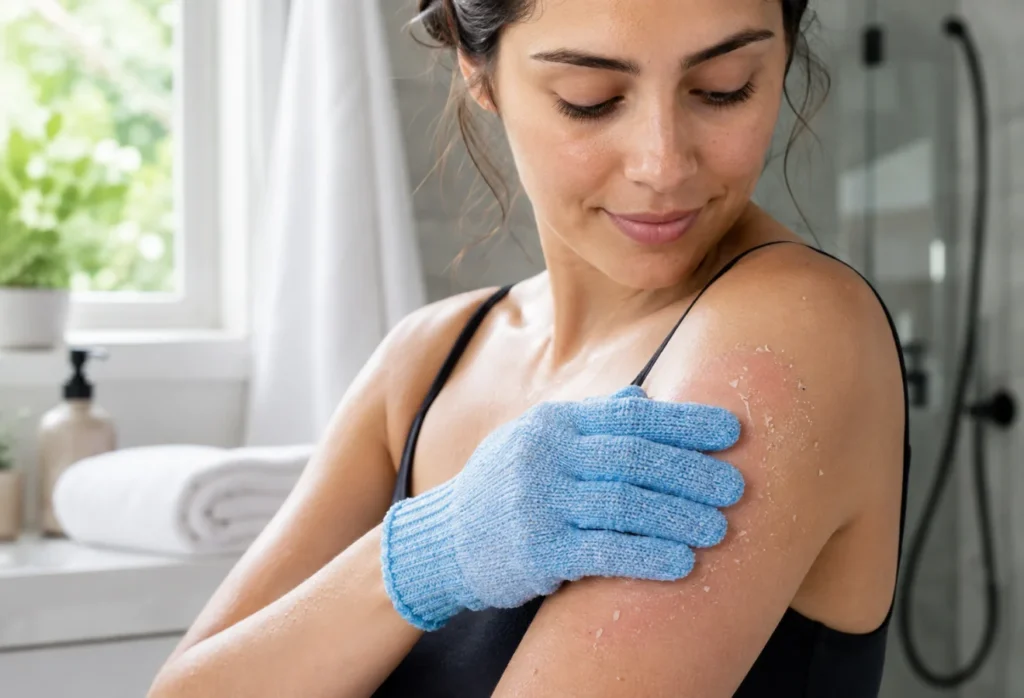
Exfoliating gloves are shower gloves made of a coarse fabric, usually nylon, viscose or sisal, for scrubbing dead skin off your body. You rub the rough weave over wet skin, it loosens the dead cells sitting on the surface, and they come away.
So do exfoliating gloves work? Yes, at the one job they have. The little rolls that gather on your legs while you rub are those dead cells, and a chemist has put them under a microscope to check. The same rubbing strips a self-tan early and, with heavy use, wears into your skin barrier, the layer that holds water in. Bumps and cellulite stay where they are, and dark spots can get worse.
Exfoliating Gloves Work By Friction
Dermatologists call this mechanical exfoliation, meaning a tool physically removes dead cells from the surface. A brush, a pad or a sponge does the same job.
What they work on is already dead. The surface is 10 to 20 layers deep, all flat cells that have lost their nucleus, and they flake away on their own. When too many build up, legs and arms look dry, flaky and dull. Rubbing clears that buildup, and that’s the smoothness you feel afterward.
Are the rolls really you, or is the fabric falling apart? A chemist with a PhD tested 3 mitts in 2022 and looked at a roll-covered one under her microscope. The rolls were dead skin, and the weave was intact.
She also pointed out that you need some of that layer. It protects the living tissue underneath from drying out, infection, chemicals and friction.
Exfoliating Gloves Remove Dead Skin And Self-Tan
Old cells come off first, and a few other things go with them.
| What Comes Off | What To Know |
|---|---|
| Loose dead cells | These are the rolls you see |
| Roughness on elbows, knees and ankles | Skin is thickest there |
| Self-tan | The color sits in dead surface cells |
| Part of your barrier, with overuse | Water loss about doubled in 1 study |
Self-tanner reacts with dead cells in the surface layer, and the color fades within a few days. Those are the same cells the rubbing removes, so the tan goes with them. Uneven buildup also makes a tan go on patchy. Dermatologists say to exfoliate before you apply, with extra time on the elbows, knees and ankles. The tool they name for that is a washcloth, which tells you how little pressure it takes.
Exfoliating Gloves Cannot Remove Bumps Or Cellulite
Keratosis pilaris is the rough, sandpaper-like bumps that show up on the upper arms, the front of the thighs and the buttocks. It can’t be cured. Gentle sloughing is part of keeping it under control, and a loofah, a buff puff or a rough washcloth all qualify. Scrubbing irritates the bumps and makes them worse.
As for cellulite, dermatologists say there’s no proof that brushing your body reduces it or how it looks.
Hard Scrubbing Damages The Skin Barrier
A small Korean study from 2005 followed 20 women in their 20s and 30s for 8 weeks. The researchers set out to show that overusing a coarse scrubbing towel, or scrub products, leaves people dry and itchy. In the towel group, the reading for water escaping through the skin rose from 6.8 to 13.4, close to double. In the group that changed nothing, it moved from 6.8 to 6.9.
The published summary doesn’t say how often the towel group scrubbed, so it can’t tell you where the safe line sits. It does show what a damaged skin barrier looks like on an instrument. At home it shows up as redness, peeling and a tight, uncomfortable feeling.
Years of hard rubbing can leave another mark. A 2005 report in a dermatology journal gathered cases from doctors in Jordan, Mexico, Iraq, Japan and Italy. Their patients had brownish patches over bony areas, with no other symptoms, linked to long-term rubbing with scrub pads, nylon towels and horsehair gloves. Most were young, thin women, and the patches sat over the collarbone, the spine, the side of the neck and the upper back.
Dermatologists add a warning for anyone whose burns, bug bites or breakouts leave dark spots. Aggressive exfoliation can trigger more pigment, and the risk is higher with darker skin tones.
Use Exfoliating Gloves Once A Week
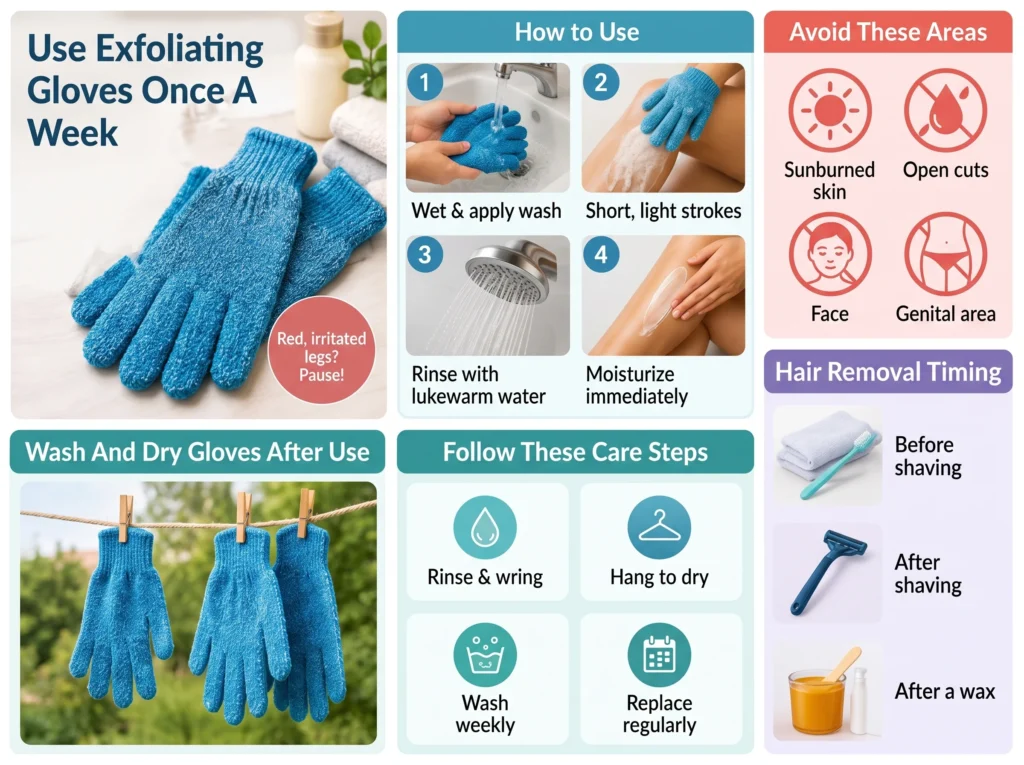
The dermatology advice on timing comes without a number: the more aggressive the method, the less often you need it. A coarse weave sits at the rough end of home care, so once a week is a cautious place to start. Red, irritated legs mean you’ve gone past your limit.
- Wet the gloves under warm water and add body wash if you like.
- Use short, light strokes, which is the advice for any brush or sponge.
- Rinse with lukewarm water. Hot water is out.
- Put on moisturizer immediately.
Leave out any area that’s sunburned or has an open cut. Your face and genital area are off the list too, as they are for loofahs, because those areas are too sensitive for it. A professional body treatment puts the pressure in someone else’s hands, and ours is the Spa Glow Exfoliation ($60, 40 minutes).
Hair removal changes the timing. Built-up dead cells can trap a hair as it grows back. The medical advice for ingrown hairs is still milder than a coarse mitt. It’s a warm washcloth or a soft-bristled toothbrush, in circles, for a few minutes before you shave. After a shave, the rule for loofahs is to wait a couple of days, since bacteria can get in through any nick, and the same caution fits here. After a wax, the standard list is cold packs if it hurts, no hot baths or showers, loose clothing and moisturizer. Scrubbing isn’t on it. If we’re waxing your legs (half leg from $40, full leg from $65), ask at your appointment when to start again.
Wash And Dry Gloves After Use
Whatever comes off your body ends up in the weave. In a 1994 lab study, wet loofah sponges grew bacteria that included Pseudomonas and Klebsiella, and the shed cells caught in the fibers fed that growth. That study used loofahs, but a coarse mitt offers the same thing: fabric, moisture and dead cells for food. The chemist who ran the microscope test names Pseudomonas folliculitis, bacteria settling into the hair follicles, as the most common infection.
The care advice dermatologists give for loofahs fits here too:
- Rinse the pair well after every use and wring the water out.
- Hang them somewhere cool to dry, outside the shower.
- Clean them at least once a week, and let them dry fully each time.
- Replace them on a schedule. The guide for natural loofahs is 3 to 4 weeks, and for plastic ones 2 months.
Skin Types That Should Skip Gloves
| Skin Type | Why To Skip |
|---|---|
| Dry, sensitive or acne-prone | Mechanical exfoliation may be too irritating. Dermatologists suggest a washcloth and a mild chemical exfoliator |
| Heals with dark marks | Aggressive scrubbing can add pigment |
| Eczema | The bathing advice is not to scrub with a washcloth or a loofah |
| Psoriasis | Wash very gently with your hands. Loofahs, buff puffs and washcloths can irritate it and set off a flare |
| Using retinol or benzoyl peroxide | These can cause peeling by themselves, and scrubbing on top may worsen dryness or bring on breakouts |
Which group you’re in isn’t always obvious from the mirror. We offer complimentary consultations for questions like that, and a dermatologist is the right call for eczema or psoriasis that keeps flaring.
Watching the rolls pile up is satisfying, which is the trouble with them. A bigger pile looks like a better job, and nothing in the fabric tells you when you’ve taken enough. Redness is the first thing that will.