

You soaked in an Epsom salt bath, and a few hours later you had diarrhea. Connecting the two makes sense. The answer to “can Epsom salt bath cause diarrhea” is probably not, as long as you didn’t swallow the water. The salt does work as a laxative, but that’s when people drink it. A bath is a different exposure, and there’s little solid evidence that a normal soak gets much magnesium through your skin. So the bath is a fair suspect, but it probably isn’t the one that did it.
The Laxative Effect Starts in Your Gut
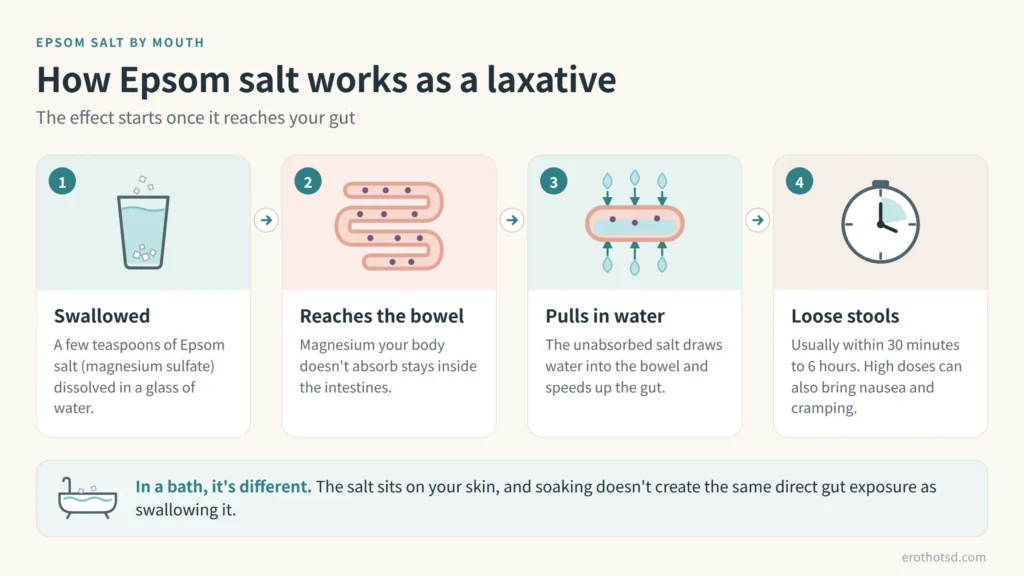
Epsom salt is magnesium sulfate. The bag you poured into the tub may even carry a Drug Facts label that calls it a saline laxative. Those laxative directions are for drinking it. You dissolve a few level teaspoons in a glass of water. According to the label, it usually works within 30 minutes to 6 hours.
So can Epsom salt cause diarrhea? Yes, when you swallow it. The NIH Office of Dietary Supplements explains why. Magnesium salts that stay unabsorbed in the intestines pull water into the bowel and speed up the gut. High doses often cause loose stools, sometimes with nausea and cramping.
The same laxative effect is also used medically to empty the bowel. Magnesium sulfate is one of the ingredients in some prescription colonoscopy prep kits, the drinks people take before the exam.
Soaking in It Is a Different Exposure
In the tub, the salt dissolves and sits on the outside of your body. Your skin’s outer layer works as a barrier that limits what gets through.
Claims about magnesium absorption through skin are everywhere, especially on labels for bath salts and magnesium sprays. Researchers reviewed that evidence in a 2017 paper in the journal Nutrients and concluded that the science doesn’t support those claims.
That isn’t the same as saying zero magnesium gets in. The fair summary is that there’s little good evidence an ordinary soak raises your magnesium enough to make a difference.
Even if a little does get through, soaking doesn’t create the same direct exposure inside the intestines that swallowing magnesium sulfate does. That direct gut exposure is what drives the laxative effect above.
That’s also why too much Epsom salt in the bath doesn’t automatically mean a stronger laxative effect. Extra salt makes the water saltier against your skin, but soaking still isn’t swallowing. Where it could change things is if someone drinks the water, since each mouthful would carry more salt.
Diarrhea After an Epsom Salt Bath Doesn’t Prove Much
Timing is persuasive. It’s also easy to misread, because diarrhea is common and a bath usually isn’t the only thing that happened that day. It tends to sit in an evening that includes dinner and maybe a drink or a supplement.
The National Institute of Diabetes and Digestive and Kidney Diseases lists the usual culprits. They include infections, foods you don’t handle well, medicines such as antibiotics or magnesium antacids, and gut conditions like IBS. Any of those can land on bath night by chance.
A few hours’ gap also fits a late dinner, or a stomach bug that was already coming. Timing alone can’t pick the bath out of that lineup.
Before blaming the salt, I’d ask a few quick questions:
- Did you swallow any of the water?
- What did you eat and drink in the 24 hours before?
- Did you start a new medicine or supplement, especially one with magnesium?
- Is anyone else in your house sick?
The “Epsom Salt Baths Make You Poop” Claim
The claim that Epsom salt baths make you poop is common online, but it often mixes up soaking with taking magnesium sulfate by mouth. That’s easy to do, since the same box can list the salt as a soak and as an oral laxative. Timing plays a part too, for the reasons in the last section. And some of it comes from the idea that magnesium soaks in and loosens things up. The research above doesn’t back that up well.
I’d read those posts with that in mind. If you’re dealing with constipation and thinking about trying it, the Epsom salt laxative directions on the box are for drinking it. The label warns people with kidney disease to ask a doctor first. It also says to stop and see a doctor if you need a laxative for more than 1 week.
Benefits Of Epsom Salt Bath
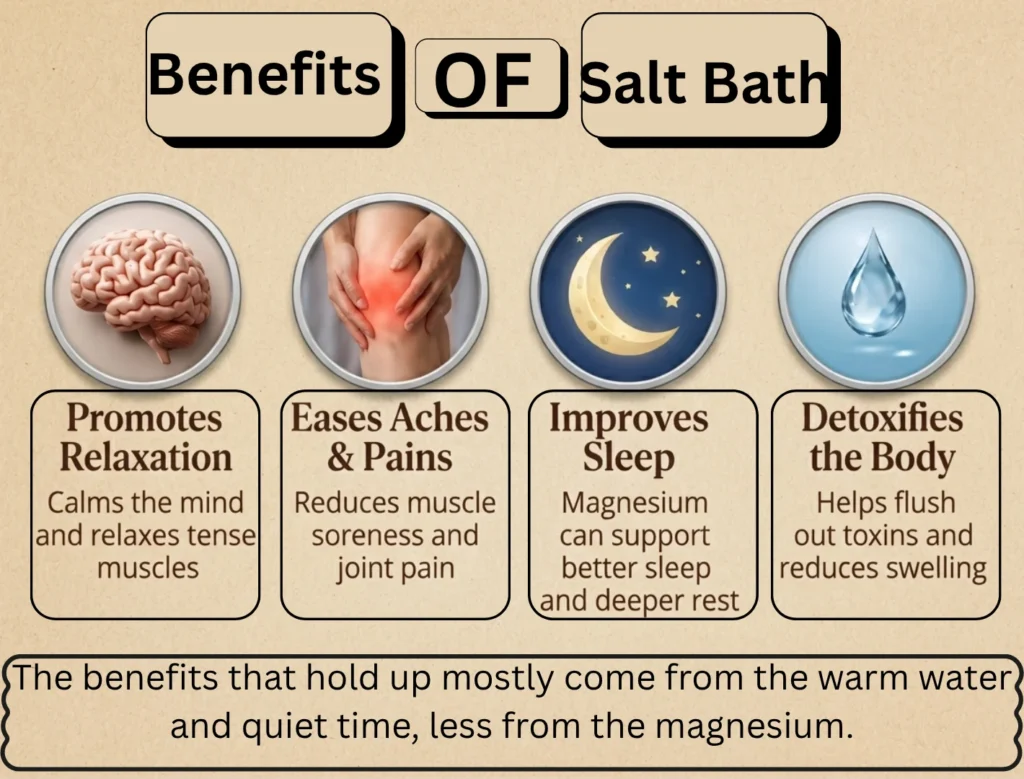
The benefits that hold up mostly come from the warm water and quiet time, less from the magnesium. None of this means you have to give up your soak.
- Tired feet. The Epsom salt package itself lists it as a soaking aid for minor discomfort and tired feet, so a foot soak is one of its everyday uses.
- Falling asleep. A 2019 research review looked at warm baths and showers before bed. The sweet spot was water around 104 to 109 degrees F, 1 to 2 hours before bedtime. On average, it helped people fall asleep about 10 minutes faster. That’s the warm water at work, so it holds with or without the salt.
- Scaly, itchy skin. If you have psoriasis, adding Epsom salt, bath oil or oatmeal to the water might help calm scaly, itchy patches. Keep the water warm instead of hot, stay in for 15 minutes or less, and put on a fragrance-free moisturizer within 5 minutes of getting out.
What I’d skip are the bigger promises, like raising your magnesium levels through your skin. The research on soaking doesn’t back that up. And keep the swallowing advice below in mind, especially with kids.
If You Swallowed Some of the Water
Swallowing Epsom salt bath water is where the soak and the laxative effect can connect. Now the salt is in your gut, which is the usual way magnesium sulfate diarrhea happens.
What happens next depends on how much you swallowed and how concentrated the bath was. A sip from a lightly salted tub is not the same as several big gulps from a heavily salted one.
Young kids tend to drink the water, and they’re smaller, so the same amount can go further. If a child drank a lot of it, or you’re not sure how much, call Poison Help at 1-800-222-1222. The same applies to an adult who swallowed a large amount.
Large amounts can be dangerous. One emergency medicine journal reported a case of severe magnesium poisoning after someone swallowed Epsom salt. The NIH also notes that the risk goes up when the kidneys can’t clear extra magnesium.
When It Keeps Happening After Epsom Salt Bath
Once could be chance. If it follows bath after bath, look for a pattern and treat the bath as one piece of it.
Here’s what I’d check:
- Whether anyone is swallowing the water, like kids in the tub or you rinsing your mouth with it.
- Oral magnesium. If you take it as a supplement in the evening, it reaches your gut on the same night. The NIH lists an upper limit of 350 mg a day for adults from supplements and medicines. It names magnesium oxide, chloride, carbonate and gluconate as the forms most often reported to cause diarrhea.
- Antacids and laxatives that contain magnesium, like milk of magnesia.
- Food and drinks that evening, such as a late dinner or anything your stomach already struggles with.
- New medicines, especially antibiotics.
The simplest test is to change one thing. Take your next couple of baths without the salt and keep the rest of your routine the same. If it still happens without the salt, Epsom salt becomes a much less likely explanation. The same test works for an Epsom salt bath stomach upset, like cramps or nausea without diarrhea.
If symptoms only show up after the Epsom salt baths, that still doesn’t prove the salt caused them. Check whether anyone is swallowing the water, and look again at what else changes on those nights. If the pattern keeps going, bring it to a doctor.
Symptoms That Need a Doctor
Short bouts of diarrhea often clear up on their own. The NIDDK lists these as reasons to see a doctor right away:
- signs of dehydration, like extreme thirst or dry mouth, dark urine, peeing less than usual, or feeling dizzy
- severe pain in the belly or rectum
- stools that are black and tarry or contain red blood or pus
- in adults, diarrhea that lasts more than 2 days, a high fever, or 6 or more loose stools a day
For children, the NIDDK says to see a doctor if diarrhea lasts more than a day. It also warns that newborns and infants can become severely dehydrated in a day or two.
If someone swallowed a large amount of Epsom salt, watch for signs of too much magnesium. The NIH lists nausea, vomiting, flushing and low blood pressure among the first symptoms. Severe cases can bring muscle weakness, trouble breathing, a big drop in blood pressure and an irregular heartbeat. Call 911 for anything severe, and Poison Help for advice.