
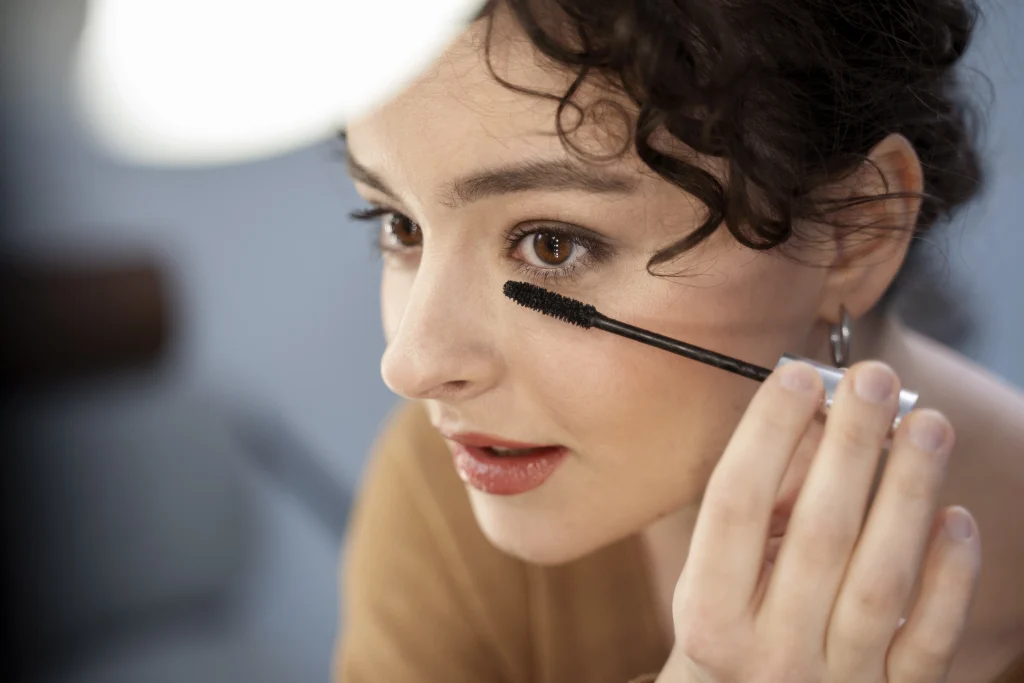
Best mascara for sensitive eyes, if you ask me, is the tube you can take off at night without scrubbing. I know that sounds like a strange place to start. Part of my work at the salon is lash tinting, though, so I hear a lot about mascara from women whose eyes sting or itch. Nearly all of those complaints come down to 2 things: what the formula is made of and how hard it is to remove.
So I’d forget the brand for a minute and turn the box over. On the back I look for:
- No “fragrance” or “parfum”.
- Black or brown-black, not a colored shade.
- The word “tubing” or “washable”.
- No fibers and no waterproof claim.
Black, fragrance-free and tubing or washable is the combination that suits most sensitive eyes.
Start With The Fragrance Line On The Ingredient List
Scent does nothing for a mascara. Nobody smells your lashes. A lot of brands add fragrance anyway, because it makes the product feel nicer to use. One word on the label can hide dozens of separate chemicals, as brands are allowed to group them under “fragrance” or the French “parfum” without naming them. Balsam of Peru, a resin used for scent, comes up again and again in allergy testing. If perfume or scented lotion has ever given you a rash, I’d cut fragrance first and see if your eyes calm down.
Preservatives are the next thing to check. Mascara has water in it and gets opened daily, so it does need some protection from germs. A few preservatives, however, work by slowly giving off tiny amounts of formaldehyde. Those are the ones I’d avoid:
- Quaternium-15.
- DMDM hydantoin.
- Imidazolidinyl urea.
- Diazolidinyl urea.
You’ll see parabens on a lot of “avoid” lists too. True paraben allergy is uncommon, so I wouldn’t pay extra for a paraben-free sticker.
Colored mascaras are a quieter problem. Blue, plum and brown shades need extra dyes to get their color. Black is mostly carbon black or black iron oxide.
Shellac and colophony (a pine resin) turn up in some long-wear formulas. Pigments can also carry traces of nickel. Most people don’t notice them. If you know you react to nickel, though, read for it.
Lanolin Is Gentle Unless You Happen To Be Allergic To It
Sensitive-eye mascaras love to list lanolin and beeswax near the top. For most women they’re perfectly fine. Each is also a known allergen. Gentle for the average person doesn’t mean gentle for you, so if lanolin has bothered you in a lip balm or hand cream, a “sensitive” mascara made with it will bother your eyes just as much. The ingredients I’m happier to see are plant waxes like carnauba, candelilla and rice bran wax for body. I also like film-forming polymers, often written as acrylates copolymer, because they let a mascara wrap the lashes instead of crusting on them. Glycerin and panthenol keep the formula soft. When you’ve worked out which ingredient sets you off, write it down in your phone, because you’ll want it the next time you’re standing in a store aisle.
What Does Hypoallergenic On The Box Really Promise?
Very little. The United States has no legal definition for “hypoallergenic,” so a brand can print it without running any special tests at all. “Ophthalmologist tested” only means an eye doctor oversaw some kind of trial. The box won’t tell you how many people took part or how they reacted.
Mascara Formulas Explained, From Gentlest To Harshest
| Formula | How it comes off | My take for sensitive eyes |
|---|---|---|
| Tubing | Warm water and light pressure | First choice |
| Washable (water-based) | Warm water and a mild cleanser | A good second |
| Waterproof | Oil-based remover and rubbing | Special occasions only |
| Fiber | Bits fall off during the day | Skip it |
If I could only point you to one formula, it would be tubing. Instead of painting the lashes, its polymers set into a thin tube around each one. Nothing crumbles into your eyes during the day. At night you hold a warm, wet washcloth on your closed eyes for about 30 seconds. Press down gently and the little tubes slide off the ends of your lashes. Seeing them on the cloth is oddly satisfying the first time.
Waterproof is the opposite case. Solvents like isododecane keep it from budging, so taking it off means an oil remover and a fair bit of rubbing along a lash line that’s irritated to begin with. A few waterproof mascaras have also tested positive for PFAS, the chemicals used in nonstick pans. I keep a waterproof tube for weddings and beach days and nothing else.
Contact Lens Wearers Have A Few Extra Rules
- Lenses go in before makeup. They come out before you take it off.
- Coat from the middle of the lash to the tip, and stay off the waterline.
- Skip the lower lashes on dry-eye days.
- Fiber mascara is out, full stop.
Toss The Tube Sooner Than You Think
Three months after opening, I’d throw a mascara away even if half of it is left. Bacteria grow well in a dark, damp tube while the preservatives slowly lose strength. If it smells off or goes clumpy, toss it sooner. Pumping the wand pushes air in and dries it out, so twist it gently instead. Don’t share it. Don’t sleep in it. Overnight mascara can block the small oil glands along your lash line and leave your eyes drier in the morning.
A new tube gets a patch test before it goes anywhere near my eyes:
- Dab a little behind your ear or on your inner forearm.
- Leave it for 24 to 48 hours.
- Check for redness, itching or swelling.
- If the skin stays clear, try it on just the tips of your lashes for a day.
Arm skin is tougher than eyelid skin, so this won’t catch all reactions. It catches enough to justify the 2 day wait.
When Your Eyes Say No To Mascara Altogether
Some women react to any mascara they try, however short the label. For them I’d suggest giving up the tube and letting the lashes do the work. A tint darkens your own lashes for several weeks. A lift curls them up so they look longer with nothing on them. Most women who book the two together go mascara-free for a month or more. At our salon a lash lift is $40, a tint is $20, and the combo comes to $45.