
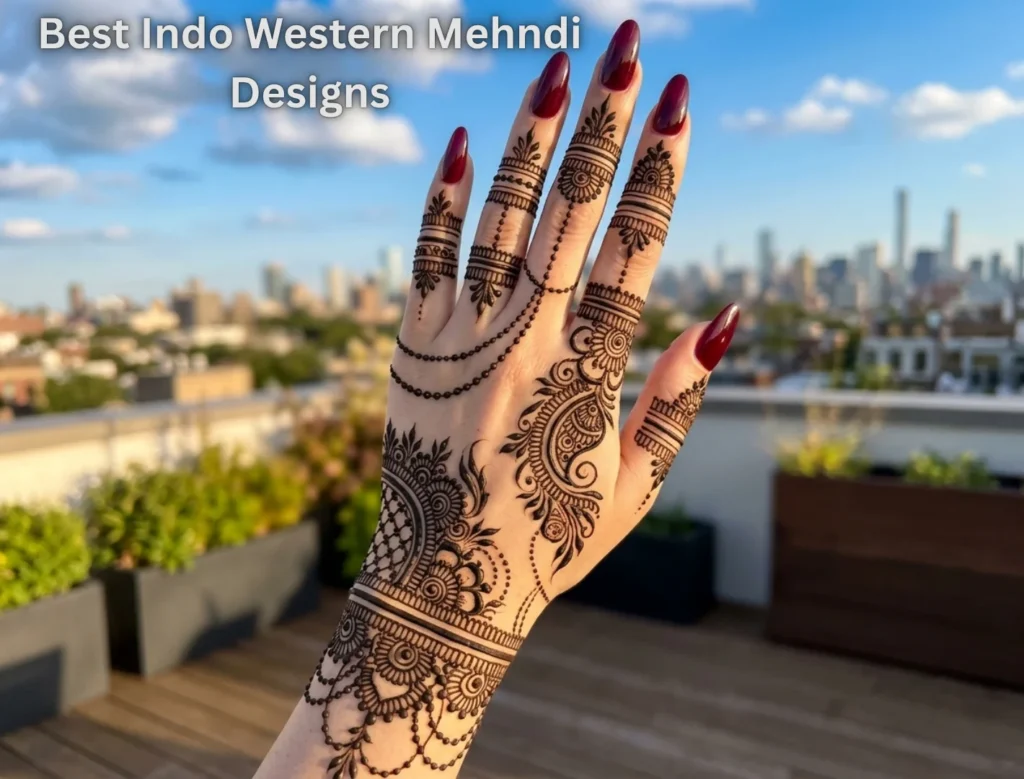
The best Indo Western mehndi designs for a cape outfit are the ones that sit on your wrist, palm, fingers and the back of your hand. I say that first because a cape sleeve covers a lot of the forearm, and think it’s the one thing people forget when they pick a design from a photo of a bare hand.
When we talk about Indo Western mehndi, it’s mean regular henna styled to match a fusion outfit. You still get the traditional motifs, but with cleaner geometric lines and more open skin. It’s less about a new pattern and more about where you put it.
Check Where Your Cape Sleeve Falls Before Choosing a Design
Before you settle on anything, I’d put the outfit on and look at where the sleeve stops. Then move around a bit. Lift your arm like you’re holding a glass, sit down, reach for something. Cape sleeves move with you, so the part they cover keeps changing.
If the sleeve covers an area most of the time, I wouldn’t put detailed work there. Spend that time on the wrist and hand instead, where people will actually see it.
I’d also ask your artist to finish the design with a closed border near the sleeve line. Long vines running up the arm look cut off when the fabric drops over them. And if you can, carry the outfit itself to your appointment. A photo doesn’t show how the sleeve hangs.

Which Designs Suit Each Type of Cape Sleeve
- Wrist-length sleeves: keep it on the hand.
- Elbow-length sleeves: you have a little forearm to play with, so I’d let a wrist cuff taper upward a short way and stop well before the sleeve. Don’t push it right up to the fabric.
- Sheer organza or net: go for open, bold shapes. Fine filled-in work blurs through the fabric.
- Asymmetrical capes: one arm usually shows more. I’d put the fuller design on that arm and keep the other one simple.
- Flowing capes: stick to the wrist and fingers, because you can’t predict where the fabric will land.
5 Indo Western Mehndi Designs That Work With a Cape
1. Wrist Cuff Mehndi Finishes Neatly at the Sleeve Edge
This is the one I’d recommend first for most cape outfits. It’s a band of pattern around the wrist with a clean edge on both sides, so it looks like a bracelet. The sleeve ends, the cuff starts, and the two don’t fight each other.
For a fusion look like geometric fills inside the band, like small diamonds, a chain pattern, or two outlines with plain skin between them. Big floral fills can look too traditional next to a modern cape.
I’d keep it somewhere around 1 to 2 inches wide, but that’s only a starting point. A smaller wrist might need less, and if your sleeve sits a little higher you can go wider. Your artist can judge it once they see your hand. It works with wrist-length, elbow-length and flowing sleeves, and it’s not a hard design to do.
2. Palm Mandala Stays Clear of Most Sleeves
One big mandala in the middle of the palm with thin vines going out to the fingertips. Sleeves almost never reach the palm, so this works with nearly any cape.
Keep the vines thin. If they get heavy, the whole hand starts to look traditional bridal, which isn’t the point here. The time it takes depends on how much detail you want inside the circle.
3. Finger and Knuckle Mehndi Shows in Most Hand Positions
Fingertips, a thin band over the knuckles, and maybe one line down the middle finger. Your fingers show whether your hand is open, closed or holding something, so this is the safest pick if your cape is heavy or flowy.
I like it best paired with a wrist cuff. You get the hand framed at both ends with the middle left open.
4. Back Hand Geometry Is What Photos Usually Capture
Think about how your hands look in pictures. They’re mostly palm down, holding a glass or resting on your lap. So the back of your hand ends up in far more photos than your palm does.
That’s why I’d keep the palm simple and put the stronger design on the back. Chevrons, grid patterns or a half mandala all suit it. Keep the design closer to the knuckles than the wrist so the sleeve doesn’t cover the top of it. If you want more ideas for this spot, our backhand mandala mehndi designs are a good place to look.
5. Negative Space Mehndi Holds Its Shape Under Sheer Fabric
Sheer fabric softens anything under it. Heavy filled-in work turns into a dark patch, but outline designs with skin showing between them still read clearly.
The rule I’d follow is simple: leave enough plain skin between each shape that you can still tell them apart. Make the shapes a bit bigger than you normally would, too. Arabic-style designs work well here because they already use bold lines and open gaps. Our guide to simple Arabic mehndi designs has patterns you can show your artist.
The lines aren’t hard to draw. Getting the spacing right is the part that takes thought.
Book Your Mehndi One or Two Days Before the Function
Henna comes off orange and keeps getting darker for about 24 to 48 hours. So I’d book it a day or two early, not the morning of. That way the color is at its darkest on the actual day. These tips for darker mehndi color help while it develops.
One more thing. A lot of fusion outfits are ivory, blush, mint or metallic, and fresh henna paste can leave marks on light georgette that are hard to get out. Make sure every bit of paste is off and your hands are dry before you put the outfit on.
Frequently Asked Questions
Does back-hand mehndi suit a cape outfit?
Yes, and I’d say it’s one of the best choices for one.
Which mehndi patterns work under sheer sleeves?
Open ones. Outline work, Arabic-style vines and larger geometric shapes all hold up. Anything with a lot of fine lines or solid fill tends to blur through organza or net, so I’d skip those.
How do I coordinate mehndi with jewelry?
I’d let one of them be the main piece. If you’re wearing a statement bracelet or a haath phool, keep the wrist design light so they don’t clash. If your jewelry is minimal, a wrist cuff design can stand in for a bracelet. And with big cocktail rings, keep those fingers plain so the rings stand out.