
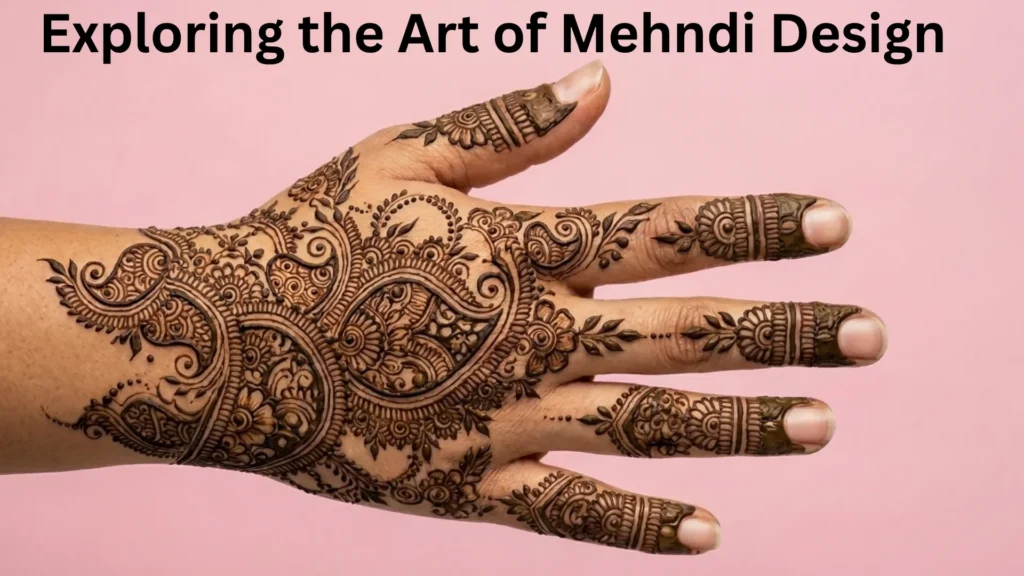
Mehndi design, the old practice of drawing on skin with henna paste, can look like 5 different art forms depending on whose hand is holding the cone, and you see it fast once you put a few next to each other. An Indian bride’s palm disappears under paisleys and hairline detail right up to the wrist. An Arabic-style hand gets 1 loose trail of flowers and a lot of bare skin. Over in Morocco a Fes artist might cover every inch in tight ornament while someone in Marrakech keeps it light, all leaves and curls.
Same plant every time. Same orange-to-brown stain. What changes is the artist, the occasion and a few hundred years of local habit, and that’s where it gets interesting.
Henna Starts As Dried Leaves From A Small Shrub

The shrub is Lawsonia inermis and it has its genus all to itself. Its leaves carry a reddish-orange dye called lawsone. Dry the leaves, powder them, mix a paste and leave it on, and the lawsone grabs onto keratin in the top layer of your skin, which is why palms and soles (where that layer is thickest) come out darkest.
“Mehndi” goes back to the Sanskrit mendhikā, which named the plant before it named the paste or the art.
As for who started it, no one can say for sure, and any article that hands the credit to 1 country is guessing. Most accounts trace the plant to the Middle East and North Africa, with Asia picking it up thousands of years ago. Egyptians used it on mummies. The Mughals, who ruled much of India from 1526 to 1857, made it the body art people still copy. Traders and families carried styles back and forth the whole time, so every label below has fuzzy edges.
The 5 Styles Split Into Filled Hands And Open Ones
Coverage is the easiest way to tell them apart. South Asian bridal work fills the skin, Arabic work leaves it showing, and Moroccan and Sudanese hands land somewhere in the middle. Everyone borrows from everyone, so the lines blur.
An Indian Bridal Mehndi Design Leaves Almost No Skin Showing
Fine lines, packed tight. That’s the South Asian signature. On an Indian bride it usually begins at the fingertips and keeps going over the palm and up the forearm, feet done to match, until there’s barely any skin left to see. Paisleys, peacocks, vines, flowers and mandalas do most of the work, and some families add religious symbols. Plenty of brides hide the couple’s initials somewhere in there too.
The application is its own party. Food, music and dancing go on around the bride while the artist sits with her for hours, and half the relatives go home with a smaller design of their own.
Styles shift by region and by family. Younger brides often ask for traditional paisleys next to something modern, or a lighter layout altogether.
Pakistani Families Make Mehndi Design A Whole Night
The mehndi night lands the evening before the main ceremony. Loud, long, full of food. Some families start earlier with a dholki, a smaller get-together where everyone sings along to a dholak drum. At the mehndi ki rasam itself, close relatives henna the bride’s hands and feet and feed her mithai.
Design-wise there’s a lot of overlap with Indian work (dense florals, paisleys, a mandala in the palm, detailed fingers, sometimes the groom’s name tucked in). Guests usually walk away with a floral patch on the back of the hand or a couple of finger bands. No single national style exists here either. A bride’s result comes down to her artist, her city and whatever photos she saved on her phone.
You Notice The Bare Skin First In An Arabic Design
Here the empty space is part of the plan. Bold flowers, leaves and vines run diagonally from one side of the wrist toward the opposite fingertip, across the palm or the back of the hand. The lines are thicker and looser than Indian fill, with some shading inside the petals, and the gaps stay open on purpose. Gulf-style hands go even bolder with the flowers, and that’s the picture most people have in their head when they say “Arabic mehndi.”
It’s quick, so it shows up at Eid and birthday parties as often as weddings. Fades nicely too, over 1 to 2 weeks. Never held a cone? A few simple Arabic mehndi designs are a good place to start.
Moroccan Henna Changes From City To City
Lots of it is geometric. Diamonds, triangles, grids, very careful symmetry. But the style moves around a lot from city to city:
- Fes is known for Fessi, dense ornament that can cover the whole hand with almost nothing repeated.
- Marrakech goes lighter, with leaves twisting into each other.
- The north leans floral and the south goes bolder.
North African henna in general borrows heavily from Amazigh culture. A lot of Moroccan artists skip the cone and draw with a modified syringe, which is how those straight lines stay so clean. Many mix their own paste with water, tea, oils, sugar or lemon. Weddings, engagements and pregnancies all get henna there. At her henna party the bride has the busiest hands in the room.
Some families say certain shapes bring baraka (good luck) and keep the evil eye away. Meanings differ from house to house, so a chart that assigns 1 fixed meaning to every diamond is guesswork.
Sudanese Women Sing While They Henna The Bride
A day or 2 before a Sudanese wedding, the bride sits in the middle of the room while her female relatives and friends henna her hands and feet, singing and dancing around her. In some communities the groom gets his hands and feet dyed too. Designs are ornamental, deep stained areas against bare skin. Feet get as much attention as hands.
Henna isn’t the only ritual that week. There’s the dukhan, a smoke bath that leaves the bride-to-be perfumed, and the jirtig, a ceremony of its own with a special dress, jewelry and anointing.
Most Designs Are Built From Flowers, Paisleys, Mandalas And Lines
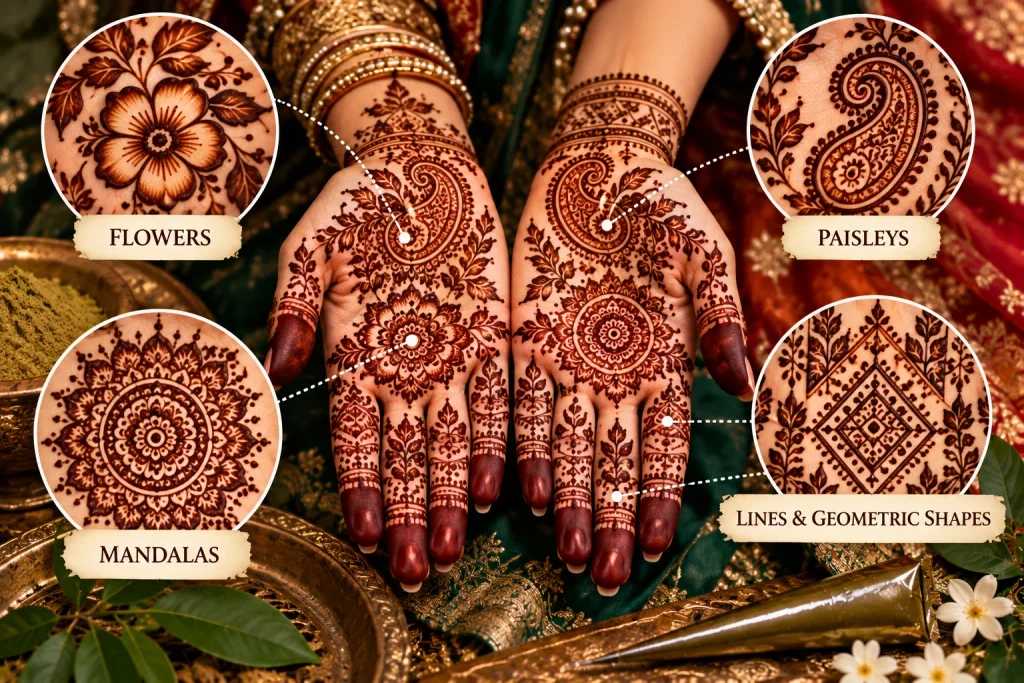
Put any of these hands side by side and you’ll find the same small set of shapes, used in very different ways.
Flowers are everywhere. South Asian artists keep them tiny and crowded, Arabic designs blow them up with heavy outlines, and in Marrakech the leaves get strung into chains. The paisley, that curved teardrop, mostly belongs to Indian and Pakistani work, where it fills gaps and adds movement.
Then there’s the mandala, a circle that grows out from a center dot in rings of petals. It usually anchors the palm, though plenty of people now wear one alone as a backhand mandala mehndi design with nothing around it. Straight lines in strict symmetry, grids and diamonds especially, point to Morocco and North Africa. Some families read them as protection. Others see plain decoration.
Think About The Day Before You Think About The Pattern
Settle the occasion and most of the pattern decisions settle themselves:
- Weddings usually mean full bridal coverage, Eid or a party suits something lighter.
- Palms stain darkest, while backs of hands, fingers and feet come out lighter and fade sooner.
- Fine South Asian fill takes hours and an open Arabic design can be done in under 1.
- Bridal hands and feet can eat a whole afternoon, so book early.
- Some people go with their family’s tradition and some pick whatever they like the look of.
Check What’s In The Cone Before It Touches Your Skin
Natural henna comes off orange and darkens to a reddish brown over 1 to 2 days. Keep it dry for the first several hours, since a heavy wash can lighten it, and there’s more on aftercare in these tips for darker mehndi colour.
Color is the smaller worry, though. “Black henna” often has a coal-tar hair dye in it called p-phenylenediamine, or PPD. US health officials have warned it can cause redness, blisters, weeping sores, loss of skin color and sun sensitivity, sometimes 2 to 3 weeks later, and a few people have ended up with permanent scars. PPD isn’t allowed in cosmetics meant to stain skin, so a paste that turns jet black within an hour is a no. Ask your artist what’s in the cone before they start.