
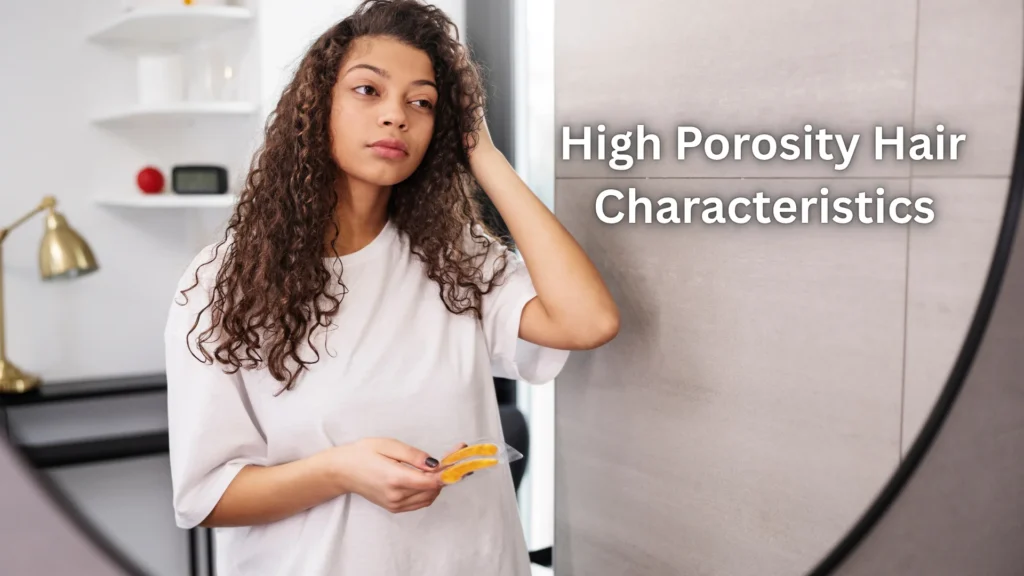
High porosity hair can get water into your strands with ease but can’t seem to keep water in your strands. Everything else follows.
If you’re that most commonly damaged hair type and your hair acts differently than the other two types, or if the products that work on your friend’s hair do nothing for you, it helps to know that you’re in that specific group. It changes what you buy, how you layer your product, and how often you need to bother.
What Is High Porosity Hair?
The cuticle, or outer layer, of each hair is made of overlapping layers of scales that look like roof shingles. When the scales are tightly laid flat the hair is water resistant, when raised or cracked the hair is porous and readily absorbs water, but expels it quickly.
Then, there’s high porosity, when nothing you put on stays put. This is why everything feels dry a couple hours post-moisturizing.
Hardly anybody starts here. Something got it there, and usually it’s chemistry.
Bleach is the big one by a mile. Researchers comparing unbleached and bleached fibers measured an actual change in pore volume and size, and the longer they’re bleached, the bigger the change. Permanent color and relaxers do the same thing with different chemistry: they both lift the cuticle layer from the hair in order to do their job.
After that it’s heat, especially daily hot tools at high settings with nothing protecting it. UV does its own version by a different route.
And then all the small stuff that doesn’t feel like damage while you’re doing it. Rubbing your head dry with a towel. Brushing when it’s dry. Dragging a comb through a knot because you’re late. None of it registers on the day and all of it adds up over a few years.
If you want the full picture across all three types, hair porosity explained covers low and medium too.
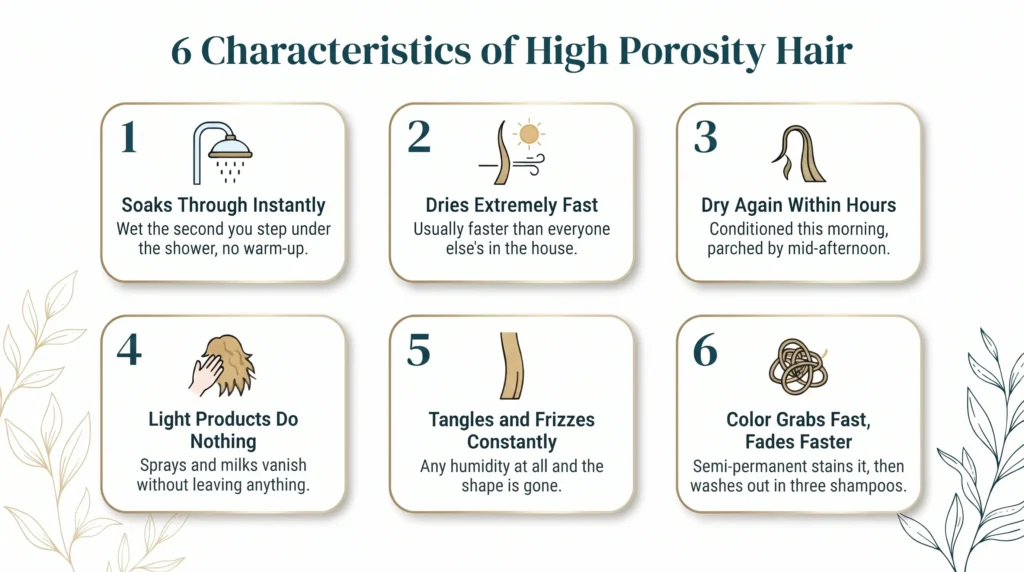
6 Characteristics of High Porosity Hair
1. It soaks through instantly. Step under the shower and it’s wet right away, no warming up first.
2. It dries fast. Sometimes faster than you’d like, and usually faster than everyone else’s in the house.
3. It’s dry again within hours. You conditioned it this morning and by mid-afternoon it feels like you didn’t.
4. Light products do nothing. Sprays and milks disappear without leaving anything behind.
5. It is always tangling and frizzing. Any humidity at all and you’ve lost the shape.
6. Color grabs fast and fades faster. Even semi-permanent dye stains it, then it’s gone after three shampoos. This is the biggest tell of the six because nothing else really explains that combination.
5 Ways to Care for High Porosity Hair
Go for the rich stuff. Creams and butters, not milks and sprays. Light formulas just don’t do enough here.
Seal after you moisturize. Water first, then something to trap it in, while it’s still wet, not after it’s already dried out. Doing it in that order is the whole thing. Coconut oil is a good choice for this and there’s decent evidence behind it. Rele and Mohile in the Journal of Cosmetic Science (2003) found coconut oil to reduce protein loss from the hair shaft, where mineral oil and sunflower oil had no positive effects. Lauric acid penetrates the hair shaft quickly and has a higher affinity to hair compared to other oils, and it reduces the swelling of the cuticle during washing. What most people miss is that pre-wash application beat post-wash.
Layer instead of using one miracle product. Try a leave-in, followed by a cream, then an oil. Because they’re doing different jobs, one bottle is almost never going to do it all.
Use protein, but not every week. Damaged strands do benefit from protein filling the gaps in a beaten-up cuticle. The specific evidence is narrower than advertised. For chemically relaxed textured hair, one study found that certain hydrolyzed keratin peptides cut breakage, but with different effects depending on their size. That’s more of a finding about these particular molecules, not a guideline that says everyone should wear a mask every seven days. If you overdo it, it goes stiff and starts snapping.
Wash lukewarm, and skip the cold rinse. You’ve heard a hundred times that a cold rinse closes the cuticle. It’s been tested directly: chemists at TRI Princeton rinsed samples above 98 degrees F and below 65 and measured the results, and the cold rinse did nothing for shine. Warm water came out glossier, partly because cold doesn’t rinse the residue off as well.
It fails for a mechanical reason, however. Water causes the fiber to swell and forces cuticle scales apart at any temperature. Cold isn’t a switch you can flip. What flattens a cuticle is pH, which is why conditioners are made acidic, and that’s the step doing the work people credit to the cold rinse.
Very hot water is a different story though. Researchers in the journal Annals of Dermatology found that repeated washing in hot water caused lifted and cracked cuticle, and holes in the outer layer, getting worse as temperature increased. So lukewarm is right. Just not for the reason everybody gives.
How to Tell If Yours Is High Porosity
Match yourself against the six above and you’ve got your answer. But there are two things useful to know before you settle on a label.
The glass of water test tells you almost nothing. You put a strand in the water and see whether it sinks, but that result depends on surface tension and whatever product is still attached to it. Your own color and heat history is a far better guide.
And porosity isn’t the same throughout a strand, either. Damage research found more of it near the tips than the roots, and that makes sense, since your ends have been through years more washing and brushing and heat. Plenty of people have high porosity ends sitting on roots that are nothing like it, which is why your ends drink product and your roots go greasy on the same routine.
What to Look for When You Buy
In this case, look at the label rather than the product name, as formula counts more.
What you’re looking for here is a thick conditioner that you can leave on for a few minutes, ideally with the shampoo and conditioner it was built to work with, and a leave-in that’s got enough body that you can still feel it once you’re finished. Something to seal with, an oil or a butter, and heavier is fine on this type even though it isn’t on others, so most of our hair oil range applies. A bond or protein treatment used as needed rather than regularly. And a sulfate-free cleanser, because stripping something already porous makes it drier.
Bring one new thing in at a time and give it a few weeks. If you change four products at once, you’ll never know what’s working.
When to Get Someone to Look at It
Porosity you can deal with at home. The other things, no.
Breakage that’s constant regardless of shampoo, hair going thin near the temples, a scalp that stays itchy, or lengths that stretch when wet but don’t bounce back. That last one means damage deep in each strand, and a stylist will see it in about ten seconds.
If you’re in Columbus, our hair department can work out where along the strand the damage sits, which can help determine whether you’re in need of a treatment, a chop, or just a break from whatever’s causing it.