

A curly mullet takes about 90 minutes in the chair and roughly 8 weeks to find out whether it worked.
That gap is where most of the disappointment lives. Women come into our chair on North High Street at week 3 convinced the cut was wrong, and most of the time the cut was fine. What went wrong happened at the first wash, or in the 2 weeks after it, or at the point the back gained enough weight to drag the whole shape down.
So here it is in the 3 stages that actually decide it, the cut, the wash, and the grow-out. If you’re still deciding which version to ask for, we’ve covered the 5 that work on curls separately. This is what happens once you’ve picked one.
The Cut
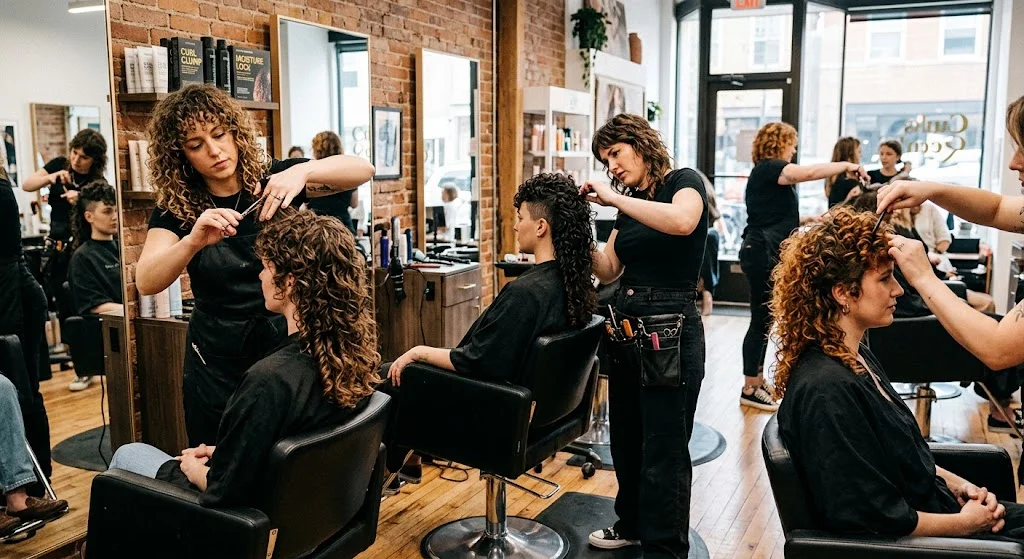
What a Curly Mullet Is, And What You’re Really Maintaining
Short through the sides and top, long through the back, with the transition between them either blended away or left visible depending on the version. That’s the shape. But the definition that matters once you’re wearing one is narrower than that.
The back has to hold visible weight. It’s a block of curl that needs to keep clumping together, and that clump is the entire cut. When it holds, you have a mullet. When it dries out, separates, or gets flattened under too much product, you have long hair at the back and short hair at the front, which is a different thing and a much worse one.
Everything below follows from that.
It Has To Be Cut On Dry Hair
So a stylist cutting your hair wet is cutting to a length that stops existing the moment it dries, and on a mullet that error lands on the sides, which are the one section with nothing to spare.
You’ll know within the first few minutes whether you’re getting the right kind of appointment. A curl cut starts with your hair dry and already doing what it normally does. It gets worked in sections, curl clump by curl clump. Nobody reaches for a spray bottle. If you’re soaked within 30 seconds of sitting down, you’re getting a straight-hair haircut performed on curly hair, and it may be an excellent one, just not the one you booked.
Ask for a look at the shape before you get up, too. Not after the blow-dry, in your own pattern. That’s the version you’ll be wearing.
The Wash

The First One Tells You What You Got
Whatever you leave with is a salon finish. Someone else’s hands, someone else’s product, more time than you’ll ever spend on it. It’s marketing, and it isn’t information.
The cut shows up at wash 1. That’s when the curls come back to their own clump pattern, the back settles into its real weight, and the silhouette either reads the way you wanted or it doesn’t.
When you do look, check 3 things and ignore the rest. Whether the back still holds visible weight at the bottom or tapers away to nothing, which is the tell that it was over-thinned. Whether the sides sit where you agreed or higher, easiest to see at the temple. And where the front pieces fall relative to your shoulder. Layer placement and slight unevenness between sides shift on their own within a fortnight anyway.
So don’t book a correction before then. We’d rather see you at day 4 with a specific complaint about a specific section than at day 1 with a vague feeling that something is off. Half the time that feeling is unfamiliarity.
The Routine That Keeps The Back Heavy
This is the part the style galleries skip, and it’s the part that decides whether the cut survives.
- Wash less than feels right. The American Academy of Dermatology is blunt about it. Thick curly hair doesn’t need washing daily or even weekly, though they set a floor of once every 2 to 3 weeks for scalp health.
- Condition the whole strand. Straight and fine hair gets conditioner on the ends. Curly hair gets it root to tip, per AAD guidance, because the bends in a curl stop your scalp’s own oils travelling down.
- Detangle wet, never dry. Soak it, put a leave-in through it, then work in sections with fingers or a wide-tooth comb. AAD specifically warns against brushing dry, which breaks strands and creates frizz.
- Watch the load on the back. Leave-in, then cream, then a light gel if frizz is your problem. Doubling up on cream drags the back down, and the back is the section the whole shape depends on.
- Diffuse low, or don’t diffuse. AAD says limit blow drying, keep it on low or medium, use a protectant. Dry hair in the back goes fluffy instead of heavy.
- Leave it alone while it dries. The crunchy cast that forms is doing the work. Scrunch it out with a drop of oil once it’s completely dry, not before.
- Blot with a t-shirt. Rubbing with a towel is friction, and friction on curls is frizz.
- Pineapple it overnight. Loose, on top of your head. Or a loose braid. Either beats dragging the back across a pillowcase for 8 hours.
Between washes, the back is the section that goes first. Refreshing it doesn’t mean soaking your whole head. Damp your hands, work water into whichever section has lost its clump, add a little leave-in and reshape the curls with your fingers. AAD’s detangling rule holds here too, wet it thoroughly and use fingers or a wide-tooth comb, never a brush on dry hair. A shower cap on non-wash days is deeply unglamorous and it’s the cheapest way to get 3 days out of a style instead of 1.
When the back stops clumping altogether and no amount of cream brings it back, that’s a moisture problem rather than a product problem, and layering more on top won’t touch it. Our deep conditioning treatment starts at $50 and it earns its place on this cut specifically, because the silhouette is doing nothing at all if the bottom section won’t hold together.
If you use gel or oil regularly, run a clarifying shampoo before your moisturizing one now and then. AAD recommends it, and buildup in the back flattens exactly the section you’re trying to keep full.
The Grow-Out

Weeks 4 to 6, The Shape Softens
Hair grows around half an inch a month. That sounds slow until you realize a mullet is built entirely on the relationship between 2 lengths, and both of them are moving.
The layers migrate. They were cut to sit at a particular point, and by week 5 they sit lower, so the back carries more weight than the shape was built around. The sides catch up and soften the contrast. Nothing has gone wrong. The cut has stopped being the cut.
There’s one thing we’ll talk you out of around here. Keratin smoothing is on our menu and plenty of curly clients love what it does for them, but it loosens the pattern, and a mullet whose back has been smoothed has nothing left holding the shape up. If you want both, get the smoothing done first and let us cut around whatever you end up with. Doing it the other way costs you the cut.
This is the point most women book a full haircut and lose the length they’ve been growing. It isn’t necessary. What the shape needs is the sides and the perimeter tidied while the back is left alone, which is a much shorter appointment than a cut.
Week 8, What To Book
For a curly mullet at women’s lengths, 8 to 12 weeks between shape-ups is the honest range. Longer than a short cut needs, because there’s enough length that migration isn’t obvious straight away. Shorter than growing it out, because past 12 weeks a stylist is rebuilding rather than maintaining.
When you book, say 3 things. It’s a curly cut and you want it dry. You’re keeping the back. And it’s a shape-up rather than a cut, so the time gets allocated properly.
We also run appointments at your home within 30 miles of Columbus, which suits a shape-up better than a first cut. The first one is worth doing here, where the light and the mirrors are on our side.
Curly work runs longer than a standard appointment because it’s done section by section on dry hair, so it’s priced above a regular cut. Current rates are on our hair services page. Mention the curls when you get in touch and we’ll block the chair time rather than squeezing you into a 30 minute slot.