
There’s a reason full hand mehndi is still the thing every bride comes back to, and it’s not just tradition for tradition’s sake, it’s that nothing else quite covers the hands the way it does, flowing from the fingertips all the way past the wrist so the whole hand reads as one finished piece instead of a scattered few motifs. For a wedding day, that completeness is the whole point.
So this is a walk through what full hand bridal mehndi actually involves. The main styles, how to think about the design, and the practical stuff nobody tells you until you’re three hours into sitting still.
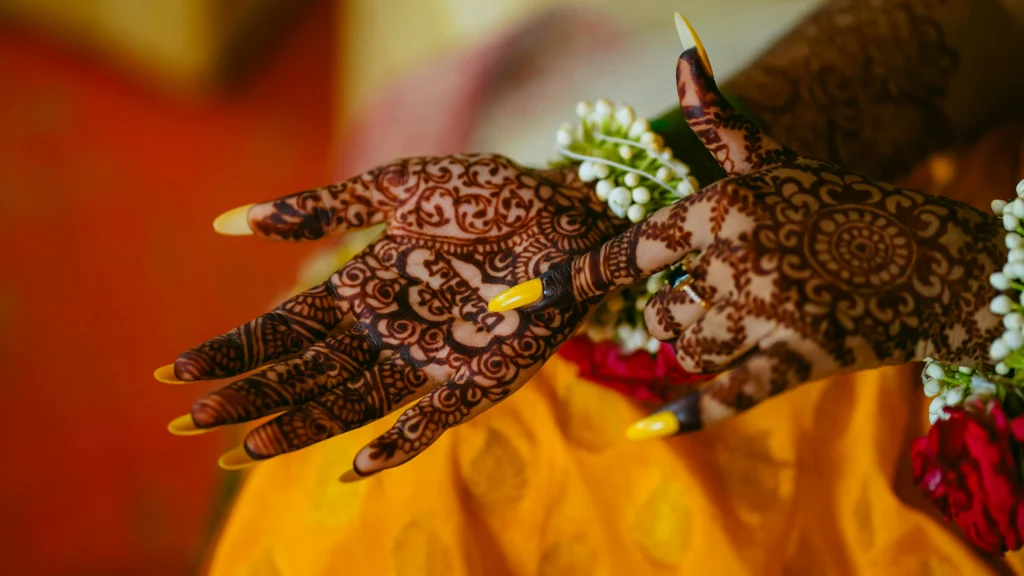
What “full hand mehndi designs” actually means
It sounds obvious, but it’s worth pinning down, because full hand doesn’t just mean a bigger version of a small design. It means the pattern is planned to cover the whole hand as a connected composition, fingers, palm or back, and the wrist, all flowing together rather than sitting as separate bits.
That’s the difference between bridal mehndi and the everyday kind. An everyday design can be one flower and a vine. A bridal one is built to be dense, detailed, and continuous, because it’s meant to stand out in every photo and hold up next to a heavily worked outfit.
The main styles brides choose
There’s more variety here than people expect, and knowing the families helps you figure out what you actually want before you sit down with an artist.
Traditional Indian
The dense, intricate one most people picture. Lots of fine detail packed close together, paisleys, flowers, little repeating motifs, often with barely any bare skin left. It’s the most time-intensive and the most dramatic, and it’s the classic bridal choice for a reason.
Arabic
The one to know if you love the look but not the hours. Arabic mehndi uses bolder, more flowing floral and vine patterns with deliberate open space left between them, so it covers the hand beautifully but reads lighter and takes far less time than a fully packed traditional design. A lot of modern brides land here.
Indo-Arabic
Exactly what it sounds like, a blend. The fine detail of traditional work mixed with the flow and breathing room of Arabic, so you get intricacy where you want it and open space where you don’t. It’s a nice middle ground if you can’t decide.
Modern and minimal
Newer, and growing fast. Think geometric elements, negative space used on purpose, sometimes personalized touches worked in. Not everyone’s taste for a wedding, but for a bride who wants something that feels like her rather than a template, it’s worth a look.
Little details brides love to work in
The fun of bridal mehndi is that it can carry personal meaning, and there are a few traditional touches worth knowing about.
- The groom’s name or initials hidden somewhere in the pattern, which the groom then has to find, is an old and genuinely sweet tradition.
- Bride and groom figures, a little doli or baraat scene worked into the palm, common in traditional designs.
- Peacocks, lotuses, and mandalas, all classic motifs that each carry their own meaning around love and new beginnings.
- A wedding date tucked subtly into the design, more of a modern touch, but a lovely one.
You don’t need all of these, and cramming them all in usually looks busy rather than meaningful. Pick one or two that actually matter to you.
The practical stuff nobody warns you about
Here’s the part that gets skipped in every pretty inspiration post, and it matters more than the design itself on the day.
Full hand bridal mehndi takes hours. A dense traditional design on both hands, and often the feet too, can genuinely run four to six hours or more, so you plan for that, you don’t schedule it the morning of, and you get it done a day or two before so the color has time to deepen and you’re not sitting still and stressed on the wedding day itself.
And the color takes time to develop, which is the thing brides panic about. Mehndi goes on green-brown and looks disappointing at first, but the real color, that deep reddish-brown, keeps darkening for a day or two after the paste comes off, so don’t judge it the moment it flakes. The longer you can leave the paste on, ideally overnight, the darker and longer-lasting it ends up.
A few things that genuinely help the color:
- Leave the paste on as long as you possibly can. This is the single biggest factor, more than any product.
- Don’t wash the area for as long as you can manage after it flakes off, since water too early cuts the color short.
- A little warmth helps the stain develop, which is the old trick behind clove steam or just keeping your hands warm.
- Dab on a bit of oil or balm before showering for the first day or two to protect it.
Choosing your artist
This is the one thing worth not cutting corners on, because full hand bridal mehndi is genuinely skilled work and the gap between a good artist and an average one shows in every photo. Look at their actual bridal portfolio, not just their neatest single shot, check they can do the specific style you want, and book early, because good simple mehndi design artists get reserved well ahead in wedding season.
Have a proper conversation about what you want beforehand too, bring reference images, talk through how dense you want it and how far up the arm it goes, so there are no surprises when you’re already sitting there with paste on both hands and no way to change your mind.