
Making mineral makeup at home sounds simple. In one way, it is. Most mineral makeup is just a carefully blended mix of powders, pigments, and texture ingredients. But here is where beginners usually go wrong: they treat makeup like a craft project.
Our salon chairs at EROthots regularly show us the results of that mistake. Clients come in with irritated skin from a “natural” powder bought from a small seller, a homemade blush that streaked, or a shade that oxidized orange by lunchtime. Homemade does not automatically mean gentle, and “natural” on a label means nothing legally.
This guide covers both sides of the chair: the formulation side how to actually mix a safe, wearable mineral powder at home and the professional side, meaning what our makeup artists and skincare team want you to understand before you put homemade powder on your face.
What Is Mineral Makeup?
Mineral makeup is a powder-based cosmetic made from mineral ingredients and color pigments loose foundation, finishing powder, blush, bronzer, eyeshadow.
The appeal is simple: it feels lightweight, looks natural, and skips the heavy feel of some liquid foundations. The structure is also simple: a base powder for slip, a white powder for coverage, iron oxides for color, and a couple of ingredients for oil control and adhesion.
What’s not simple is getting the shade, finish, and wear time right. Our artists shade-match dozens of faces a week, and even with professional products it takes skill. With homemade powder, expect iteration which is why this guide walks through how the first few batches typically go, mistakes included.
What You Can (and Shouldn’t) Make at Home
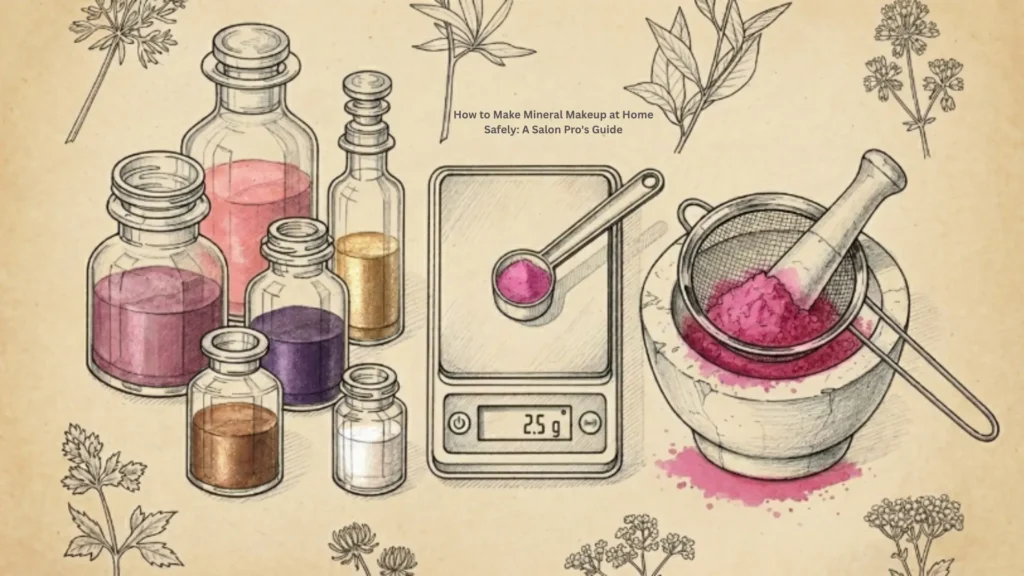
Start with loose powders:
- Finishing powder ← easiest, start here
- Setting powder
- Loose blush
- Loose bronzer
- Loose mineral foundation
Do not start with: pressed powder, mascara, eyeliner, lipstick, or anything claiming SPF. These need binders, preservatives, or regulated testing that home setups don’t have.
A note from our lash and brow side of the salon: the eye area is the most sensitive zone we work on, and eye-area products are the most common source of reactions we encounter. If you ever make anything for the eye area at home, the pigments must be explicitly approved for eye use face-approved is not enough.
The Ingredients (and What Each One Actually Does)
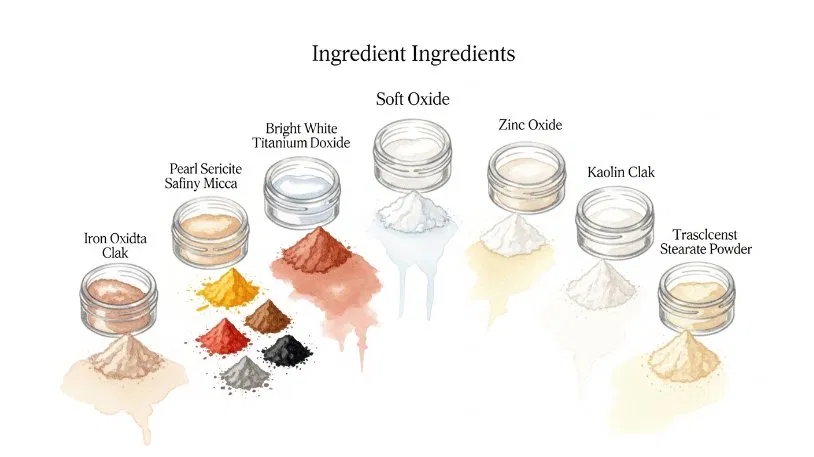
Before you buy anything, understand what each powder is for. Do not buy random colored powders online and assume they’re skin-safe.
Sericite Mica the base
Gives the powder its smooth, silky slip. Sericite is the beginner choice for face products because it’s satin-matte rather than glittery. Regular shimmer mica works for eyeshadow, not foundation.
Titanium Dioxide coverage
The main opacity ingredient. This is what makes foundation actually cover uneven tone. It’s also an extremely fine powder this is the ingredient that makes the dust mask non-negotiable. We’ve covered this ingredient in depth in our guide to titanium dioxide in makeup: safety, uses and risks read that before you buy it.
Zinc Oxide coverage and texture
Similar role to titanium dioxide, with a slightly more matte, adhesive feel. Critical point: zinc oxide being a sunscreen ingredient does NOT make your powder a sunscreen. More on this below it’s the claim our skincare team worries about most.
Iron Oxides the color
Yellow, red, brown, and black iron oxides are how you build skin tones. They are shockingly strong: as little as 0.05g of black oxide barely the tip of a knife can shift an entire 10g batch from medium-warm to ashy gray. Treat black oxide like a seasoning, not an ingredient, and add it with a toothpick.
Kaolin Clay oil control
Absorbs oil, mattifies. Useful for oily skin formulas. Above roughly 10% of the formula it starts looking chalky the same powdery-buildup effect our artists have to correct when clients over-powder before an event.
Silica finish
Soft-focus, blurring effect. Common in finishing powders. Handle with the same respiratory caution as titanium dioxide.
Magnesium Stearate or Zinc Stearate adhesion
This is why professional mineral makeup survives an eight-hour wedding and naive homemade versions vanish by lunch. 3–6% of the formula is the usual working range.
Where to Buy Cosmetic-Grade Ingredients (US)
Stick to suppliers that specialize in cosmetic raw materials and publish INCI names and usage documentation for every product. In the US, the names formulators rely on most include TKB Trading, Making Cosmetics, and Coastal Scents all of them sell sericite, oxides, and texture ingredients in small hobby quantities. A starter set (sericite mica, titanium dioxide, four iron oxides, kaolin, and zinc stearate) typically runs in the range of $40–$70 and covers twenty or more 10g test batches, so this is a cheap hobby to start properly.
The test for cosmetic-grade: the listing should state an INCI name (for example, CI 77492 for yellow iron oxide) and explicitly say “cosmetic grade.” If a listing says “great for soap, candles, and resin” and gives no INCI name, walk away that powder was never intended for your face. Words like “natural,” “pure,” and “non-toxic” mean nothing legally. Craft mica, candle pigment, resin pigment, soap colorant, and food coloring are all unsuitable for facial makeup. No exceptions.
Tools You Need
- Digital scale that reads to 0.01g not 0.1g. Pigment additions are tiny; a 0.1g scale literally cannot see them.
- Small mixing bowl
- Mortar and pestle, or a small coffee grinder dedicated to cosmetics only never reuse it for food
- Fine sieve, 80–120 mesh fine enough to catch pigment clumps without clogging
- Gloves
- Dust mask or respirator
- Clean jars and labels
- A notebook or spreadsheet for batch records
The scale and the notebook are the two items beginners skip, and they’re the two that separate a repeatable formula from lucky guessing.
A Starting Formula (Real Weights)
This makes ~10g of loose foundation in a light-medium warm shade a deliberately small batch.
| Ingredient | Weight | % | Role |
|---|---|---|---|
| Sericite mica | 6.0 g | 60% | Base / slip |
| Titanium dioxide | 1.5 g | 15% | Coverage |
| Kaolin clay | 1.0 g | 10% | Oil control |
| Zinc stearate | 0.5 g | 5% | Adhesion |
| Yellow iron oxide | 0.6 g | 6% | Color |
| Red iron oxide | 0.25 g | 2.5% | Color |
| Brown iron oxide | 0.12 g | 1.2% | Depth |
| Black iron oxide | 0.03 g | 0.3% | Depth |
This will not match your skin. It’s a starting point. Your shade depends on depth and undertone and undertone is where almost everyone goes wrong.
Not sure of your undertone or skin type? Use our free professional skin type assessment before you formulate. It takes a few minutes and tells you whether your skin runs oily, dry, combination, or sensitive which changes the formula. Oily skin types benefit from the full kaolin and a touch of silica; dry skin types should cut the kaolin in half or the powder will cling and flake.
The Process, Step by Step
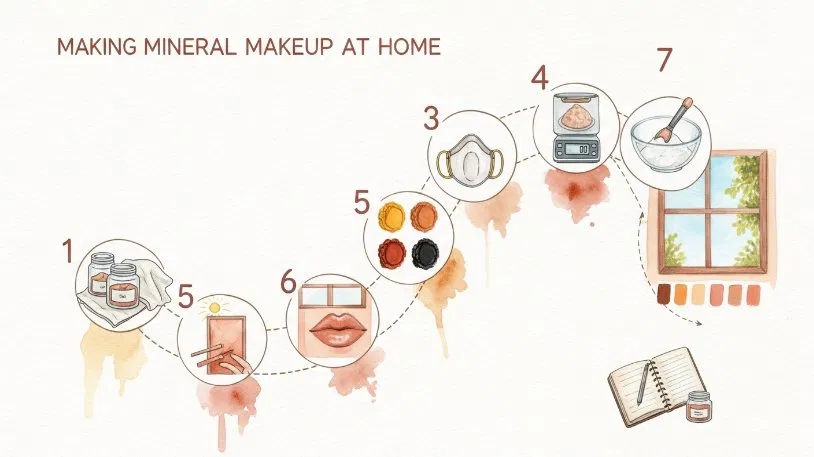
1. Clean everything
Wipe the table, wash and fully dry tools and jars. The same hygiene discipline we run in the salon applies at your kitchen table contamination ruins batches and irritates skin.
2. Put the mask on before opening any jar
Titanium dioxide and silica go airborne the moment you scoop them. No fans, no open windows, no pets or kids in the room.
3. Weigh and blend the base powders
Sericite, kaolin, stearate. Blend until uniform; sieve out clumps.
4. Add coverage powders slowly
Titanium dioxide or zinc oxide in two or three additions, blending fully between each. Rushing this gives you white streaks that look blended but aren’t.
5. Add iron oxides in this order: yellow → red → brown → black
Yellow is the most forgiving; black is the least. Blend thoroughly and check the color after every addition. Grinding each pigment into a small spoonful of base first a “pre-dispersion” before mixing it into the full batch prevents speckling.
6. Test on your jawline in daylight
This is exactly how our artists shade-match in the salon: jawline, natural light, never bathroom lighting. Swatch a small amount along the jawline and check it at a window or outdoors. Indoor bulbs hide both gray casts and orange casts; daylight exposes them instantly.
7. Adjust in 0.05g increments and write everything down
Professional formulas exist because someone kept records. Yours will too.
Shade Troubleshooting (From the Salon Chair and the Mixing Bowl)
These are the same corrections our makeup artists make when fixing a bad shade match translated into formulation terms.
| Problem | Likely cause | Fix |
|---|---|---|
| Too light | Not enough oxides overall | Add brown + yellow in a 2:1 ratio, 0.05g at a time |
| Too dark | Pigment-heavy | Add base powder plus a little titanium dioxide don’t “lighten” with white alone or it goes pasty |
| Orange | Too much red/yellow | Dilute with base, rebalance with a trace of brown |
| Gray / ashy | Too much black, or undertone imbalance | Dilute heavily; in future batches add black with a toothpick |
| Pink | Red-heavy | Counter with yellow |
| Chalky, dry finish | Too much kaolin or titanium dioxide | Increase the sericite proportion |
| Vanishes in 2–3 hours | No or low stearate | Bring adhesion to 4–5% |
The undertone mistake we see most: people judge their undertone by depth. They see “medium” skin and assume “warm,” or “fair” and assume “cool.” Depth and undertone are independent there are deep cool complexions and fair golden ones. If your batch looks right in the jar but wrong on your jaw, the depth is fine and the undertone is off. Adjust the yellow-to-red ratio before touching anything else.
Safety Rules (Non-Negotiable)
- Cosmetic-grade ingredients only INCI names on the listing, or don’t buy.
- Mask on for every mixing session. Every one.
- No SPF claims, ever even with zinc oxide in the formula. SPF is a tested, FDA-regulated claim in the US. An untested powder marketed as sun protection can give someone a serious burn. This is the single claim our skincare team flags most often on small-brand products.
- No acne, healing, or medical claims.
- Eye and lip area: only pigments approved for those areas.
- Patch test on your inner arm for 24–48 hours before using a new formula on your face. Watch for redness, itching, burning, stinging, or small bumps any of these means the formula doesn’t go near your face.
- Stop immediately if a product irritates your skin during use, and if a reaction persists or worsens, see a dermatologist rather than pushing through.
Homemade does not automatically mean safer. A bad ingredient choice makes homemade makeup worse than store-bought.
Can You Sell Homemade Mineral Makeup?
Experimenting for yourself is one thing. Selling is a different game entirely.
In the US, cosmetics are regulated by the FDA and color additives are one of the few areas where approval is mandatory, not optional. Every pigment in a product offered for sale must be an approved color additive for that use area. You’ll also need compliant labeling, batch records, and claims discipline, especially around SPF and “treatment” language, which the FTC also watches. Rules differ in other countries, so if you sell internationally, check each market separately.
We carry small-brand products in our shop, and the difference between brands we’ll stock and brands we won’t usually comes down to exactly this: supplier documentation, INCI-accurate labels, and no illegal claims. Making a powder is easy. Selling a cosmetic responsibly is not.
Final Thoughts From the EROthots Team
DIY mineral makeup is one of the best ways to understand what’s actually in your cosmetics texture, coverage, color, and oil control stop being marketing words and become things you’ve weighed on a scale. We’re for it.
But the chemistry is simple and the precision is not. Weigh to 0.01g, add pigment in absurdly small amounts, test in daylight, keep the log, and never make claims you can’t back up. And if your first batch turns out gray or orange good. That’s the batch that teaches you the most.
Want to see how the pros do it first? Book a makeup session or skin service at EROthots (2929 N High St, Columbus, OH walk-ins welcome), where our artists can show you your true undertone in person. It’s the single best shortcut to formulating a shade that actually matches. You can also browse the tested, professionally vetted products in our face makeup collection for ready-made mineral options.
Questions about an ingredient or a reaction? Contact our team we’re happy to help.