
Good skin isn’t only about what you put on it. It’s about what you put in you too. Some vitamins do real work here. Some get badly oversold. Worth knowing which before you spend money.
The two work together more than people realize, because your skin is the biggest organ you’ve got and it’s honestly last in line for whatever you eat, so when you’re short on the ones that count, your face is where it shows first. Dullness. Dryness. Lines that turn up early.
The ones that count help build collagen and elastin, the proteins that keep skin firm, and a few are antioxidants that fight the free radicals and UV that age skin too fast. So here’s the honest version, on your plate or in the products you use to feed your skin.
Vitamins for Glowing Skin

Vitamin A, the one that earns it

The big one, and it lives up to it.
It pushes your skin to build collagen and turn cells over faster, and that’s why retinol, which comes from it, is the anti-aging ingredient dermatologists actually back instead of just slapping on a label. Over time it really does improve texture and tone.
Where you get it:
- Food: sweet potatoes, carrots, spinach, kale, cantaloupe, apricots, eggs, cod liver oil.
- Skincare: retinol creams and serums.
But retinol’s strong, so go slow. Small amount, a couple of nights a week, then build up, because if you go in hard it’ll leave your skin red and raw, especially if you’re already sensitive.
And it makes you burn easier. So daytime sunscreen isn’t a suggestion when you’re on retinol, it’s the thing stopping the retinol from working against you.
Vitamin C, the one with real proof

This is the one with the strongest science, so take it seriously rather than just trusting the bottle.
A 2017 review in the journal Nutrients, by Pullar, Carr and Vissers, put it plainly: normal skin holds high concentrations of vitamin C, and it’s directly involved in building collagen and protecting skin from UV damage. That’s a real research review, not something a wellness account made up on a Tuesday.
Food’s easy. Citrus, berries, kiwi, bell peppers, and cruciferous stuff like Brussels sprouts and Broccoli, which does plenty for you beyond skin anyway.
On the skin it brightens, evens tone, fades dark spots, feeds collagen.
Two things when you buy it, and they matter more than the price:
- Get L-ascorbic acid, the most effective stable form.
- Get it in an opaque, airtight bottle, because vitamin C falls apart fast once light and air reach it. That clear dropper bottle on a sunny shelf is oxidized before you’re halfway through it.
And if you’d rather not gamble on getting all that right yourself, a treatment built around it like our Luminous ‘C’ and Sea Facial does the job in one go, pairing vitamin C with freeze-dried seaweed to soften fine lines.
Vitamin E

Another antioxidant, and it works hand in hand with vitamin C, the two of them actually regenerate each other, which is half the reason you see them bottled together. On its own it fights free radicals and UV and calms irritated skin.
- Food: almonds, sunflower seeds, hazelnuts, avocados, spinach, olive oil.
- Products: mostly moisturizers and face oils, for dry skin.
Two quick cautions. Pick something non-comedogenic so it won’t clog you, and patch test first, because some people react to it, so do that little test before applying it all over your face.
Vitamin K
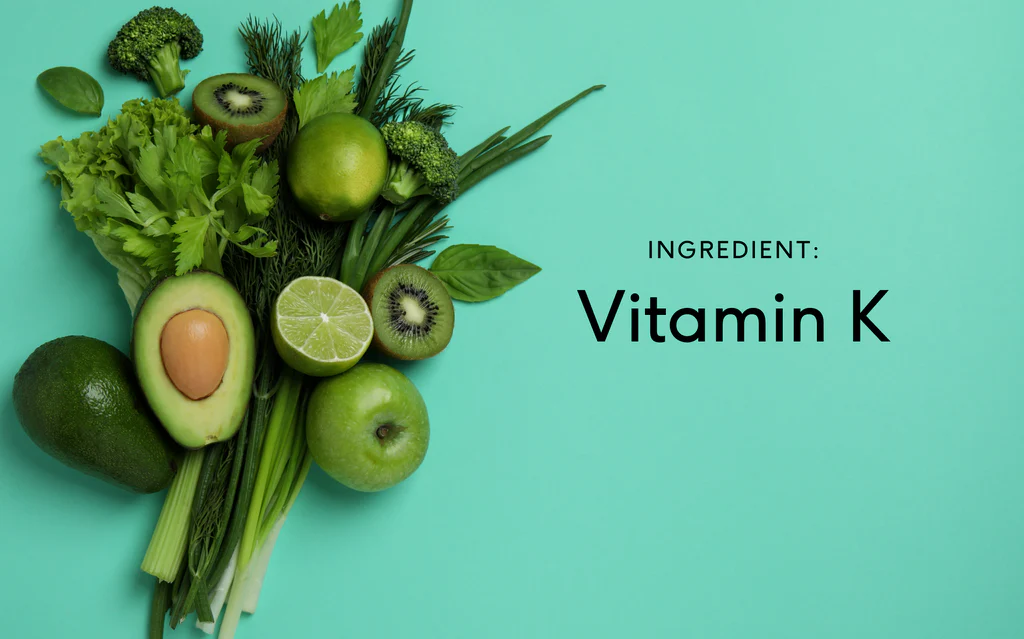
This one’s niche, and I’d rather be straight than oversell it. The skin claims here are the thinnest of the lot.
Its real job is blood clotting. The skincare angle is mostly dark circles and under-eye bruising, where some eye creams use it, and it might help, but the evidence is a lot softer than for A or C. WebMD’s page on Vitamin K covers the basics.
Food’s the easy win anyway: leafy greens, broccoli, Brussels sprouts, cabbage, fermented stuff. And if you do use a vitamin K eye cream, be gentle, because tugging that thin under-eye skin does more harm than the cream undoes.
Vitamin D

Matters for your skin and for you generally, since it’s tied up in cell growth and calming inflammation.
But here’s the awkward catch. Your body makes it from sunlight, and sunlight is also the exact thing wrecking your skin and driving up cancer risk. So the answer isn’t to go bake in it. Get it from food and sensible exposure, wear sunscreen, don’t treat the sun as a supplement.
- Food: fatty fish like salmon and mackerel, egg yolks, UV-grown mushrooms, fortified milk and juice.
Topical vitamin D isn’t really a thing, outside some research on psoriasis and eczema. It’s not a glow ingredient, and anyone selling it as one is reaching.
The B vitamins worth knowing

A few pull real weight. Here they are, no padding.
Niacinamide (B3) is the standout, and it’s earned the hype. Anti-inflammatory and antioxidant both, and it genuinely helps tone, texture, and fine lines. Get one at 2% or more and give it a few weeks, since it’s a slow real improvement, not an overnight one.
Pantothenic acid (B5) helps skin hold water and keep its barrier working, which is why it shows up in hydrating serums next to hyaluronic acid or glycerin. Same story, results take weeks.
Biotin (B7) feeds keratin, the protein behind skin, hair, and nails. Honestly it’s barely a topical ingredient though, the benefit comes from diet or supplements, so talk to a doctor before you start popping it rather than assuming more helps. Food-wise it’s eggs, nuts, seeds, legumes, whole grains, mushrooms, and it’s as good for your hair as your skin.
The bit nobody really wants to hear
Here’s the honest truth under all of it.
Vitamins help, and the research backs several of them. But they’re one piece, not the whole thing, and no serum undoes bad sleep, a rough diet, and skipped sunscreen.
The people with genuinely good skin are nearly always doing the boring stuff instead. A decent nutritious diet, real sleep, some movement, sunscreen every day, a routine they stick to. The vitamins ride on top of that. Not instead of it.
And before you load up on supplements, talk to a doctor or someone who actually knows skin, because more isn’t better, some of these are fat-soluble and quietly build up in you, and what your skin needs comes down to your skin, not a list off the internet.
That’s the whole reason we run an OBSERV Skin Analysis at the salon. It images what’s going on under the surface, so we match treatments to what your skin’s actually doing instead of guessing. If you’re near Columbus, the team can walk you through it in person.
Feed it from the inside, back it up from the outside, keep the sun off it, give it time. That’s the whole equation. It beats any single miracle bottle you’ll ever get sold.
Research references:
Pullar, J. M., Carr, A. C., & Vissers, M. C. M. (2017). The Roles of Vitamin C in Skin Health. Nutrients, 9(8), 866.
Zasada, M., & Budzisz, E. (2019). Retinoids: active molecules influencing skin structure formation in cosmetic and dermatological treatments. Postępy Dermatologii i Alergologii, 36(4), 392–397.
Bissett, D. L., Oblong, J. E., & Berge, C. A. (2005). Niacinamide: a B vitamin that improves aging facial skin appearance. Dermatologic Surgery, 31(7 Pt 2), 860–865.
Reichrath, J. (2007). Vitamin D and the skin: an ancient friend, revisited. Experimental Dermatology, 16(7), 618–625.
Patel, D. P., Swink, S. M., & Castelo-Soccio, L. (2017). A review of the use of biotin for hair loss. Skin Appendage Disorders, 3(3), 166–169.