
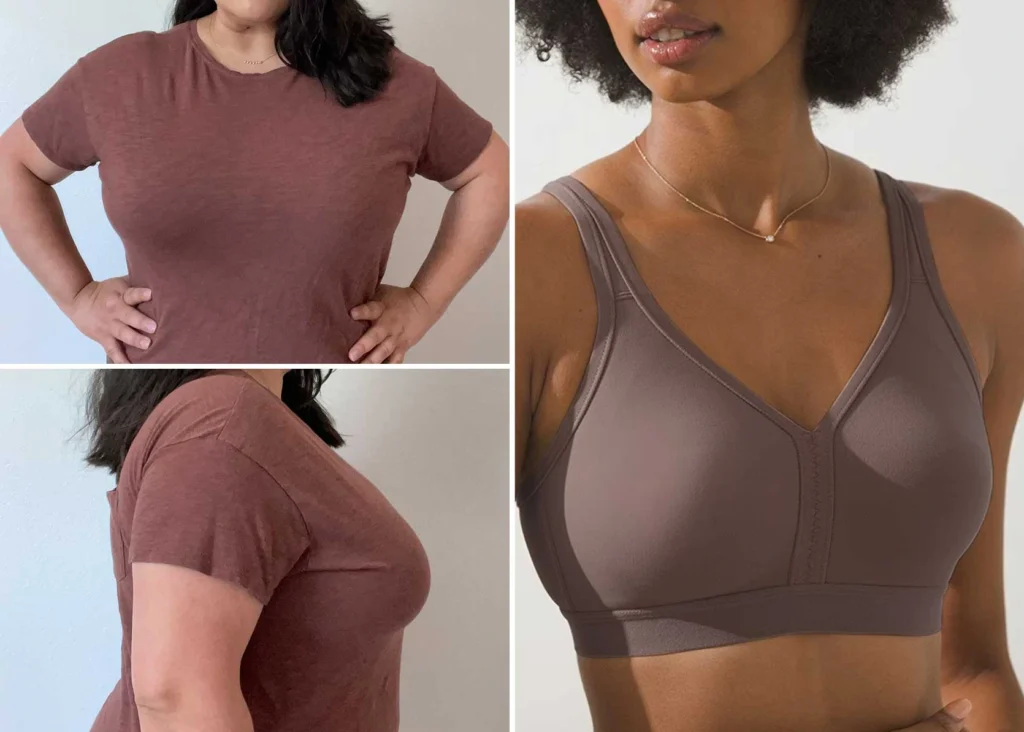
I, Rabia Sarfraz, know firsthand how frustrating it can be to find the perfect bra. It often feels like an endless search, trying to balance comfort, support, and style. There’s nothing worse than straps that dig into my shoulders, an underwire that feels restrictive, or a fit that just doesn’t offer the support I need. Thankfully, wireless bras have changed the game, proving that comfort doesn’t have to come at the expense of support.
Which makes the wireless question a volume question more than a comfort one:
- Under a C cup, more or less anything that fits properly will work. Buy what feels good.
- D through G it works, but the bra has to be built for it. Wide band, three or four hook rows, cups with seams or reinforcement instead of plain molded foam.
- Above a G you can still go wireless. You’ll be picking between containment and shape though, and that’s better known before you order than after.
What Makes Wireless Bras a Must-Have?

Most articles answer this with the missing wire. Wrong answer. What makes one worth owning is a band that carries weight without a frame helping it out, and when that part is right the bra is a real improvement on whatever you had before. When it isn’t, you’ve bought the same fit problem back in softer fabric.
Here’s the mechanical version.
A band an inch or two too big can’t grip your ribcage so it slides. Rides up your back. That tips the whole thing like a see-saw, the front drops, cups start gaping along the top edge, and now the weight of your breast tissue is hanging off your straps instead of sitting on your ribcage where it belongs. Most people respond by tightening the straps, since that’s the adjustment everybody knows how to make. Grooves in the shoulders. Neck tight by evening. Any fitter has heard the same summary a few hundred times, it digs in, there are marks on my skin, I want it gone. And the wire takes the blame because the wire is the bit you can feel.
Something else happens at the same time that catches people out. Once the band rides up at the front, the wire stops sitting in your inframammary fold and starts sitting on breast tissue, which hurts, but it’s a placement problem the band created rather than anything wrong with the wire.
So she switches to wireless. Sometimes it’s a permanent fix, because the wire really was sitting wrong and taking it out removed the pressure point. Fairly often the relief runs out after about three weeks, since the replacement got bought in the same band size and the whole thing repeats, just slower and in softer materials.
Wireless doesn’t repair a fit problem. It moves where you notice it.
Most women are wearing a band that’s too loose and it’s usually not their fault. Department store measuring added four or five inches to your ribcage measurement as standard for years, and plenty of women have never been fitted by anybody at all. If you’ve worn the same band number since your twenties, that number has almost certainly stopped being right, bodies move.
Choosing the Right Fit for Your Shape
Shape doesn’t tell you whether wireless will work. Volume does that. Shape tells you which of the different styles to reach for once you’ve settled the first question.
| Shape | What goes wrong without a wire | What to look for instead |
|---|---|---|
| Teardrop (fuller at the bottom, softer up top) | Cups gape along the upper edge, nothing’s filling them | Molded or lightly padded cups that hold their own shape, or stretch lace that collapses to follow yours |
| Round (fairly even top and bottom) | Usually nothing. Easiest shape to take wireless | Unlined or lightly lined. Skip padding, there’s nothing to correct |
| Asymmetrical (one side larger, so, most people) | Fit the larger side and the smaller cup wrinkles | Removable pads so you can fill one side, and straps you can set at different lengths |
| Wide-set (gap between the breasts, tissue toward the armpit) | Tissue migrates sideways with no wire containing it | Side slings or panels sewn into the cup |
| Close-set (little to no gap) | Center panel presses against the breastbone | A low or soft center gore, or a plunge cut |
The wide-set row needs more than a table cell. Side slings are panels of stretch fabric sewn into the outer edge of the cup and they push tissue back toward the middle. In an underwire bra the outside arm of the wire does some of that work. No wire and no sling means nothing does it, and you spend the day feeling like everything’s drifting toward your armpits. Listings call them side support panels, side slings, sometimes just extra side coverage. Check before you buy, it can’t be added later.
The Style Spectrum of Wireless Bras
Once fit is settled the styles stop being interchangeable and start doing different work.
A seamless t-shirt bra has bonded or molded cups with no stitching across the face of the cup, which is why it vanishes under a fitted knit. Molded foam holds less shape at volume than a seamed cup, though. Seamed cups shape better once there’s real weight in them but they can show lines under clothing where a smooth cup wouldn’t, so what you wear over it settles that one for you.
Lace is where the listing and the garment part company most often. It comes down to how much stretch is in the lace, and nothing else. Rigid lace or lace that’s been partly bonded holds a surprising amount. Four-way stretch lace holds essentially nothing whatever the description claims about support.
Sports bras are wireless by default, and it’s worth knowing which mechanism you’ve got. Compression flattens tissue against your chest wall, encapsulation wraps each breast separately. Over a D cup, walking and yoga do fine on compression alone. Running doesn’t. Running wants both working together.
Nursing and maternity is the one category where wireless wins for structural reasons rather than comfort ones, because ribcage and cup volume are both moving week to week and a rigid frame can’t follow that. Four hook rows rather than two. You will use them.
Beyond Style – Fabric and Features Matter
Above a D cup this stops being a comfort preference and turns into an engineering problem.
A wire is a frame. It shifts weight outward onto the band and holds the cup in a defined shape while doing it. Take the frame away and something has to cover both jobs at once. Elastic tension manages up to a point, then stops managing, because the load grows faster than the fabric’s ability to resist and the cup collapses into a rounded lump.
Brands that solve this solve it with construction, and the gap between wireless bras engineered to hold and ones engineered to feel nice is much wider than the marketing lets on. Glamorise builds its MagicLift line with a crisscrossed cup running under and over the bust plus a reinforced band sewn into the inner bust, and it goes from a 32 band to a 58 in cups B through K. Wacoal’s wire-free styles stop at a G. Soma’s Embraceable covers 34 to 44 bands in C through H, though the cup sizing runs generous enough that a lot of women size up a full letter coming from somewhere else. None of those are the same object as the one-size seamless bralette, which has no band structure to speak of and can’t be corrected when it fails since there’s nothing in it to adjust.
The features that actually predict whether it’ll hold:
- A band two to three inches deep under the cup line.
- Three or four hook rows.
- Seamed or crisscrossed cups instead of plain molded foam.
- Straps set wider apart, anchored further out on the cup.
- Side panels if your tissue likes to travel.
Fabric sits underneath all of that and changes how a bra feels rather than how much it holds. Cotton breathes and softens up over time. Microfiber sits flatter under close-fitting clothes. Bamboo blends handle heat and damp better than most synthetics, which matters more than people expect if you run warm or you’re going through hot flashes. None of it is support. A lovely soft cotton bra in the wrong band size fails exactly the way a cheap polyester one does.
Stretch content is the one fabric spec that crosses into support territory, since less give means more load carried, and it’s also the number nobody bothers publishing. Roundups of the best lingerie for women lead with how things feel against the skin and skip stretch percentage entirely. Stretch percentage is what decides whether you’re still being held at six in the evening.
One more thing that surprises people. Wireless bras wear out faster at volume, because nothing rigid is sharing the load and everything doing the work is elastic under constant tension. Foam compresses and stops springing back. Bands relax. Wear one daily as your only bra and the support drops off noticeably inside a few months. Three in rotation with hand washing stretches that a long way. It’s also why a new bra should fit on the loosest hook, the tighter ones are your budget for later.
Why I Switched to Wireless Bras

Honestly, the reason I’d give anyone asking isn’t the one the category sells.
Not everyone switching is in pain. Plenty are moving toward a more relaxed lifestyle and want one less rigid thing in the day, which is reason enough on its own. But when pain is driving it, which kind of pain you’ve got decides whether any of this helps.
Pain from straps carrying weight they shouldn’t be carrying gets fixed by correcting your band size, and going wireless is incidental to it. Pain from a wire sitting on tissue instead of under it does improve when the wire goes, though a proper fitting would have sorted that too. And if it’s a rigid wire pressing somewhere sensitive on your ribcage, wireless is a clean answer with nothing else to think about.
What it won’t do is fix back pain with some other cause behind it. Upper back or neck pain that doesn’t shift when your bra fit shifts is a doctor conversation rather than an underwear one. It also isn’t a post-surgical garment. Anyone recovering from breast surgery will have been told specific things by their surgeon about closure type, compression, timing, and those instructions beat anything general written here.
Five Checks That Tell You If a Wireless Bra Actually Fits
Ten minutes, tags still on:
- Fasten it on the loosest hook. If it only feels secure on the tightest one the band is too big and you’ve got no adjustment left for later.
- Two fingers flat under the band at the back. Snug, with resistance. If three slide in easily, drop a band size and go up a cup letter to keep the volume.
- Look at yourself from the side. The band should sit parallel to the floor the whole way round. Riding up at the back means loose. Every time.
- Loosen both straps nearly all the way, then stand up. It should still hold you, with less shape to it. If everything drops, the band was never doing the work.
- Arms overhead. Band shouldn’t climb, cups shouldn’t lose contact underneath.
Pass all five and the rest of it is preference. Fail the second or third and nothing else about the bra matters yet, no amount of strap tightening is going to rescue that.