
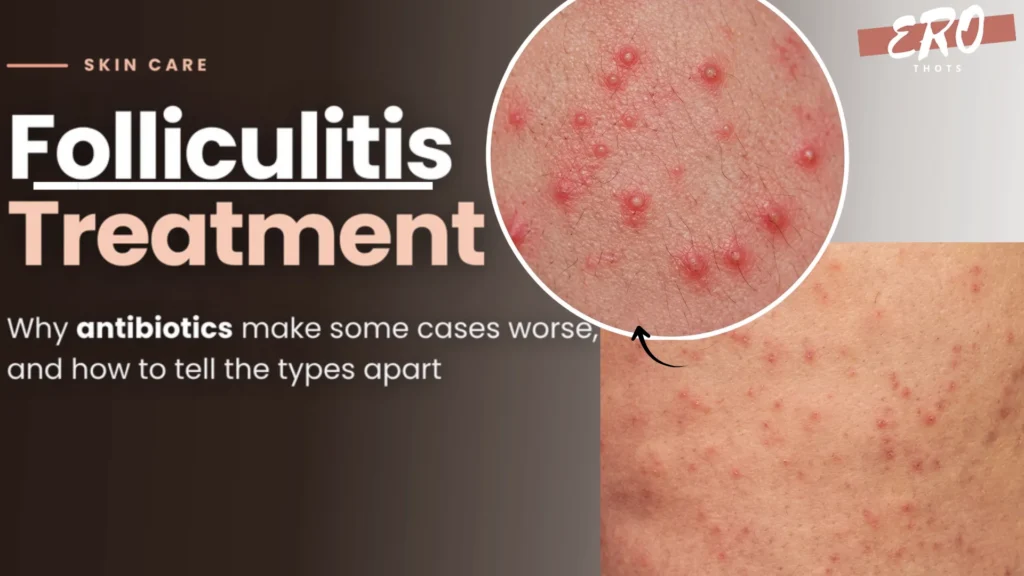
Folliculitis is an inflamed or infected hair follicle, and what shows up on the skin is a scatter of small red bumps, a few of them topped with a white head, sitting wherever hair grows and looking so much like acne that it often gets treated as acne. Folliculitis treatment depends on what inflamed the follicle, because the antibiotic that sorts out a staph case will feed a yeast one.
Folliculitis Treatment Splits Three Ways

There are 3 directions this goes and they don’t overlap much. Mild cases need very little, warm compresses and an antiseptic wash, and most are gone inside 7 to 10 days with no prescription involved. Bacterial cases need an antibacterial. Yeast cases need an antifungal.
Then there’s whatever set it off, which is where a lot of the stubborn cases live, because a collar rubbing the back of the neck or a razor dragged over the same patch twice a week or a hot tub that hasn’t seen chlorine in a while will keep producing fresh bumps however much cream goes on the old ones, and the prescription gets blamed when the real cause is still happening daily.
Clinical guidance doesn’t call for a swab on the first visit. Treating on appearance is the normal opening move, which puts a lot of weight on what you tell whoever is looking at it. Where the bumps are. Whether they itch. Whether there’s a blackhead anywhere in the patch. What you did to that bit of skin in the week before they turned up.
Mupirocin Or Clindamycin Clears The Common Kind
Staphylococcus aureus is behind most folliculitis, and the treatment for it isn’t complicated. Topical mupirocin or topical clindamycin handles most cases. A 5% benzoyl peroxide wash in the shower for 5 to 7 days works too. Once the spots have spread across a wide area, that’s when an oral antibiotic comes in, usually cephalexin for 5 to 10 days.
Months On Antibiotics Can Backfire
Gram-negative folliculitis turns up in people who have been on oral antibiotics for long stretches, usually tetracyclines for acne. It isn’t common. It does mean a course of treatment can produce its own crop of bumps, and more of the same drug won’t shift those.
Years Of Acne Treatment, And It’s Yeast
Malassezia folliculitis comes from a yeast everybody carries, which only causes trouble once it overgrows. A 2025 review pulled together what tends to happen to these patients before anyone identifies the yeast. In one group of 26, about 2 in 3 had already been misdiagnosed and put on antibiotics or acne products. In a bigger group of 110, 3 out of 4 had been treated for acne and it hadn’t worked.
Antibiotics are one of the things that let the yeast overgrow in the first place. Humidity, heavy sweating, occlusion and a weakened immune system do it too.
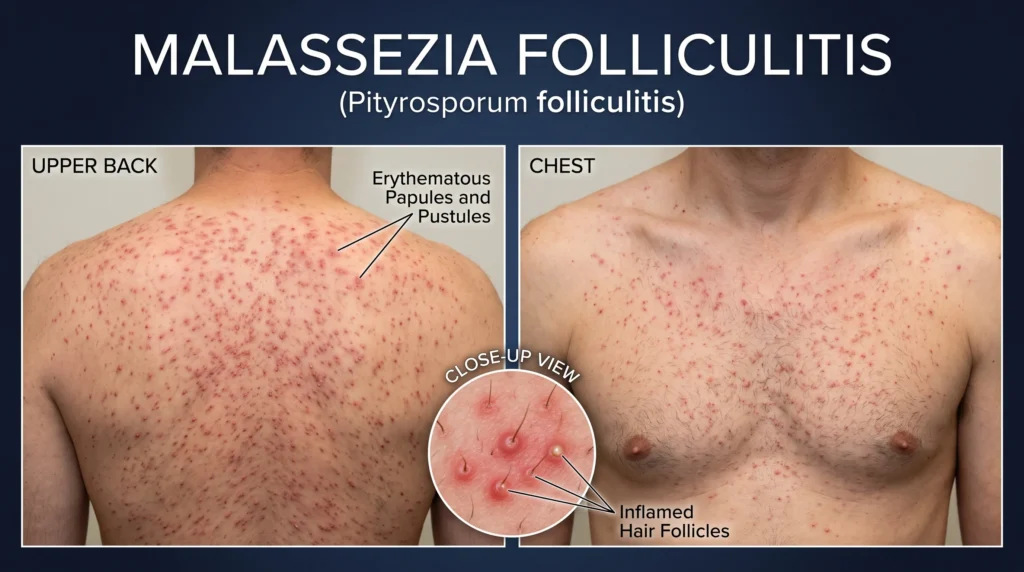
Look For Itch, And No Blackheads
Three things separate it from ordinary acne:
- the bumps are all much the same size, where acne gives you a mix
- there isn’t a blackhead or a whitehead anywhere in the patch, which is the strongest single sign
- it itches, and about 2 in 3 said so in one patient group, 7 in 10 in another
It sits in the oily areas, so upper chest, back, shoulders, hairline and face. One group of 48 ran heavily male, 11 to 1, and most of them worked somewhere warm.
Antifungals Clear It
Fluconazole by mouth, 200mg a day, for 1 or 2 weeks. Ketoconazole 2% cream twice a day takes longer at 4 to 6 weeks, and a 2% selenium sulfide shampoo once a week for 3 weeks is the other option. Expect it back at some point. About a quarter of the people who respond see it return inside 4 months. The humidity and the sweating have to change as well or you’re on a loop.
Steroid Creams Buy You A Rebound
A topical steroid will take the redness down within a day or two. On the yeast type it suppresses the inflammation while the yeast carries on underneath, and the review describes a rebound flare once the cream stops.
Ask For The Swab
Testing isn’t routine at the start, and that’s reasonable enough. If the first treatment fails, or the thing keeps returning, the next step in the guidance is a Gram stain and culture of the pustules. A nasal swab goes with it, since staph often lives in the nose between flares and reseeds the skin from there.
For the yeast type it’s a skin scraping under the microscope, which picks it up about 4 times out of 5. A Wood’s lamp shows a yellow-green glow in about 2 out of 3. Neither takes long.
Waxing An Inflamed Follicle Is The Worst Thing You Can Do
Waxing carries a higher folliculitis risk than the other hair removal methods, even on calm skin. Pulling hair out of follicles that are already inflamed does the obvious. While a flare is active, stop the hair removal, and stay out of pools, saunas and hot tubs until it settles. Don’t pick at the spots either. Opening one up is how a surface problem gets deeper.
Razor Bumps Are Something Else
Pseudofolliculitis barbae is a stiff hair growing back into the skin and irritating it. No infection, so there’s nothing there for an antibiotic to do. People confuse keratosis pilaris with folliculitis too, those rough sandpapery patches on the arms and thighs, and that one is keratin building up around the follicle.
Between flares the useful habits are dull ones. Exfoliate regularly, wash the area before and after hair removal, keep the razor clean and sharp, don’t share it with anyone. If you’d rather someone else handled the exfoliation, our Spa Glow Exfoliation ($60, 40 minutes) does it. And if your skin is up on the morning of a wax, move the appointment.
Hot Tub Rash Sorts Itself Out
Pseudomonas folliculitis comes out of a tub whose water chemistry has drifted. It shows up 6 hours to 5 days after you’ve been in, concentrated under where the swimsuit sat, so torso and buttocks mostly. It generally clears on its own. The tub is what needs attention, and changing out of a wet swimsuit instead of sitting around in it helps.
Take It To A Doctor If It Spreads
Take it to a physician if:
- the rash moves past where it started.
- spots go firm or painful, or start draining.
- you get a fever, chills, or feel wiped out.
- a hot tub rash hasn’t faded after a few days.
- it’s in the beard area, which can scar
Skin that keeps reacting to hair removal is a separate conversation, and we run complimentary consultations for that.
From a couple of feet away these all look the same. What separates them is the history, so the itch and the missing blackhead and the hot tub last Tuesday are the details to lead with.