

So is your skin barrier damaged? If the stinging, tightness or flaking keeps coming back, and it started after you added something new or stronger, your skin barrier may be irritated or disrupted. In most cases, the barrier recovers once you stop the habits that keep wearing it down. Most of the fix comes from taking products out of your routine.
You’ve stuck with your routine, you buy decent products, yet your face looks worse anyway. Things that never bothered you now sting. Your skin feels tight right after washing, then oily by lunch, while the dry patches won’t budge.
What The Skin Barrier Actually Does
The barrier is the outermost layer of your skin, the part dermatologists call the stratum corneum. Flat, dead cells sit packed together with fats filling the gaps, a bit like bricks held in place by mortar. By weight, those fats are roughly 50% ceramides, 25% cholesterol, 15% free fatty acids.
That layer keeps water in. It also keeps irritants, germs, allergens out. Once it wears down, water escapes faster, so things that used to feel like nothing start to burn.
Bad Skin Day Or Damaged Barrier? How To Tell The Difference
Everybody gets off days. A short night, a stressful week or your period can all show up on your face. A bad day tends to look like this:
- A pimple or two that showed up overnight.
- Dull and puffy after a rough night’s sleep.
- Slightly oilier or drier than usual, but nothing stings.
- It goes back to normal without you changing a thing.
Barrier damage hangs around longer, and it shows up in these ways.
Common Causes Of A Damaged Skin Barrier
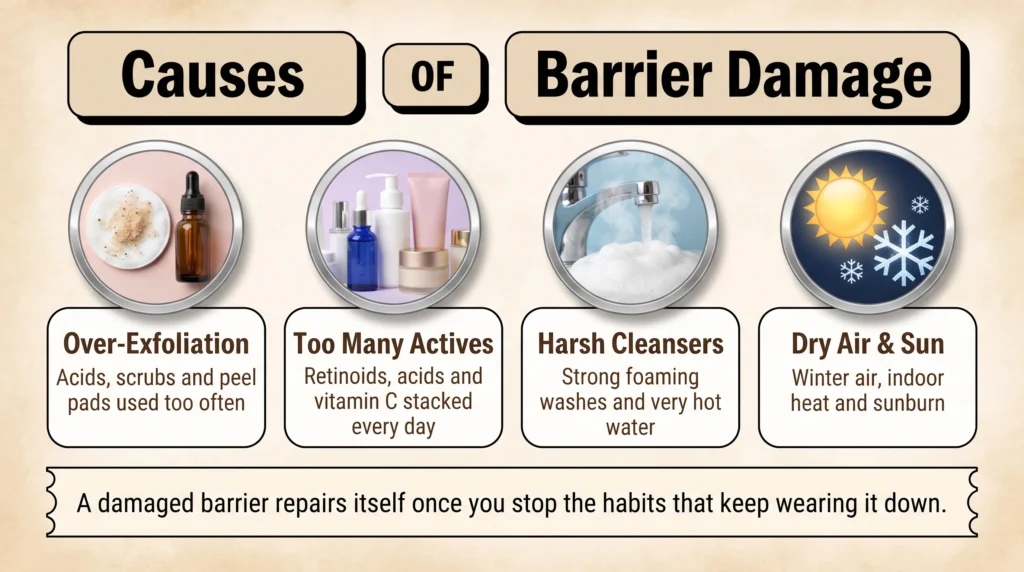
Over-Exfoliation
Acids, scrubs, peel pads, cleansing brushes all remove the top layer of cells on purpose, which is the layer you’re trying to protect right now. The more aggressive the exfoliation, the less often it should happen. Overdo it and your face turns red, irritated. If you have a darker skin tone, or you get dark spots after bug bites, burns or breakouts, be especially cautious with aggressive exfoliation.
Too Many Actives In One Routine
A retinoid at night, vitamin C in the morning, an acid toner, a benzoyl peroxide spot treatment might each be fine alone. Stacked together, they all land on the same thin layer, day after day, with no break.
Harsh Cleansers, Hot Water
A face that feels squeaky and tight after rinsing is a hint your cleanser is too strong right now. Some foaming cleansers contain sodium lauryl sulfate, the same detergent researchers use to irritate skin on purpose in barrier studies. Switch to a gentle, fragrance-free cleanser with lukewarm water, using your fingertips instead of a washcloth. Wash twice a day at most, plus after you sweat.
Cold Air, Indoor Heat, Sun
Dry winter air pulls moisture out of your skin, indoor heat does the same. A sunburn damages the same layer you’re trying to fix, so sunscreen stays in your routine while almost everything else comes out.
Adding More Products Makes It Worse
When everything stings and flakes, the natural reaction is to add something. A calming serum for the redness, a mask for the dryness, maybe a stronger acid for the bumps. Each new bottle lands on a surface that’s already irritated, so even gentle ingredients can burn. Every reaction also makes it harder to tell what started the trouble, while the routine keeps getting longer.
How To Repair Your Skin Barrier, Step By Step
Step 1: Cut Your Routine Back To The Basics
A repair routine needs only 3 things: an ultra-gentle cleanser, a hydrating moisturizer, a sunscreen. Stop bringing in new products for now, too.
- Morning: gentle cleanser, moisturizer, then a broad-spectrum sunscreen with SPF 30 or higher.
- Night: gentle cleanser, then moisturizer.
Put these away until things calm down:
- Retinoids and retinol.
- Exfoliating acids, peel pads, toners with AHAs or BHAs.
- Scrubs, cleansing brushes, washcloths.
- Benzoyl peroxide and vitamin C serums.
- Heavily fragranced products.
If a dermatologist prescribed your retinoid or acne treatment, ask before you stop it. Keep showers to 5 to 10 minutes in warm water, never hot on your face.
Step 2: Pick A Moisturizer With The Right Ingredients
Look for these on the label:
- Ceramides, cholesterol, fatty acids. These are the fats your barrier is built from, so a moisturizer that contains them can help support it. You don’t need to match any exact mix. Seeing ceramides on the label, ideally with cholesterol or a fatty acid such as linoleic acid nearby, is enough.
- Glycerin, hyaluronic acid. Both pull water into the top layer.
- Niacinamide. Lab research shows it raises the skin’s own production of ceramides along with other barrier fats, which helps lower water loss. Products typically use 5%.
- Panthenol. In detergent-irritation studies, a cream with dexpanthenol, the active form of panthenol, sped up repair and cut redness better than a placebo cream.
Step 3: Seal It In With Petroleum Jelly
Put your moisturizer on while your face is still a little damp. At night, add a thin layer of plain petroleum jelly over the driest, most irritated spots. It’s one of the most effective ways to slow water loss from the skin.
Petroleum jelly sits on the surface, slowing water loss right away, which gives your skin time to rebuild underneath. One exception: if you have bumps clustered around your mouth or nose, skip this step. Heavy, occlusive products are a known trigger for perioral dermatitis.
Step 4: Bring Back Your Actives One At A Time
Once the stinging and tightness are gone, start adding things back one at a time. For a retinoid, pick the gentlest formula you can find. Use it every other night to start, build up slowly, keep it to nighttime, wear sunscreen every day. Give each product time to show how your skin handles it before you add the next. If the burning comes back, drop the last thing you added.
If You Want To Return To Professional Treatments
None of the repair steps above needs a salon visit. Your barrier can recover with the simple routine alone, so a facial is entirely optional.
If you’d like to ease back into treatments once the stinging is gone, start with something hydrating rather than exfoliating. Our Plantomer Facial ($90) uses a hydrating seaweed blend made to soothe and nourish the skin, with no peel or scrub involved. If your face has been reactive lately, mention it when you book so your esthetician knows what’s going on.
Chemical peels go last. A peel is exfoliation too, so it waits until your home actives are back without any stinging. Ours run $80 to $140 when you’re ready.
How Long It Takes To Heal
There’s no set recovery period, since it depends on what caused the damage and how far it went. Mild irritation often settles within a few days to a couple of weeks once the irritating products are out. More stubborn damage can take longer. You’ll know it’s healing when your usual moisturizer stops burning, washing no longer leaves you tight, the flakes stop coming back.
See a board-certified dermatologist if things aren’t improving on the simple routine. The same goes for cracks that bleed, yellow crusts, pus or swelling, which can point to an infection.
The waiting is the hard part. When your face looks irritated, doing less feels wrong, so it’s tempting to try one more serum. Hold off. Your barrier is good at repairing itself once nothing keeps disrupting it.