
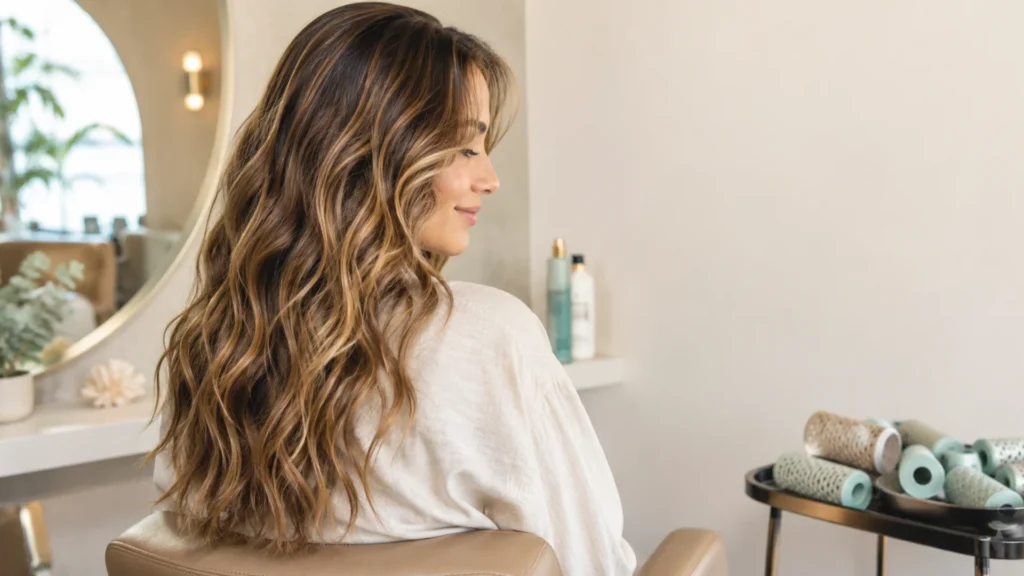
Most people in the US pay somewhere between $100 and $400 for a beach wave perm, and hair length is the main thing that moves the number.
| Hair length | Typical range | What drives it |
|---|---|---|
| Short, above the shoulder | $150 to $300 | Fewer rods, shorter chair time |
| Medium, shoulder to mid-back | $250 to $450 | More sectioning, more solution |
| Long or very dense | $400 to $700 | Two to three hours of rolling alone |
Some salons quote far lower. A body wave listed at $70 to $150 is common, and specialty beach wave services often start around $100 to $200. That’s a spread of roughly $600 for what sounds like one service, and the reason has almost nothing to do with the salon being expensive.
For a Columbus reference point, chemical work at our salon starts at $75 for single process color and $85 for highlights or balayage, and a wave service sits in similar territory depending on your length and density. We quote it at consultation instead of publishing a flat number, because the honest answer changes with the head of hair in front of us.
What Happens In The Chair
Plan for two to three hours. Longer if your hair is past your shoulder blades.
- Consultation and Assessment: The stylist checks elasticity and looks for previous chemical work. This is where a perm gets declined, and it should.
- Wash, no Conditioner: Conditioner coats the cuticle and stops the solution penetrating evenly.
- Sectioning and Rolling: The slowest part. Beach waves use larger, softer rollers than a traditional perm, which is what produces a loose S-bend instead of a spiral.
- Processing: An alkaline solution breaks the disulfide bonds inside the hair shaft. These are the internal links that hold your hair in whatever shape it currently has.
- Neutralizing: A second solution reforms those bonds around the new shape. This step is the perm. Skip or rush it and the wave doesn’t hold.
- Rinse and Finish: Usually air dried or diffused on low.
The solutions used for beach waves are often ammonia-free and gentler than old-style perm chemistry. Gentler is not the same as harmless. It’s still a chemical restructuring of the hair, and the American Academy of Dermatology makes the point that perm timing should follow the specific product’s directions instead of a general rule, because the products differ.
Expect the wave to hold three to six months, growing out gradually rather than leaving a hard line.
Who This Works On, And Who Should Wait
Works well on:
- Virgin hair, or hair with light previous processing.
- Straight hair that won’t hold a curl.
- Naturally wavy hair that wants more definition.
- Medium to coarse textures, which take the pattern most reliably.
Wait, or get a second opinion, if:
- Your hair is bleached or heavily highlighted.
- You’ve had a perm in the last three to six months.
- You’ve had a relaxer or keratin treatment recently.
- Your ends are already breaking.
Fine hair can take a beach wave perm, but it needs a shorter processing time and a stylist who’s willing to check early and often.
That keratin point catches people out more than any of the others. We offer keratin smoothing in-house and it’s a lovely service, but it’s doing the opposite job to a perm. One relaxes the pattern, the other builds one. Stack them close together and you get hair that holds neither.
9 Care Tips That Keep The Wave
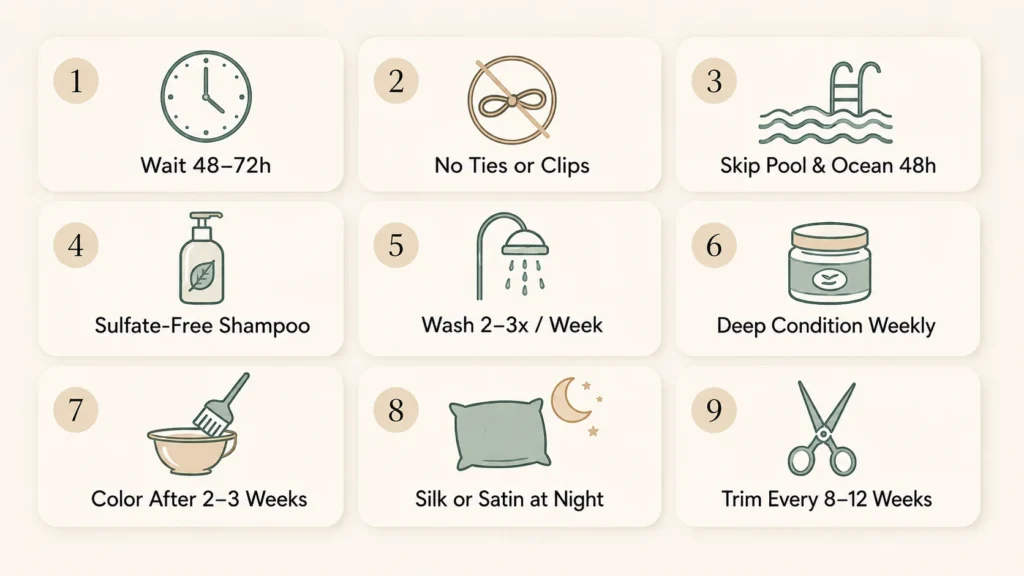
The first three matter most, and they all happen in the first two days.
1. Don’t Wash It For Atleast 48 Hours: Longer if your hair is fine, previously colored, or your scalp runs sensitive. 72 hours is the safer number for all three. The bonds are still settling and water makes each strand swell, which loosens the shape before it’s locked.
2. Don’t Tie It, Clip It, Or Tuck It Behind Your Ears: Any crease, bend, or bit of tension marks the new curl. This includes sunglasses pushed up on your head. Two days of leaving it completely alone.
3. Stay Out of Pools And The Sea For 48 Hours: Chlorine and salt water both weaken a fresh pattern. Later on, wear a cap and rinse with fresh water straight after.
Then the routine changes, and this is the part that decides whether you get three months or six.
4. Switch To Sulfate-Free Shampoo: Sulfates strip the moisture permed hair needs and fade the pattern noticeably faster. This is the single most common reason a perm relaxes early. Anything labeled for curly or chemically treated hair will do the job, and we keep a shampoo and conditioner shelf in the salon if you’d rather not guess in a drugstore aisle.
5. Wash Less Often: Two or three times a week. Between washes, rinse with water and use a little conditioner to reshape rather than doing a full wash. A lightweight hair oil through the mid-lengths and ends helps on the days you skip, though keep it away from the roots. Lukewarm water, not hot.
6. Deep Condition Weekly, And Consider A Bond Treatment: Permed hair is drier by definition, since the process opens and reforms the cuticle. A weekly mask isn’t an optional extra here. We run Olaplex in-house and it’s the treatment we’d point a newly permed client toward, because it works on the same bonds the perm just rearranged.
7. Wait Two to Three Weeks Before Any Color: Two chemical services back to back is how hair ends up over-processed. If you want both, space them, and tell whichever stylist goes second what was done first. Our colorists spend a fair amount of time on correction work, and a decent share of it starts with two chemical services booked too close together.
8. Sleep On Silk or Satin: Cotton friction breaks the pattern overnight. A silk pillowcase, a scarf, or a loose pineapple all work. Don’t sleep with it tied up during the first week.
9. Trim Every Eight To Twelve Weeks: Damaged ends unravel the wave from the bottom up. A small trim keeps the shape reading as intentional rather than grown out.
One more that isn’t a care tip but belongs here: wait three to six months before perming again. Repeat chemical processing on the same hair is where breakage comes from.
Call The Salon Back If Something’s Off, And Do It Inside Two Weeks
Perms occasionally don’t settle the way the stylist expected. Uneven curl, waves that came out tighter or looser than planned, a chemical smell that won’t rinse out.
Most salons will look at it and adjust within a seven to fourteen day window. After that you’re usually into paying for a correction, and corrections on chemically treated hair run $150 and up.
Which is the actual argument for the consultation, and for asking the rod-size question before you sit down. A beach wave perm that suits your hair is a good three to six months. One that didn’t get assessed properly is an expensive problem you’re then living with while it grows out.
If you’re in Columbus and thinking about it, book the consultation before you book the service. We’re at 2929 N High St, and the assessment costs you nothing but the appointment slot.