
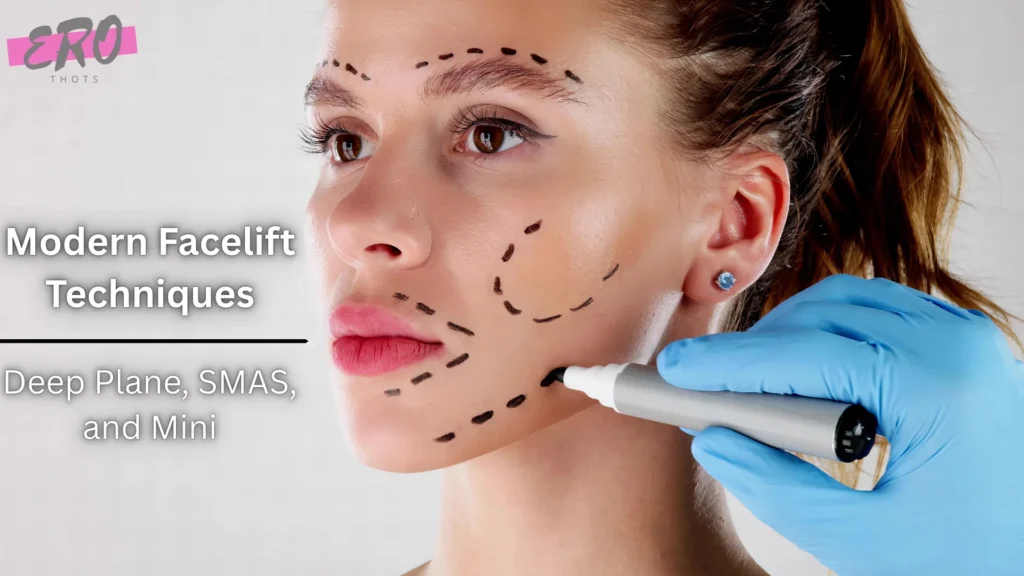
Leading procedures include the comprehensive Deep Plane Facelift, minimally invasive Mini Facelift, and structural Fat Grafting to restore youthful volume.
Nobody regulates what a clinic calls its facelift.
Every technique name describes one variable: which tissue layer the surgeon gets underneath, and how far they release it. Useful information. Just far less than the marketing implies.
| Technique | What gets worked | Downtime | Cited durability | Suited to |
|---|---|---|---|---|
| SMAS plication / SMASectomy | Sheet folded, trimmed, or sutured from above | 10 to 14 days | 5 to 10 years | Jowls, soft jawline |
| Deep plane | Dissection beneath the SMAS, ligaments released, tissue moved as one block | 2 to 3 weeks | Around 10 years | Midface descent, deep folds |
| Extended deep plane | Same, carried into the neck | 2 to 3 weeks | Around 10 years | Face and neck together |
| Short scar / MACS / mini | Shorter incision, usually SMAS work under it | 1 to 2 weeks | 5 to 7 years | Early jowling, elastic skin |
| Thread lift | Barbed sutures placed, nothing released | Days | 6 to 12 months | Very mild laxity |
Scale: ASPS members logged 79,058 facelifts in 2024, up one percent. Average surgeon fee $11,395, which excludes anesthesia and the operating room.
What Modern Facelift Techniques Actually Release
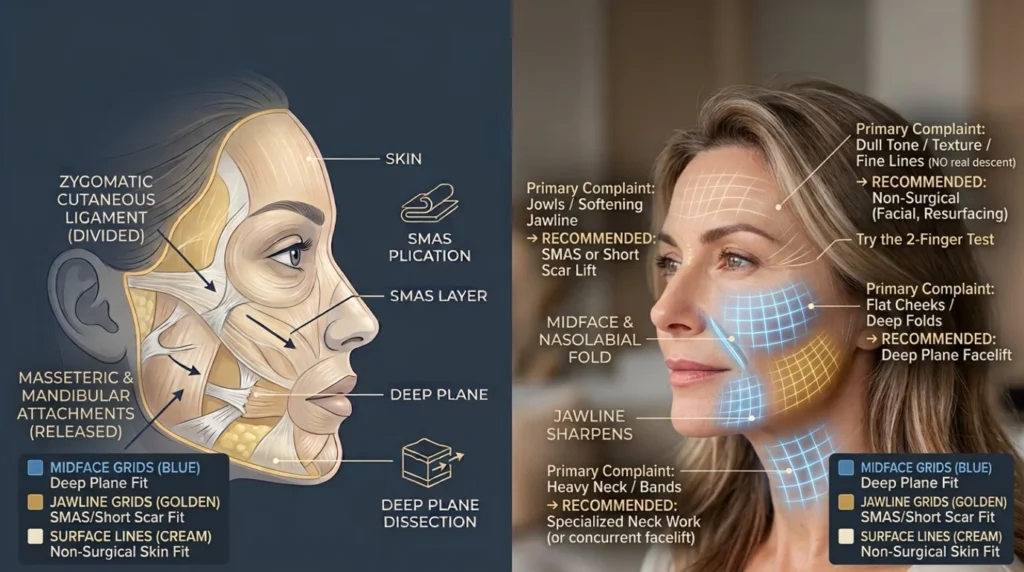
Read any name as a depth.
SMAS: the layer named in 1976
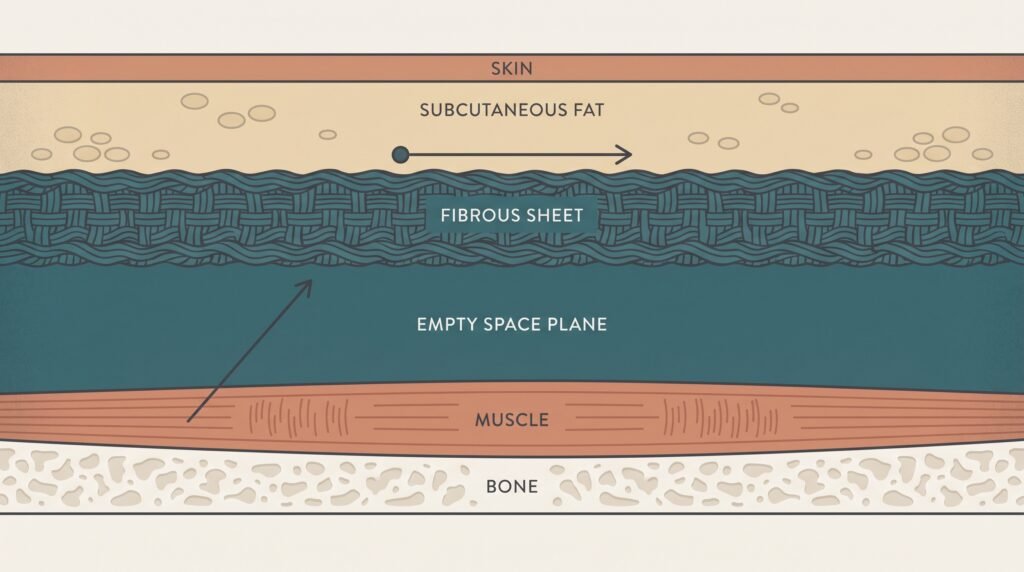
Mitz and Peyronie mapped the superficial musculoaponeurotic system, the fibrous sheet tying facial muscles to skin. A SMAS lift raises the skin, then tightens that sheet from above. Fold it over and that’s plication, cut a strip out and that’s a SMASectomy.
Fast, predictable, decades of track record. The cheek stays where it is.
Deep plane: under the sheet, not over it
Sam Hamra published this in Plastic and Reconstructive Surgery in 1990 with 403 patients behind it, and named his target plainly: nasolabial folds had never improved much with existing lifts. His dissection ran above the zygomaticus muscles and past the folds, releasing the SMAS attachments to produce a composite flap of skin, cheek fat and platysma. The composite rhytidectomy followed in 1991.
Modern versions divide the zygomatic cutaneous ligaments, often adding masseteric and mandibular attachments.
The practical difference: SMAS tightens a layer, deep plane relocates a block.
Short scar: an incision, not a technique
Sideburn to earlobe, nothing behind the ear, usually SMAS work underneath. MACS is the formalized version from Tonnard and Verpaele. “Mini facelift” isn’t a defined operation, it’s an umbrella term.
Deep Plane Versus SMAS: The Research Is Thinner Than the Marketing
Does deep plane actually win?
On satisfaction, yes, by six and a half points. On complications it also wins, which is not the direction you want.
From a meta-analysis in Aesthetic Plastic Surgery covering 21 studies and 2,896 patients:
| Deep plane | SMAS | |
|---|---|---|
| Patient satisfaction | 94.4% | 87.8% |
| Complication rate | 17.2% | around 10% |
A second meta-analysis went broader: 47 studies, 10,766 patients, hematoma at three percent for deeper techniques against two for SMAS, nerve injury rates similar and mostly temporary. Then the finding that reframes everything. Only one of those 47 studies compared the two techniques head to head. It favored the deeper approach for the midface, and the authors said selection should be individualized because the comparative data isn’t there.
There’s also a study nobody cites to patients. Two sets of identical twins had facelifts by four different surgeons using different techniques, followed ten years with photographic analysis. Outcomes came out satisfactory regardless of technique. Tiny sample, but it’s the closest thing this field has to a controlled experiment.
So the deep plane holds firm ground on a narrower claim: releasing the retaining ligaments is what lets the cheek move. If your complaint is jowling alone, that dissection buys complexity you may not need.
The label problem matters more than any figure here. The term gets used loosely, so satisfaction rates attached to the phrase are measuring a range of operations rather than one.
Which Technique Fits Which Face
Anatomy decides this. Find your primary complaint:
- Jowls, softening jawline, skin still springy. SMAS or short scar.
- Flat cheeks, deep nasolabial folds, dropped midface. Deep plane.
- Heavy neck, platysmal bands. Needs separate work. Short scar techniques have limited effect there.
- Laxity after major weight loss. ASPS flagged semaglutide-type drugs as a probable demand driver, since they can produce facial skin laxity. Lifting alone underdelivers.
- A previous facelift. Revision typically needs a deeper approach.
- Dull tone, texture, fine lines, no real descent. Pull the skin taut at your temples with two fingers. If what bothers you is still visible, it isn’t laxity, and surgery is the wrong tool.
Mini Lifts Are Surgery, Thread Lifts Are Not
The MACS lift has been reviewed properly: six studies, 739 patients, no major complications, satisfaction consistently high, shorter operative time in three of the six. Modest evidence, modest but real result.
Thread lifts are a different proposition. A series of 111,948 procedures put average longevity at six to twelve months, with PDO threads degrading inside six to eight. A randomized trial found early gains had faded by sixty days and extra threads didn’t help. The evidence overall grades weak at level III at most: short follow-up, no control groups, subjective outcomes. The one controlled, blinded study found improvement limited and possibly driven by swelling.
Six to twelve months against five to ten years. Pricing them against each other doesn’t work.

What a Salon Handles, and Where Surgery Starts
Nothing on our menu lifts a cheek.
We’re a salon, not a surgical practice, and it’s worth being blunt about that, because plenty of places sell a facial with “lift” in the name and let you draw your own conclusions. Releasing a ligament needs an operating room.
Deciding whether you need surgery at all. Our skin services run from a Signature Facial at $85 through Refine + Hydrate and Hydrate + Firm at $115 to Rejuvenate + Revitalize at $190. Those address tone, texture, hydration and clarity. They do not reposition tissue.
Afterwards, on your surgeon’s clock. Massage, extractions, actives and heat all wait for written clearance from the surgeon who operated on you. If their instructions conflict with ours, theirs win.
We’re at 2929 N High St in Columbus, with at-home appointments inside thirty miles of 43202. If you want the surface question answered before spending eleven thousand dollars on the structural one, EROthots is a reasonable start.
How to Check Whether Your Surgeon Really Performs the Facelift Technique
The label isn’t verified by anyone, so verification is your job:
- How many of this technique did you perform in the past twelve months? Ask for a number.
- Which retaining ligaments do you release, and how far medially?
- Before-and-afters of patients with my aging pattern, photographed at six months or later. Two-week photos are still swollen.
- What’s being done about my neck, and is it priced separately?
- What’s your hematoma rate, and what happens if I develop one?
- What’s the total, anesthesia and facility included?
Question two does the work. Ligament release is the defining step, so a surgeon performing it weekly names those ligaments without pausing. A vague answer isn’t proof of anything by itself. It’s a reason to book the second consultation before you book the surgery.