
Day one your blowout for hair looks like it belongs to someone with a better job. Then day two arrives and the whole thing is stuck flat against your scalp, greasy along the part line, and you’re standing in the bathroom trying to work out what you did wrong. Probably nothing. What killed it happened while you were asleep, and the culprit is a pillowcase, which is genuinely the least interesting answer to a hair problem I can think of but it’s also the true one.
What is a blowout for hair?
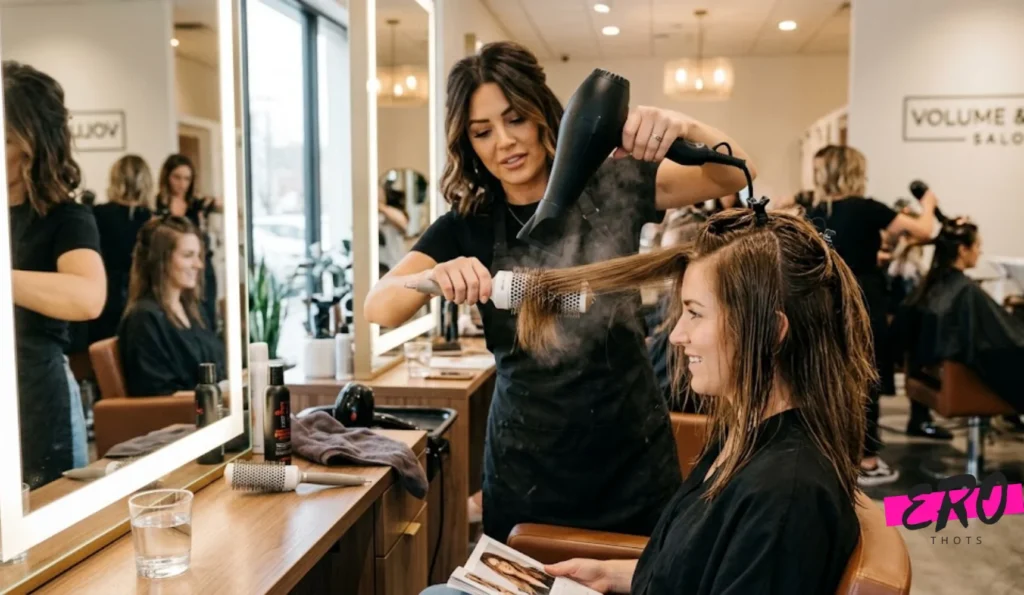
It’s a wash followed by a dry with a round brush and a hairdryer, and that’s the whole service. Nothing chemical goes on the hair, nothing gets left in it afterward, and if you washed it that evening you’d be back where you started.
The mechanics are worth a minute because they explain everything that happens later. Hair contains hydrogen bonds that break apart when the hair is wet and re-form as it dries, so your stylist is pulling sections taut with the brush and running heat down the strand while those bonds reset, which means they set in the shape of the brush instead of whatever shape your hair naturally wants to hold. Smooth length, volume at the root, and it holds until water gets involved again.
Most salons book forty-five minutes to an hour for one. Blowout bars do nothing else and tend to be quicker and cheaper, with pricing somewhere around thirty to seventy dollars depending on your city and how much hair you’ve got.
One thing worth clearing up before we go further, because the booking desk confusion on this is constant: a Brazilian blowout is not this. That’s a chemical smoothing treatment, it lasts months, and the only thing the two services share is a word.
What to change before you get into bed
Sleep is where the damage happens. Cotton pulls moisture out of hair while your scalp is producing oil into it, and on top of that you’ve got eight hours of skull weight pressing the root flat, so you wake up with the volume gone and grease already arriving at the part line.
Three things, in order of how much they matter:
- Silk or satin pillowcase. Highest return of anything on this list. Less friction, no moisture wicking, and it costs less than one salon visit.
- Dry shampoo before bed, not in the morning. Almost everyone does this backwards. Sprayed at the root the night before it sits there absorbing oil as your scalp produces it, whereas sprayed in the morning you’re putting powder on top of oil that already arrived hours ago and it only picks up whatever’s left over. Half the job for the same effort.
- Loose top knot, very top of your head. Not a ponytail, not tight, silk scrunchie or a claw clip. The hair falls away from the scalp instead of getting pinned underneath it.
Sleeping on your back helps as well, though most people can’t and there’s no point pretending otherwise.
The one to avoid on the night you get it done
Don’t tie it up in the first hour after you leave the salon. The hair is still warm and still setting, and a tie in that window presses a dent into it that won’t brush out afterward.
Day two morning, what to touch and what to leave alone
The length is what you leave alone. No brushing through it, no absent-minded finger-combing while you’re on the phone, because every single pass drags scalp oil further down the strand and that oil is the thing making it look flat and dirty. This is a harder habit to break than it sounds. I’ve watched people ruin a perfectly good second day doing it without noticing they were doing it at all.
- The root at your part line is the bit you can touch, and only with your fingers, lifting rather than brushing. A brush drags the whole thing back down.
- If you’ve sweated, dry shampoo goes at the nape and temples, and it goes on before the sweat dries rather than after.
- There’s one more trick when the root has gone properly flat and lifting isn’t cutting it, which is flipping your part to the opposite side.
- The hair on that side has spent the last day trained to sit up rather than lie down, so you get an hour or two of borrowed volume out of it before it settles.
What you shouldn’t do is reach for a curling iron to revive things. Hair that’s already been heat-styled once and is now carrying dry shampoo and whatever serum the stylist finished with does not need a second round of heat, and mid-shaft breakage is the usual result.
Why a blowout reverses
Water, basically. Those hydrogen bonds re-form as the hair dries and they’ll happily revert to the shape they held before the round brush got involved as soon as moisture gets back in, which is why humidity and sweat and shower steam and rain are all the same problem wearing different clothes.
The part you can’t fix, which is the weather
| Source of moisture | Can you do anything |
|---|---|
| Ambient humidity above roughly sixty percent | Not really. Anti-humidity spray buys hours |
| Shower steam | Yes. Cool water, fan on, shower cap |
| Sweat at the hairline | Yes. Dry shampoo immediately, before it dries |
| Rain | Only by staying out of it |
Anti-humidity products do work, to be fair to them. They coat the cuticle so water absorbs more slowly, which buys you time rather than immunity, and anything marketed as humidity-proof is overselling what a coating can do.
The gap this creates is bigger than most people expect. A blowout that comfortably holds four days somewhere dry will be finished in a day and a half somewhere humid, same hair, same stylist, same technique, and it’s the reason blowout bars do such steady business in some cities and struggle in others.
How long a blowout lasts on your hair type
I. Fine hair: two days is realistic. There’s less mass holding the shape and oil reaches the ends faster because there are fewer strands for it to travel down.
II. Thick or coarse: three to five days without much effort.
III. Curly or coily: holds the smoothness well, but it takes more heat per session to get there, which matters if you’re doing this regularly rather than for one event.
If yours dies faster than your friend’s on the same routine, that’s strand diameter and not your stylist.
Stretching a blowout to day three and four
Night two runs the same as night one with more dry shampoo. By day three you’re keeping the top layer presentable and quietly accepting that the underneath has given up, which is fine, nobody’s inspecting the underneath.
Wash day ends it and everything before that is stretching, so if you’re booking these weekly, skip one and air-dry instead. The hair needs the break more than your calendar needs the streak.