
With so many makeup brands launching every month, it’s getting harder to tell what actually matters clean makeup formulas vs traditional makeup. One brand says “clean.” Another says “clinical.” Another says “high-performance.” Someone on TikTok says silicones are evil. Someone else says clean beauty is just marketing with beige packaging.
So where does that leave a beauty brand trying to choose a formula direction? Right in the messy middle. Clean makeup formulas and traditional makeup formulas can both work. They can both fail too. The better option depends on your product, your customer, your price point, and how much performance you’re promising on the box.
This guide breaks it down without pretending one side is automatically smarter than the other.
Clean Makeup Formulas vs Traditional Makeup: What’s the Difference?
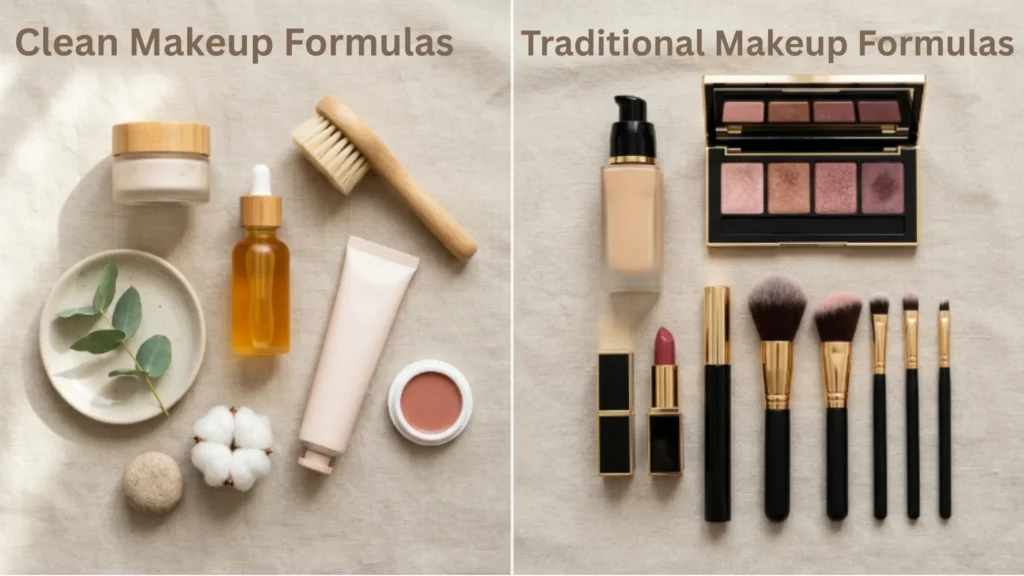
The development of clean makeup formulas usually involves restrictions on ingredients. A brand may steer clear of certain preservatives, fragrance materials, silicones, talc, PEGs, parabens, phthalates, or other ingredients on its own “no list.”
More ingredients are found in traditional makeup formulas. This may include classic preservatives, silicones, synthetic pigments, film formers, fragrance, mineral oil and other ingredients that help with texture, wear time, colour payoff or shelf life.
Here’s the catch: “clean” does not have a single legal meaning. In dermatology discussions, it is often described as, “Clean beauty is a brand-defined term and not a universally accepted scientific category.”
This is important for brands. If you say your formula is clean, you better define what you mean. Otherwise, customers are left wondering.
What is clean makeup formulas ?
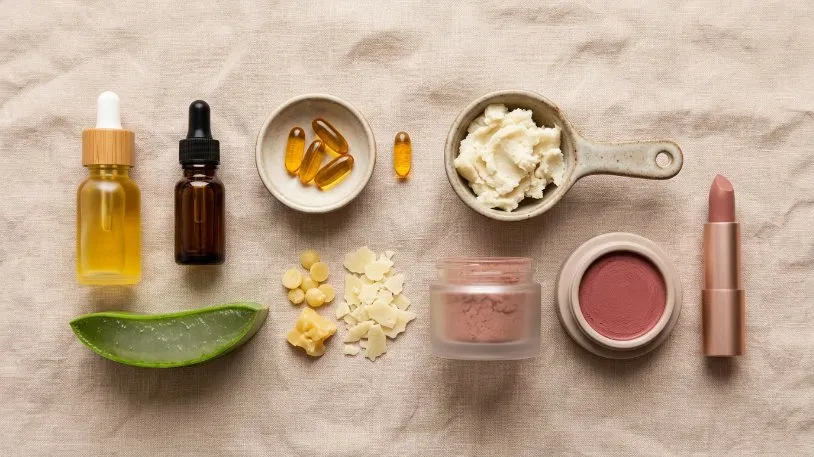
Clean makeup formulas typically exclude ingredients the brand considers undesirable, controversial, or not in alignment with its values. No synthetic fragrances maybe. Could mean no parabens. Could mean no talcum. It could be vegan, cruelty-free, refillable, mineral-based or from plant oils and waxes.
But again, one brand’s clean standard is not another brand’s clean standard. One retailer’s clean list may permit a product, another may not. So the honest definition is a simple one: clean makeup is makeup that is made to a certain ingredient standard set by a brand, retailer or certification group.
Nothing special. But yeah.
The Benefits of Clean Makeup Formulas
The appeal of clean makeup is strong because consumers like the idea that a brand has done some ingredient filtering for them.
Clean formulas can assist beauty brands with:
- Earn the trust of ingredient-conscious consumers
- Developing a softer, more contemporary brand identity
- Supporting vegan, cruelty-free, or eco-conscious positioning
- Appealing to label-reading customers
- Integrating into clean beauty retail spaces
- Everyday makeup made safer and easier
Clean makeup is often especially well-suited to products like lip balm, cream blush, skin tint, soft lipstick, highlighter, and tinted oil. These products don’t necessarily have to make extreme wear claims. They can be comfortable, they can glow, and they can be easy to use.
Clean Makeup Ingredients Brands Often Use
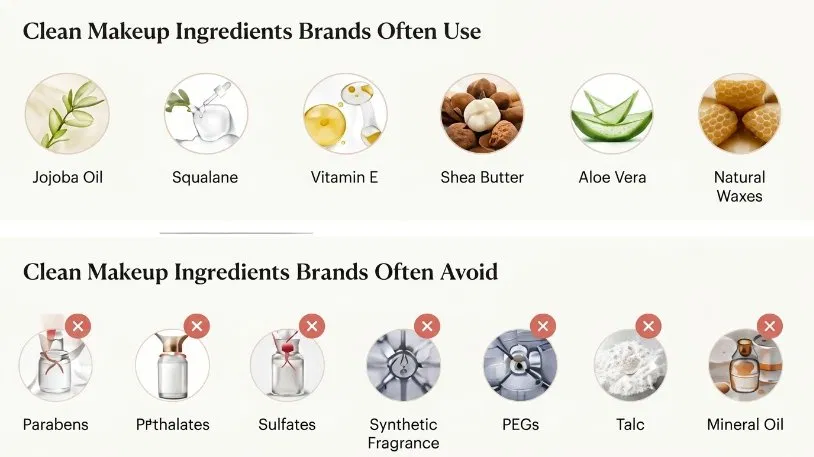
Clean makeup formulas may include ingredients like plant oils, waxes, mineral pigments, and skin-feel ingredients that support comfort and texture.
Common examples include:
- Jojoba oil
- Squalane
- Vitamin E
- Shea butter
- Aloe vera
- Sunflower seed oil
- Castor oil
- Rice bran wax
- Carnauba wax
- Mineral pigments
- Iron oxides
- Mica, depending on sourcing and brand standards
These ingredients can work well, but they still need proper formulation. A plant oil is not automatically gentle for everyone. A natural extract can still irritate some skin.
That’s the part clean beauty marketing often skips.
The downside of clean makeup
Serious performance, gets harder, clean makeup.
A clean mascara still has to be smudge-proof. A clean foundation still needs to blend well and not separate. A clean concealer that’s still got to cover without creasing. A clean lipstick should feel good, stay smooth and not smell funny after a few months.
That can make that harder, restrictions on ingredients. Not impossible. Simply more difficult. “The smaller the ingredient toolbox, the more carefully the formula has to be constructed. And this is where some clean brands fall short. They’re so focused on what they took away, they forget the customer still wants the product to work.
And no, “it’s clean” doesn’t solve a patchy foundation.
What Are Traditional Makeup Formulas?
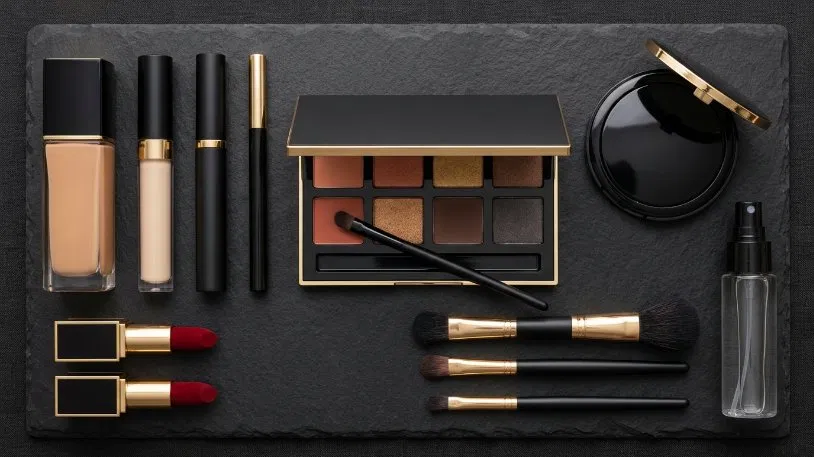
Traditional makeup recipes incorporate a broader spectrum of cosmetic ingredients. These can be synthetics, silicones, standard preservatives, film formers, fragrance, pigments, texture agents and other cosmetic materials that have long been used.
Traditional does not mean unclean:
In the U.S., cosmetic products and ingredients are not generally required to get FDA premarket approval, except for colour additives, but companies still have a responsibility to ensure their products are safe and properly labelled.
So the real question is not clean vs traditional. “It’s whether the formula is safe, stable, tested and honest about what it does.”
The Benefits of Traditional Makeup Formulas
Traditional formulas usually give the chemist more room to work.
That can help with:
- Longer wear
- Smoother texture
- Better pigment payoff
- Stronger waterproofing
- Better transfer resistance
- More shade flexibility
- Longer shelf life
- Easier scaling
- Lower formula cost in some cases
If your product promise is bold pigment, full coverage, sweat resistance, or all-day wear, traditional formulas may make more sense.
Not because clean can’t do it. Because traditional formulas often have more proven tools for that type of job.
Traditional Makeup Ingredients Commonly Used
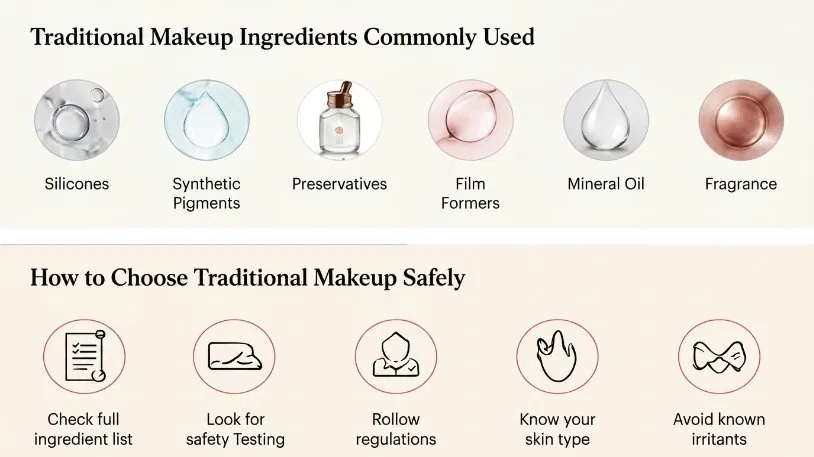
Traditional makeup may include:
- Silicones for slip and smoothness
- Synthetic pigments for strong colour
- Preservatives for product safety
- Film formers for wear time
- Mineral oil for texture and comfort
- Fragrance for scent
- Synthetic waxes for structure
- Emulsifiers for stable creams
- Polymers for hold and finish
Some of these ingredients sound scary because beauty marketing has trained people to flinch at long words.
But a long ingredient name doesn’t automatically mean danger. And a short natural name doesn’t automatically mean safety.
The formula matters. The amount matters. The use matters. Testing matters.
The Weak Side of Traditional Makeup
Traditional makeup can still have problems.
Some formulas feel heavy. Some rely too much on fragrance. Some products may bother sensitive skin. Some brands hide behind old-school habits and don’t explain ingredients well enough.
A traditional formula can also feel less exciting to modern shoppers who want transparency and cleaner-looking labels.
So yes, traditional makeup can perform well. But if the brand story feels outdated, customers may not care how good the texture is.
That’s the tension.
Clean Makeup vs Traditional Makeup Quick View
| Area | Clean Makeup Formulas | Traditional Makeup Formulas |
|---|---|---|
| Main idea | Avoids selected ingredients based on brand or retailer standards | Uses a wider ingredient range for texture, wear, colour, and stability |
| Best for | Everyday makeup, soft glam, wellness-led brands, ingredient-conscious customers | Long wear, full coverage, waterproof products, pro makeup, bold pigment |
| Ingredient flexibility | More restricted | More flexible |
| Performance | Can be strong, but harder in long-wear categories | Often stronger for wear time, pigment, and durability |
| Customer appeal | Strong with clean beauty shoppers | Strong with performance-focused shoppers |
| Risk | Can underperform if restrictions are too tight | Can feel outdated if the brand lacks transparency |
| Cost | Can be higher if ingredients or testing are more specialised | Can be more cost-effective, depending on formula |
| Marketing angle | Transparency, comfort, values, simpler ingredient story | Results, wear time, shade range, professional finish |
Clean Makeup Formulas: Better Ingredients?
Sometimes. Not always. Clean formulas may use ingredients that better match your customer’s values. That’s useful. But “better” is not automatic.
- A clean formula with poor preservation is not better.
- A clean foundation that separates in heat is not better.
- A clean lipstick that dries out after two months is not better.
Better ingredients are the ones that make sense for the product, are safe for intended use, and support the result you promised. That may be jojoba oil. It may be a silicone. Depends on the product.
Traditional Makeup: Better Performance?
Often, yes.
Traditional formulas usually have more options for long wear, waterproofing, smooth texture, and strong colour payoff. That gives them an edge in performance-heavy products.
But performance isn’t everything. A traditional foundation that wears beautifully but irritates your target customer won’t build loyalty. A long-wear lipstick that feels like dry paint may get one purchase and no repeat sale. Performance has to feel good too.
Conclusion
Clean makeup and traditional makeup are not enemies.
Clean makeup can give your brand a strong ingredient story, better trust with certain shoppers, and a softer, more modern feel. It works especially well for everyday products where comfort, glow, and simplicity matter.
Traditional makeup can give your brand better performance options, stronger wear claims, smoother textures, and more formula flexibility. It makes sense for products where customers expect serious results.
The right choice comes down to your promise.
If your brand says “clean,” the formula needs to be clear, stable, and honest. If your brand says “long-wear,” the product needs to survive the day without falling apart.
Pretty simple, really.
Better ingredients matter. Better performance matters too. But the real winner is the formula your customer actually wants to buy again.