

Saturday afternoon. Chairs full. Your client hands over her card and the terminal spins, spins again, throws an error while she stands there with her purse open.
Staying connected isn’t only an office thing.
A salon runs on the same connection everything else does, and when it’s slow you feel it at the front desk first. What most owners miss is which number actually failed. Not the download speed on the bill. Upload, and a typical cable plan advertises 500 Mbps down while delivering around 20 up. Hunter Communications
The card reader pushes data up. So do the cameras, so does the booking software. Meanwhile the client streaming video in the waiting chair is pulling down through the wide lane and she never notices a thing.
What Makes Wi-Fi Important for Beauty Salons?

Internet access here isn’t about music and social media. It’s how the business actually runs. Beauty salons rely on it for bookings, consultations, payments and keeping clients happy, and without it those things get chaotic fast.
- Online booking management. Reservations run through an app or a site, and a slow connection means the calendar lags behind reality. That’s how you end up double-booked.
- Customer experience. Guests expect free Wi-Fi while they wait. Especially the ones sitting through a full color process.
- Access to tutorials. Stylists pull reference photos mid-consultation. A spinning wheel while her hand is already in your hair is not a good look.
- Music streaming. A soothing playlist sets the room. Buffering kills it.
- Payment processing. Card systems need a stable connection or transactions fail outright.
Not every task uses your connection the same way
Those last two behave completely differently, and that’s the thing worth knowing.
Cable runs on the coaxial line that used to carry television, and the original allocation gave most of the capacity to downstream traffic because at the time nobody uploaded much. That decision is still sitting in your wall. Purple
| What it is | Direction it needs | What you see when that lane fills |
|---|---|---|
| Card terminal | Up | Declines and timeouts |
| Booking software | Both | Stale calendar, doubled slots |
| Security cameras | Up, constantly | Gaps in the footage |
| Client streaming | Down | Nothing at all |
Here’s the part that fools people. Uploads and downloads share a return path, so when the cameras saturate your upload the downloads crawl too. The whole shop feels slow. Purple
So you buy more download you never needed.
How Can a Beauty Salon Set Up the Right Wi-Fi System?

Picking a plan is only part of it. Work through these in order, because the later ones depend on the earlier ones being right.
- Assess your space. Walk the room and find the weak spots. Large or L-shaped floors may need more than one access point.
- Opt for fast internet. Comparing Spectrum internet plans against whatever else reaches your block is worth doing before the installer arrives, mainly so you know what upload figure you’re being sold.
- Invest in good equipment. A decent router handles congestion. A cheap one falls over at twenty devices.
- Place routers strategically. Not in a closed cabinet. Not in a far corner. Open air, near the middle.
- Create separate networks. Staff on one, guests on another. This one deserves more than a line, because every guide says it and almost none say why.
Why the guest network has to be walled off from your card reader
The part of your setup where card data moves has a name, the cardholder data environment, and anything connected directly to it counts as part of it. Front desk tablet. Register. The access point itself.
Now, splitting those onto their own network isn’t explicitly mandated, it’s a recommended strategy that shrinks how much of your setup falls under the standard. But underneath sits a firm line. Where a wireless network isn’t carrying card data, the standard calls for a perimeter firewall between it and the payment environment, set to deny or control traffic coming from the wireless side. Security BoulevardSpecGravity
A different network name doesn’t achieve that. VLANs alone can’t be relied on either, and the council has been clear that segmentation needs controls that actually enforce the separation, not a diagram showing one. SpecGravitynowires
So here’s the question. Can a client in your waiting chair reach your terminal from her phone? If you don’t know, assume yes. That’s the out-of-the-box default on a lot of equipment.
What to ask whoever wires it:
- Is guest traffic firewalled off from the terminal, or only on a different network name?
- Can a phone on the guest network reach the front desk tablet? Have them try it while you watch.
- Are the cameras sitting on the payment side? They shouldn’t be.
- Has the router admin password been changed from the one on the sticker?
Enhancing Customer Experience with Reliable Wi-Fi
Reliable internet makes the room feel comfortable, and comfortable clients come back and tell people. True enough. It’s just quieter than it usually gets written.
Guest access matters most to the woman sitting through forty minutes of processing time with nothing to do. She’s browsing, answering email. Not stress-testing your network.
Virtual consultations are the bigger one, since a client sending reference pictures ahead of the appointment saves you the argument in the chair. Some salons tie Wi-Fi access to a loyalty signup, which works fine as long as the signup itself loads quickly.
Music has to hold steady all day, though. A playlist that stutters during a blowout is more noticeable than one that was never playing. Nobody thanks you for fast internet. They only register the slow kind.
Streamlining Salon Operations with Fast Internet
Managing a beauty salon means juggling appointments, supplies, records and staff, and the device count is always higher than the owner guesses.
Count what’s actually connected on a Saturday
- 1 card terminal, plus 1 or 2 front desk tablets.
- 2 to 4 cameras, uploading whether anyone’s watching or not.
- 6 to 10 staff phones.
- 4 to 12 client phones on guest access.
Past twenty devices. In a room about the size of a large living room.
What all of it is doing back there
- Booking management software keeps schedules current in real time, which only works if the connection holds.
- Cloud storage keeps client records, preferences and service history securely off-site, so every calendar opening is a round trip.
- Inventory management lets you reorder without waiting on a rep.
- Remote security monitoring runs constantly in the background and eats more upload than anything else on this list.
- Training and development means stylists catching webinars between clients.
- Proposal software management tool comes into it for salons quoting bridal or event packages, since sending customized pricing without delay depends on the same connection as everything above.
Ordering and training sit on the download side, so they rarely cause the problem. They just make it obvious when one exists.
Choosing the Right Internet Plan for Your Beauty Salon
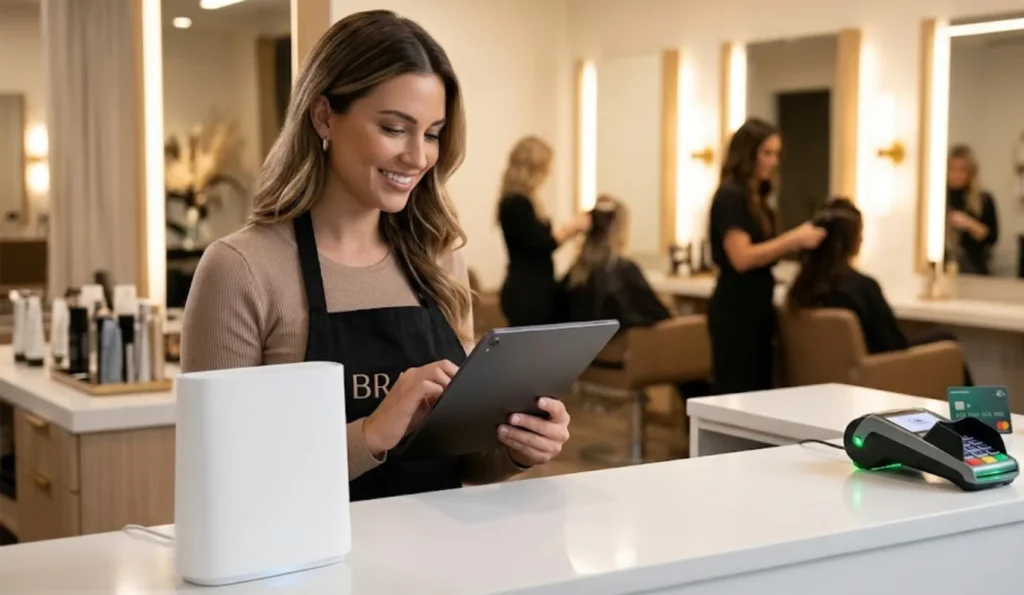
Plenty of plans out there. The right one fits the shop, not the marketing.
- Speed. Find the upload figure on the sheet, not just the headline. Twenty megabits up is a sensible floor for a shop running a terminal, cameras and cloud booking together.
- Customer support. Response time is the whole point. A Tuesday morning outage and a Saturday afternoon outage are not the same emergency.
- Data limits. No caps is safer, though it matters less than people assume. Guest streaming is download traffic and background music barely registers.
- Price versus performance. Balance cost against what you actually need, which is usually less download and more upload than you’re being offered.
- Bundled services. Phone lines or TV are worth folding in if you’d pay for them separately anyway.
Why Spectrum Internet Plans Are a Great Choice for Beauty Salons
Straight about this one. Downloads run from 300 Mbps to 1 Gbps with standard uploads around 10 to 35 Mbps, which is the asymmetry this whole article is about. Hunter Communications
What’s changed is the direction of travel. Equal speed tiers now exist on some plans, where a 300 Mbps download comes with a 300 Mbps upload, and Charter expects DOCSIS 4.0 service to reach up to 85% of its customer base over the next few years. Talk Walk ConnectionNordLayer
Whether it’s landed at your address is the question to ask. By address, before signing.
Where it holds up for a salon:
- No data caps. A real advantage for beauty salons running cameras around the clock.
- Fast speeds across multiple devices. Holds up, as long as upload isn’t the bottleneck.
- Guest Wi-Fi built in. Still needs firewalling off from the terminal, not just switching on.
- 24/7 support. Counts for something on a Saturday. The customer service side of an outage still lands on you and your front desk regardless of who answers.
US coverage areas only.
Start with your bill this week
Reliable Wi-Fi stopped being a luxury a while back. It carries the bookings, the payments, the records and the room itself.
So go pull up your last bill and find the upload number.
If it starts with a one and you’ve got cameras running, that’s your Saturday problem, and it isn’t the download speed you’ve been paying extra for. Then call whoever set up your network and ask whether the guest side can reach your terminal.
Those two things. This week. Before you spend anything.