
Everyone wants their hair to be strong and healthy, and almost everyone shops for it, better shampoo, better mask, better oil. But strong hair is mostly boring habits repeated for months. The right products help, sure, and people with great hair are usually just doing the same six unglamorous things consistently, while people with breaking hair are skipping one or two of them without realising it.
Here they are, framed around the damage each one prevents.
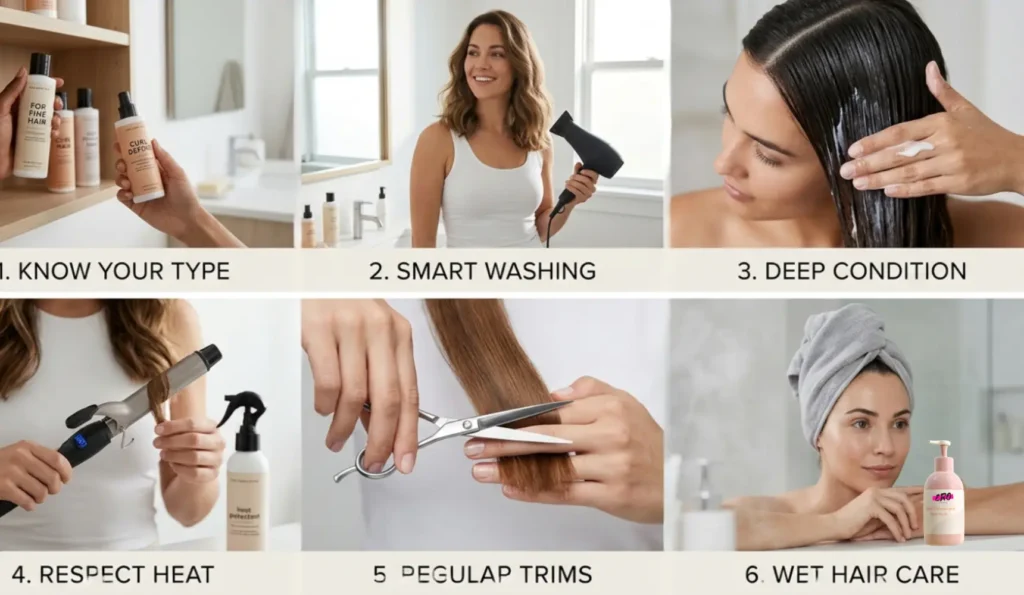
1. Learn Your Hair Type Before Buying Anything
Half of bad hair days are just wrong-product days. Hair varies by thickness, porosity, and structure, fine or coarse, straight through wavy to tight curls, and the routine that saves one type ruins another.
Curly hair wants curly hair products built to seal in moisture and define the curl without weighing it down. Straight fine hair wants the opposite, lightweight volume that won’t turn oily by afternoon. Same shelf, opposite needs.
Get this one wrong and every other habit on the list underperforms, because you’ll be fighting your products instead of working with them.
2. Wash On a Schedule That Matches Your Hair, Not the Ads
Washing too often strips the natural oils off the hair shaft and leaves it dry and prone to breaking. Washing too rarely lets product and oil build up until your hair and skin look dull, and a congested scalp on top of it.
The right frequency comes from your hair type:
- Oily or fine straight hair usually needs washing every day or two, it shows buildup fastest.
- Thick, dry, or curly hair can go longer, often twice a week or less, because the natural oils take longer to travel down the curl and the hair needs every bit of them.
- Curly washes should lean on moisturising shampoos and creams, the kind that clean without stripping the oils that define the curl.
If your hair feels squeaky and straw-like after washing, you’re either washing too often or your shampoo is too harsh. Probably both.
3. Deep Condition Once a Week
Heat styling, colour, chemical treatments, and harsh weather all take protein and moisture out of hair, and a weekly deep conditioning session is how you put some back.
Match the weight of the treatment to the hair. A rich mask or leave-in tames frizz on wavy and curly hair beautifully. Fine hair needs the light versions, anything heavy flattens it for days.
Damaged lengths drink this stuff. Healthy roots don’t need it, so concentrate the product from mid-length to ends.
4. Respect Heat Tools
Straighteners, curling irons, and blow dryers damage the proteins in hair when they’re overused or run too hot, and that damage is cumulative, split ends first, then breakage.
Two honest rules here. Always use a heat protectant before styling, and understand what it actually does: it reduces heat damage, it doesn’t make hair invincible. No spray survives a 230°C flat iron pressed on daily. So the protectant is rule one, and the lower temperature setting plus fewer heat days is rule two. Air-dry partway before blow drying and you’ve cut the exposure without changing your style at all.
5. Trim Every 6 to 8 Weeks
Split ends don’t stay put. Once a strand splits, the split travels up the shaft, and what started as a rough end becomes breakage higher up.
Now the honest version of the old advice: trimming doesn’t make hair grow faster, growth happens at the scalp and scissors can’t reach it. What trims actually do is remove the splits before they travel, so you keep more of the length you grow. That’s why the people who trim regularly end up with longer hair than the people who avoid scissors for a year and then lose inches to damage.
Every 6 to 8 weeks is the working rhythm for most hair. Wavy and curly hair also holds its shape and detangles easier with regular shaping.
6. Handle Wet Hair Like It’s Fragile, Because It Is
Wet hair stretches more and snaps easier than dry hair. Most of the breakage people blame on products actually happens in the two minutes after the shower.
- Detangle with a wide-tooth comb, not a brush, and start from the ends working up.
- Blot with a microfiber towel or an old T-shirt instead of rubbing with a bath towel. Rubbing roughs up the cuticle and snaps wet strands.
- Skip tight ponytails on wet hair, the tension plus the stretch is a breakage recipe.
None of this costs anything. It’s the cheapest habit on the list and it’s the one most people skip.